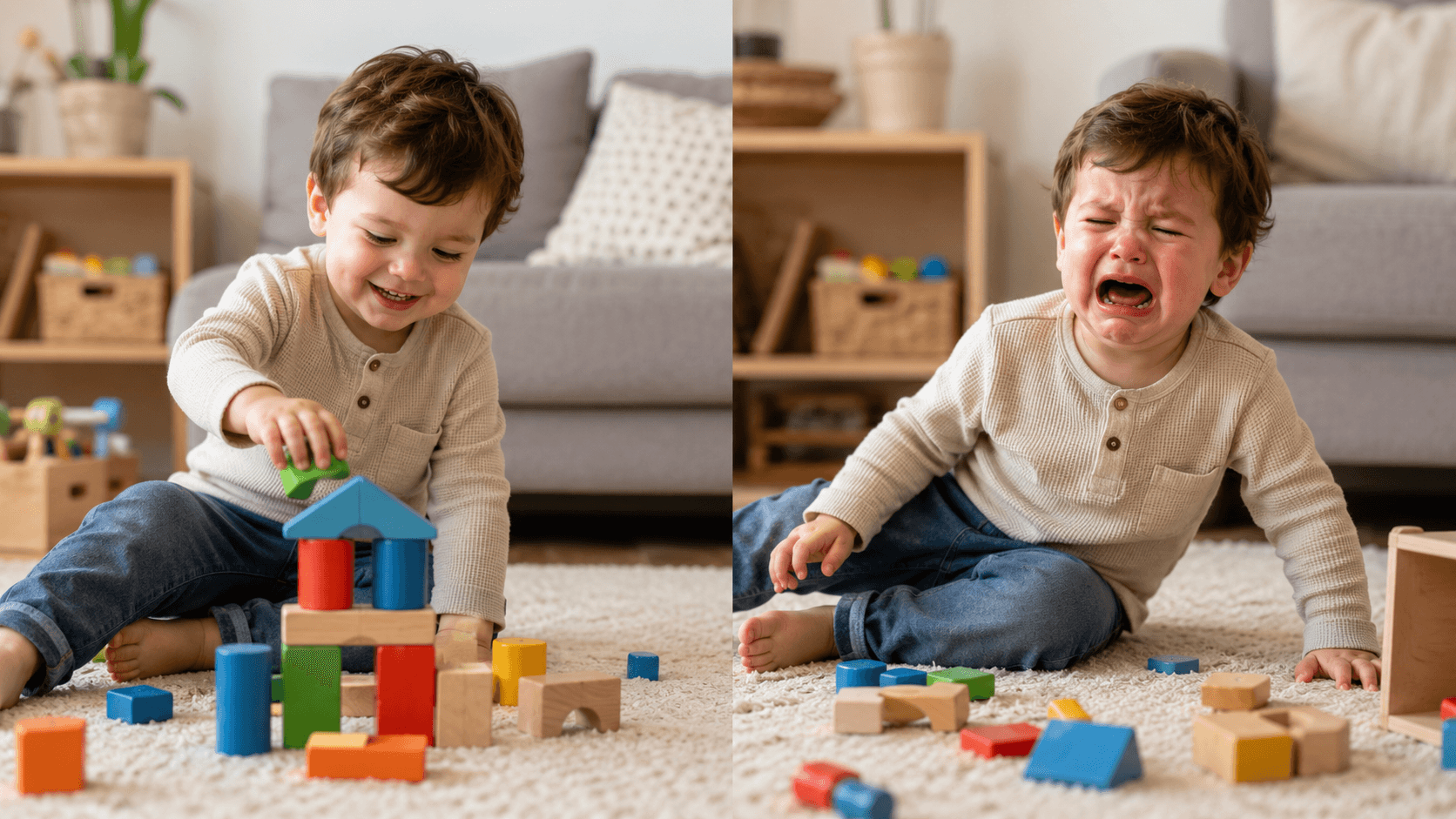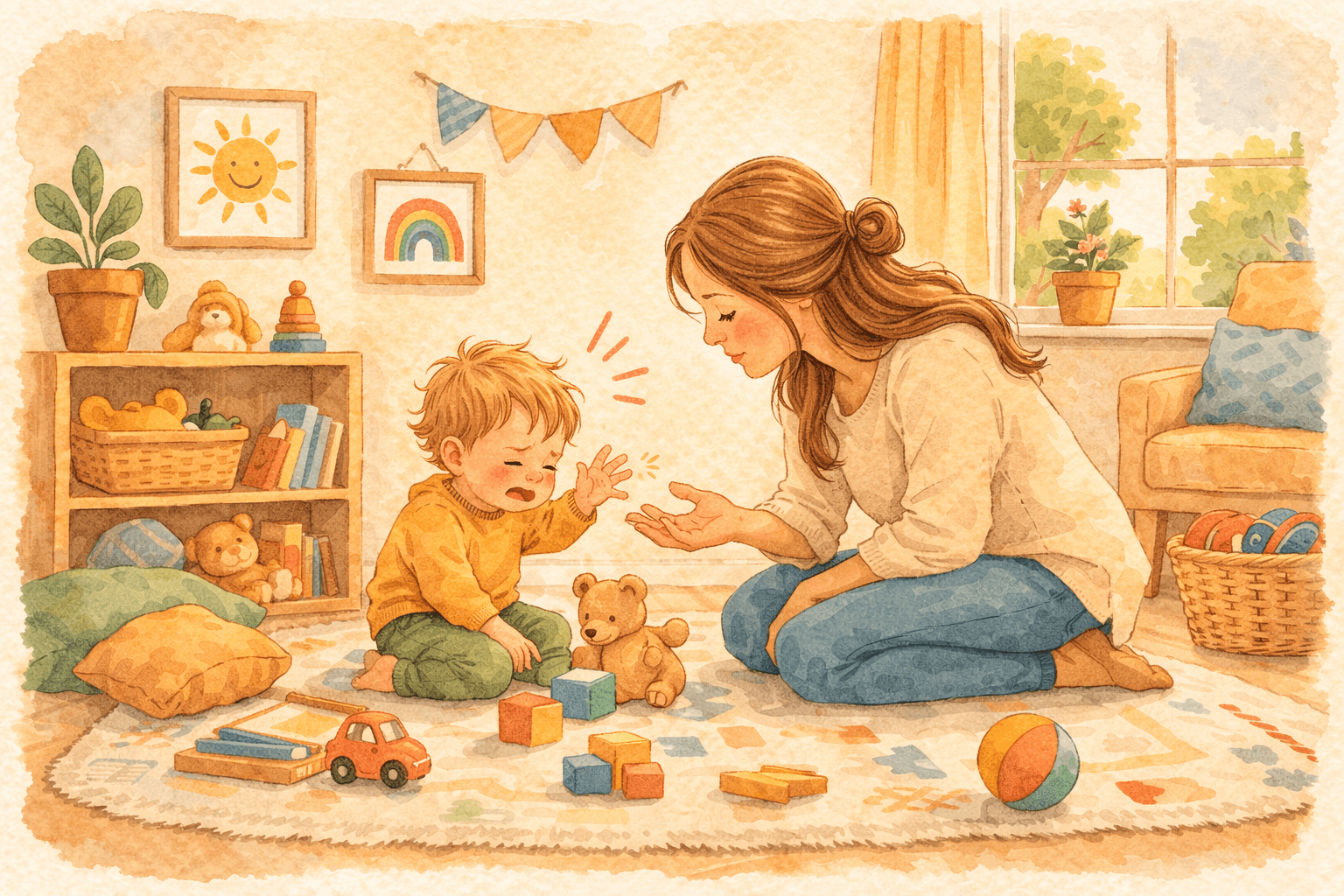
If you are dealing with toddler hitting, you are not alone, and you are not raising an "aggressive child." In most cases, hitting is a toddler-sized way to communicate: frustration, overwhelm, excitement, boundary testing, or "I want that now."
This guide covers:
- what to do in the moment
- why toddlers hit
- a simple plan to reduce hitting over time
- special cases: hitting parents, siblings or baby, daycare, and biting + hitting
- when to ask for extra support
Why Toddler Hitting Happens
Toddlers usually hit for predictable reasons. The best response depends on the cause.
1. Big feelings + low impulse control
Toddlers feel fast and strongly, but they cannot reliably stop their bodies yet.
2. Communication gap
They want help, space, or a toy, but do not have enough language in the moment.
3. Sensory overload (or sensory seeking)
Noise, transitions, hunger, fatigue, and crowded spaces can trigger hitting. Some children also seek strong sensory input.
4. Boundary testing
Hitting gets a strong adult reaction. Big reactions can accidentally reinforce the behavior.
5. Copying and experimentation
Children may copy what they see from siblings, peers, rough play, or media.
The goal in the moment is not punishment. The goal is:
- stop the hit
- keep everyone safe
- teach a replacement behavior
- practice that replacement when calm
What To Do In The Moment (20-Second Script)
Use this sequence: block -> boundary -> replacement -> repair.
Step 1: Block calmly
Move in close and gently stop the hand.
- place your hand between your toddler and the other person
- if needed, move one child a step away
- keep your face and voice calm
Step 2: Name the boundary in one sentence
Use one short phrase every time:
- "I won't let you hit."
- "Hands are not for hitting."
- "Stop. Hitting hurts."
Avoid long explanations while your child is dysregulated.
Step 3: Offer one replacement
Immediately show what to do instead:
- "You can stomp."
- "You can squeeze this pillow."
- "You can say, 'help.'"
- "You can ask for a turn."
Step 4: Repair when calm
After the storm passes:
- "Hitting hurts. Let's check on them."
- "Can we bring ice or a tissue?"
- "Can you wave or say sorry?"
Do not force apologies. Focus on meaningful repair actions.
What Not To Do
These responses often make toddler hitting worse over time:
- yelling or dramatic reactions
- asking "Why did you do that?" in the hot moment
- long lectures
- labeling your child as mean, bad, or aggressive
- inconsistent boundaries
A Simple 7-Day Plan To Reduce Hitting
Day 1-2: Pick one boundary phrase + two replacement skills
Use one boundary phrase consistently: "I won't let you hit."
Choose two replacements to practice daily:
- gentle hands
- stomp feet or squeeze pillow
Practice for 30 seconds during calm time.
Day 3-4: Identify one major trigger and adjust the environment
Common triggers:
- transitions
- hunger or fatigue
- crowded settings
- toy conflicts
Choose one support:
- snack before outings
- earlier bedtime
- fewer toys out at once
- visual timer for transitions
- separate play zones for siblings
If conflict is high at home, toy rotation helps quickly. Read Montessori Toy Rotation at Home: Ages 1-3.
Day 5-6: Teach tiny scripts your toddler can use
Practice short words they can actually remember:
- "Turn."
- "Mine."
- "Help."
- "Stop."
- "My turn."
Use role play with toys for 2-3 minutes each day.
Day 7: Align all caregivers
Hitting improves faster when every adult responds the same way:
- block
- say the same boundary phrase
- offer one replacement
- guide repair
Tell us your child's age, what triggers the hitting, and who they hit (parents, siblings, or daycare). We will suggest age-appropriate scripts and a step-by-step plan.
If Your Toddler Is Hitting You (Parents, Mom, Dad)
This is very common because parents are the safest target.
Use the same boundary, then reduce extra attention:
- Block + "I won't let you hit."
- Step your body slightly back with a neutral face.
- Offer a replacement ("stomp" or "squeeze").
- If it continues: "I am moving back to keep my body safe."
- Take a brief, calm 10-20 second reset while supervising.
Connection should happen during calm moments, not through aggressive behavior.
If Your Toddler Is Hitting The Baby Or Siblings
Prioritize fast physical prevention.
Prevention strategies:
- create two safe "yes spaces" (baby zone and toddler zone)
- give your toddler a safe helper role (bring diaper, pick a book)
- practice one-finger gentle touch with supervision
In the moment:
- Block immediately.
- Move the vulnerable child to safety.
- Give one replacement behavior.
Then teach repeatable alternatives:
- "Tap my arm if you need me."
- "Say help."
- "Show gentle hands."
Toddler Biting And Hitting Together
When biting and hitting happen together, it may signal:
- sensory seeking
- high frustration with low regulation
- transition stress (including daycare stress)
Try:
- one shared boundary phrase: "I won't let you hurt bodies."
- sensory supports like crunchy snacks and heavy work (pushing a laundry basket, carrying books)
- pattern tracking (time of day, sleep, hunger, transitions)
Toddler Hitting At Daycare Or Preschool
Ask educators for the exact pattern:
- when it happens
- who is being hit
- what happens immediately after
Then align on one response plan across home and school:
- same boundary phrase
- same replacement skill
- same repair action
At home, prioritize sleep, hunger, and short daily script practice.
Is Toddler Hitting Normal?
Many toddlers go through a hitting phase. Seek extra support if:
- hitting is intense and frequent across settings for months
- your child seems dysregulated most of the day
- communication delays are increasing frustration
- injuries are happening
- you feel overwhelmed, angry, or unsafe
Talk to your pediatrician and ask about:
- developmental screening
- occupational therapy for sensory or regulation support
- parent coaching options
FAQ
How long does a toddler hitting phase last?
Often a few weeks to a few months. Consistency and language growth usually speed improvement.
Should I use time-out for toddler hitting?
A brief calm reset can help some children. What matters most is prevention, replacement skills, and consistent boundaries.
What is the fastest way to reduce hitting?
Consistency:
- block every time
- use one boundary phrase
- practice one replacement daily
- reduce the biggest trigger
Related Reading
Age-specific hitting guides:
- 2 Year Old Hitting: Why It Happens + What to Do
- 3 Year Old Hitting: Why It Happens + What to Do
- Toddler Hitting Head: Why + What to Do
Related behavior:
Activities that help:
- Montessori Activities for 2 Year Olds (24-36 Months)
- Montessori Preschool Activities (Ages 3-5)
- 40 Montessori Practical Life Activities by Skill Area
- Montessori Toy Rotation: Step-by-Step for Ages 1-3
One Sentence To Remember
Your job is not to punish the hitting. Your job is to stop it, stay calm, teach a replacement, and practice that replacement until it becomes your child's default.