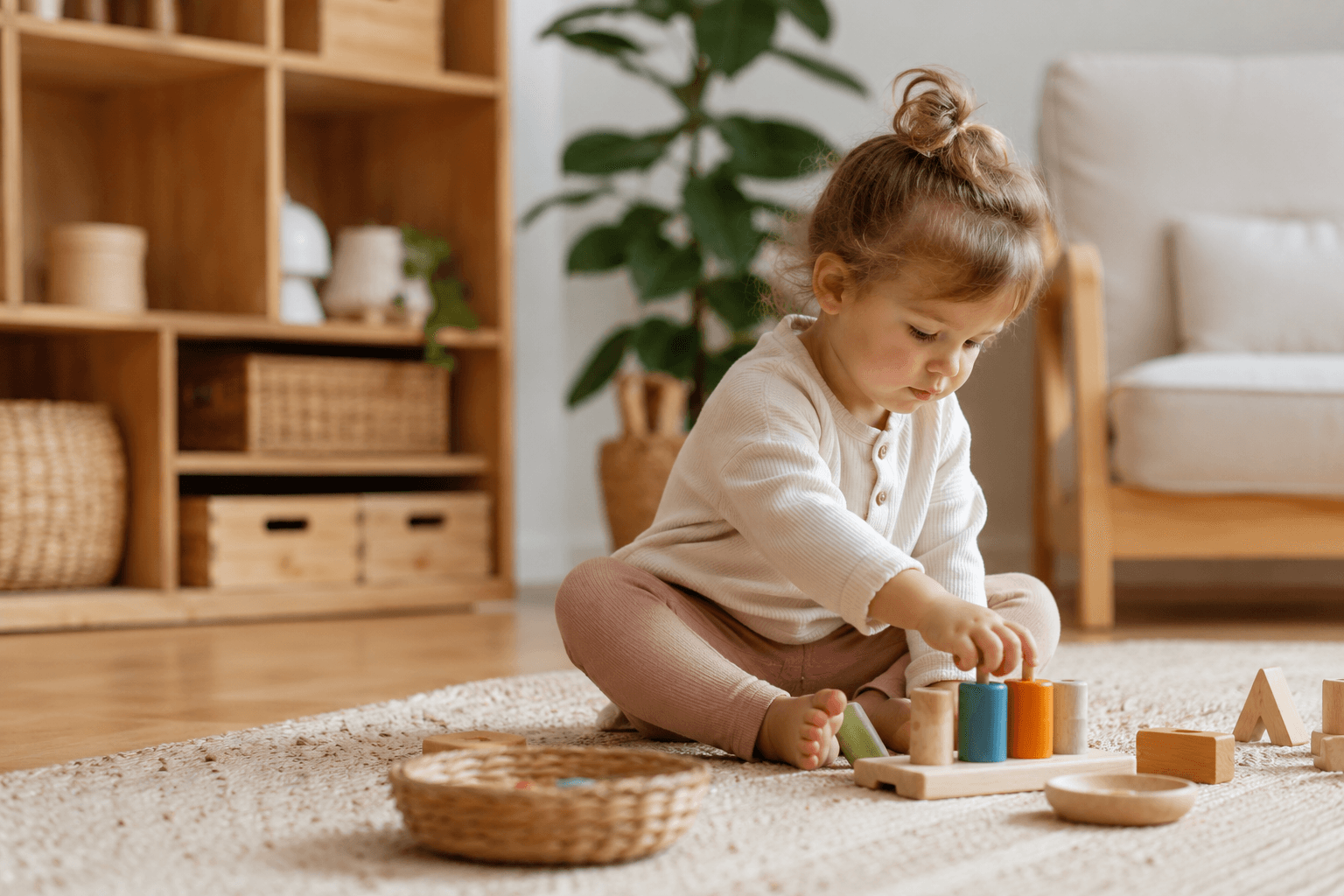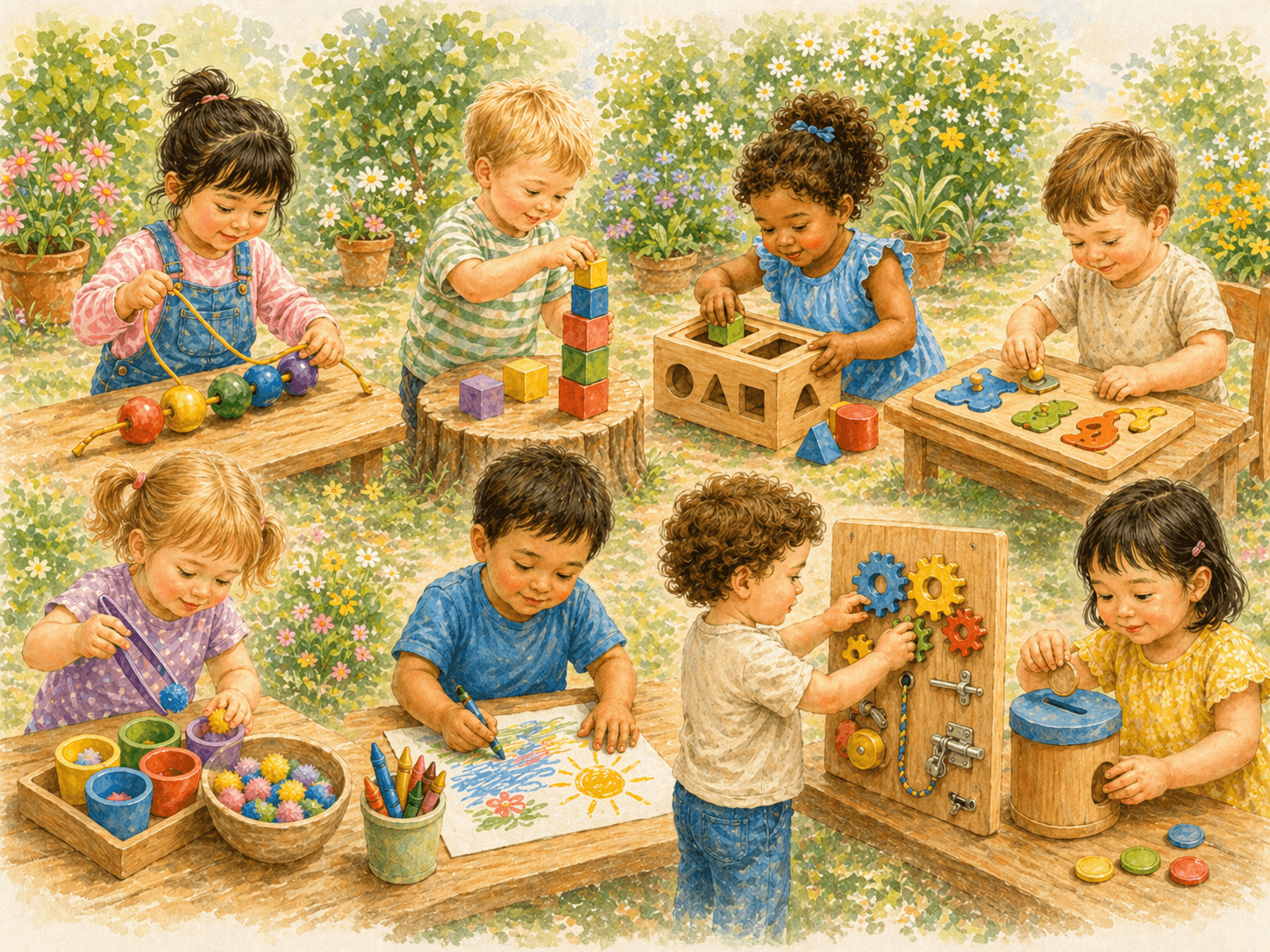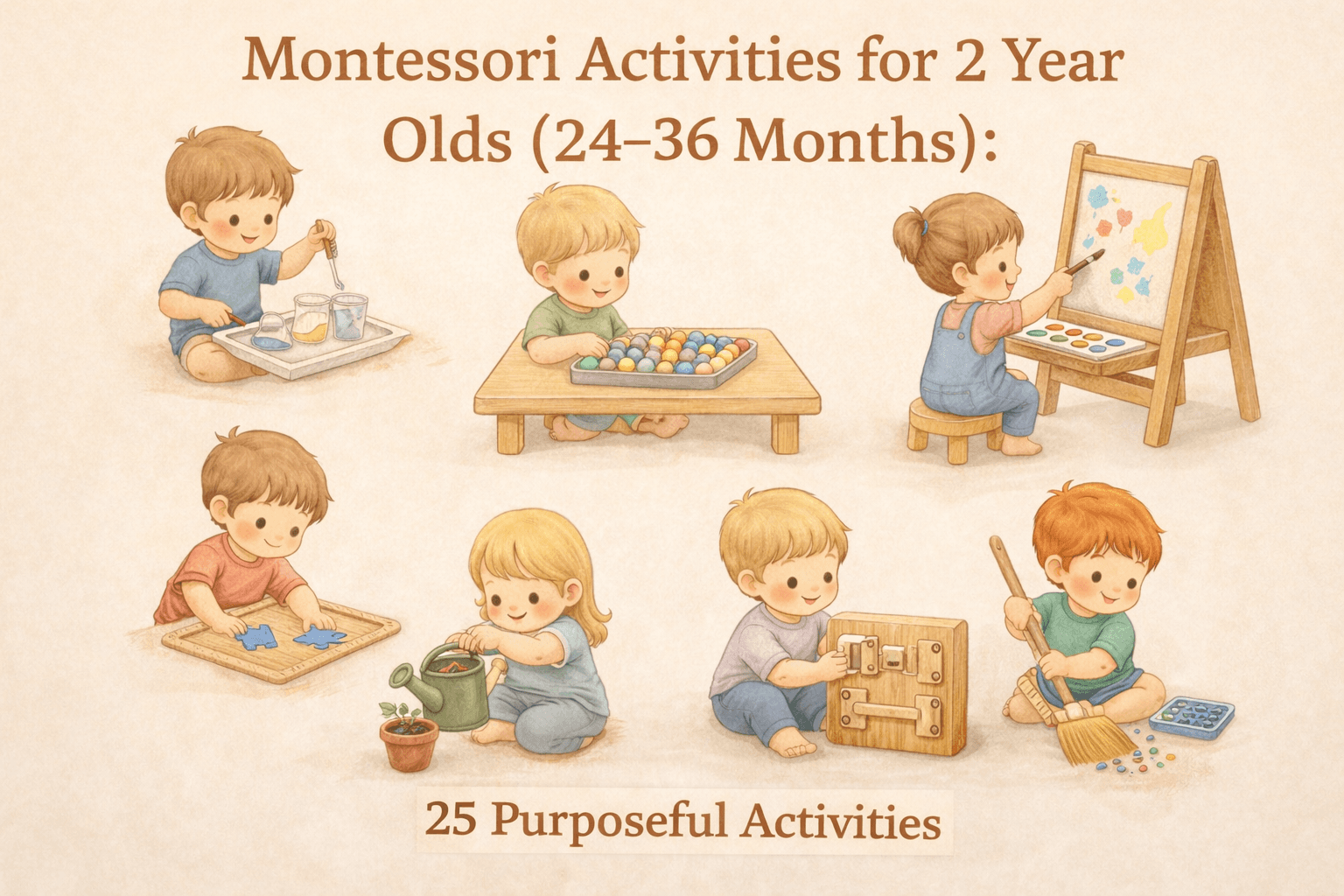
If you are looking for Montessori activities for 2 year olds, the best options are purposeful, hands-on tasks that build independence, coordination, and concentration. At 24-36 months, children can follow longer sequences and use more precise tools, so the activities can be more complex than 12-24 month basics.
What 2-year-olds are working on (24-36 months)
Many 2-year-olds can:
- Follow 2-5 step sequences
- Repeat a work cycle longer (often 5-20 minutes)
- Use more precise tools (hole punch, clothespins, lacing)
- Enjoy games with rules (hunt, match-by-category, rhythm patterns)
Your job is to offer activities that have:
- A clear start and finish
- A home for every item
- One main difficulty (not five challenges at once)
How to present an activity so it is understandable
Use this same presentation routine every time:
- Bring the tray to the workspace.
- Point to where it starts ("Here") and where it ends ("Here").
- Demonstrate once, slowly (no extra talking).
- Pause and slide the tray toward your child.
- If they struggle, reset the materials and show again - do not correct mid-action.
25 Montessori activities for 2 year olds (completely different from 12-24 month basics)
Practical life and independence (7)
1. Zipper board (zip up and zip down)
- You need: an old jacket zip section mounted to cardboard (or a zipper pouch).
- Set up: zipper closed halfway at the bottom.
- Present:
- Hold the bottom box steady with your left hand.
- Insert the zipper pin fully with your right hand.
- Pull the slider up slowly to the top.
- Pull the slider down to open.
- Control of error: the zipper will not move unless it is inserted fully.
2. Snap board (press-stud practice)
- You need: a baby onesie snap strip or snap pouch.
- Set up: 2-3 snaps open.
- Present:
- Align the snap halves.
- Press with your thumb until you hear or feel a click.
- Open by pinching and pulling apart.
- Tip: start with only two snaps.
3. Coat flip trick (putting on a jacket)
- You need: your child's jacket on the floor.
- Set up: jacket laid open, collar near the child's feet (sleeves toward the child).
- Present:
- Place hands into sleeves.
- Lift jacket over head in one motion (flip).
- Pull down and adjust.
- Why it works: it is a satisfying, magic movement.
4. Table setting with a placement map
- You need: a placemat with outlines (plate, cup, spoon) drawn or printed.
- Set up: items in a basket.
- Present:
- Place placemat.
- Put plate on plate outline.
- Put cup on cup outline.
- Put spoon on spoon outline.
- Control of error: mismatched placement is obvious.
5. Flower arranging (easy and beautiful)
- You need: small vase, 5-7 sturdy flowers, small pitcher of water.
- Set up: add a little water to the vase (adult).
- Present:
- Pick up one flower by the stem.
- Place it into the vase opening.
- Repeat until the vase looks full.
- Put the vase in a chosen spot.
- Safety: avoid toxic plants; trim thorns.
6. Peel and place sticky-note wall
- You need: sticky notes and a clear parking square on a wall or board.
- Set up: stick 10 notes on the edge of a tray (easy to peel).
- Present:
- Peel one sticky note from the tray edge.
- Place it inside the wall square.
- Press flat with the palm.
- Repeat.
- Why it is fun: it is like a mini sticker game but easier to peel.
7. Sorting socks by owner (family sorting game)
- You need: 2-3 small baskets labeled with simple symbols (star, heart, blue).
- Set up: put 6-10 socks in a pile.
- Present:
- Pick one sock.
- Decide the basket (match the symbol you assigned).
- Drop the sock into that basket.
- Tip: keep it playful: "This one goes to the star!"
Fine motor and pre-writing foundations (8)
8. Clothespin feed the monster
- You need: cardboard monster with a mouth slit, 10 clothespins.
- Set up: monster on tray; clothespins in a bowl.
- Present:
- Pinch clothespin open.
- Clip it onto the monster mouth edge.
- Repeat until the monster has teeth.
- Control of error: the pin will not clip unless opened correctly.
9. Hole punch and confetti glue
- You need: single-hole punch, scrap paper strips, glue stick, blank paper.
- Set up: punch and strips on tray; glue closed.
- Present:
- Punch 5-10 holes to make paper dots.
- Put dots in a small bowl.
- Open glue and rub one area on the blank page.
- Sprinkle confetti dots onto the glue area.
- Why kids love it: instant art payoff.
10. Scissor snips (straight cutting practice)
- You need: child scissors, thick paper strips (or playdough snakes).
- Set up: strips placed horizontally on tray.
- Present:
- Hold strip with helper hand.
- Open scissors wide.
- Close once to make one snip.
- Repeat down the strip.
- Safety: supervise closely; use blunt-tip toddler scissors.
11. Lacing card (in-out rhythm)
- You need: lacing card and thick lace with taped end.
- Set up: lace end ready at the first hole.
- Present:
- Push lace through hole (front to back).
- Pull until it is snug (not tight).
- Move to the next hole.
- Tip: choose cards with 6-8 holes to start.
12. Bead threading with a 2-bead pattern
- You need: large beads and stiff lace.
- Set up: place two pattern beads in a small dish (A-B).
- Present:
- Thread bead A.
- Thread bead B.
- Point to the pattern dish.
- Continue A-B-A-B for 6-12 beads.
- Control of error: pattern breaks visibly.
13. Nuts and bolts (large size only)
- You need: large plastic nuts and bolts or wooden screw set.
- Set up: 3 sets on tray.
- Present:
- Place nut onto bolt tip.
- Turn clockwise until tight.
- Turn counterclockwise to remove.
- Why it is satisfying: strong work feeling.
14. Sticker road (stickers along a line)
- You need: dot stickers, paper with a thick marker road (two lines).
- Set up: stickers slightly peeled (starter edge).
- Present:
- Peel one sticker.
- Place it on the road between the lines.
- Press with fingertip.
- Continue until the road is filled.
- Pre-writing bonus: builds controlled placement.
15. Stencil tracing (shapes or animals)
- You need: thick stencil and crayons.
- Set up: stencil taped to paper (so it will not slide).
- Present:
- Hold stencil with one hand.
- Trace slowly around the opening.
- Lift stencil to reveal.
- Control of error: the trace shows if the hand slips.
Feels-like-play sensorial and art (7)
16. Play dough tool tray (structured play)
- You need: play dough, rolling pin, cookie cutters, blunt dough knife.
- Set up: one dough ball and tools on tray.
- Present:
- Roll dough flat.
- Cut one shape.
- Put finished shapes into a bowl.
- Re-roll scraps and repeat.
- Work cycle: make, collect, reset.
17. Water painting (magic that disappears)
- You need: cup of water, paintbrush, chalkboard or dark construction paper.
- Set up: small towel under cup.
- Present:
- Dip brush once.
- Paint 3-5 strokes.
- Watch it dry and fade.
- Why it works: low mess, high interest.
18. Paint in a bag color squish
- You need: zip bag, washable paint (2 colors), white paper.
- Set up: paper inside bag; add 2 small paint blobs; seal tightly; tape bag edges.
- Present:
- Press paint blobs with fingertips.
- Spread to cover paper.
- Make swirls and lines.
- Control of error: no spills if sealed.
19. Scent jars (smell and sort)
- You need: 4 jars with cotton balls scented lightly (vanilla, cinnamon, lemon, coffee).
- Set up: jars labeled with simple symbols (star, heart, blue, square).
- Present:
- Open one jar and smell.
- Close it.
- Place it on the matching symbol card.
- Note: keep scents mild.
20. Ice rescue sensory game
- You need: small toys frozen in a container of ice, salt, spoon, towel.
- Set up: ice block on tray with towel.
- Present:
- Sprinkle a pinch of salt on ice.
- Wait 10-20 seconds.
- Scrape gently with spoon.
- Repeat until the toy is freed.
- Why it is fun: science plus mission.
21. Rhythm sticks: copy my pattern
- You need: two rhythm sticks (or wooden spoons).
- Set up: sit facing each other.
- Present:
- Tap: tap-tap-pause.
- Hand sticks to child: "Your turn."
- Repeat same pattern 2-3 times.
- Introduce a new pattern (tap-pause-tap).
- Skill: auditory memory and self-control.
22. Treasure wash with a paintbrush (no bowls transfer)
- You need: toy cars or animals, a dry paintbrush, a towel.
- Set up: toys on towel; brush in a cup.
- Present:
- Brush dust off one toy slowly.
- Place clean toy in a finished basket.
- Repeat until basket is full.
- Why it works: feels like caring for toys without water setup.
Language, thinking, early math, and movement (3)
23. Prepositions game (in, on, under)
- You need: a small teddy, a bowl, a box, a chair.
- Set up: items on a mat.
- Present:
- Put teddy in the bowl. Say "in."
- Put teddy on the box. Say "on."
- Put teddy under the chair. Say "under."
- Invite child to copy each one.
- Fun factor: it is basically a game.
24. Category sorting (real objects, no picture matching)
- You need: 3 baskets labeled Kitchen, Bathroom, Bedroom (or symbols).
- Set up: put 9-12 objects in a pile (spoon, cup, toothbrush, comb, sock).
- Present:
- Pick one object. Name it.
- Place it in the correct basket.
- Repeat.
- Control of error: category logic is clear and talkable.
25. Shape scavenger hunt (circle, square, triangle)
- You need: 3 simple shape cards (hand-drawn is fine).
- Set up: cards on a tray.
- Present:
- Choose one card (circle).
- Walk and find 3 circle objects (plate, lid, clock).
- Bring each back and place next to the circle card.
- Repeat with square and triangle.
- Why it compounds: movement, observation, vocabulary.
Sample shelf rotation (2-year-old friendly)
Put out 8 activities:
- 2 independence: #1 (zipper), #4 (table setting)
- 3 fine motor: #8 (clothespins), #11 (lacing), #14 (sticker road)
- 2 playful and art: #16 (play dough), #18 (paint in a bag)
- 1 language and movement: #25 (shape hunt)
Rotate 2-3 each week; keep 2 favorites always available.
FAQ: Montessori activities for 2 year olds
How long should a 2-year-old do an activity?
Often 5-20 minutes, depending on interest and difficulty.
What if my child uses it "wrong"?
If it is safe, let them explore. Re-present later with fewer words and fewer materials.
How many activities should be on the shelf?
Usually 6-10. Too many options reduce deep concentration.