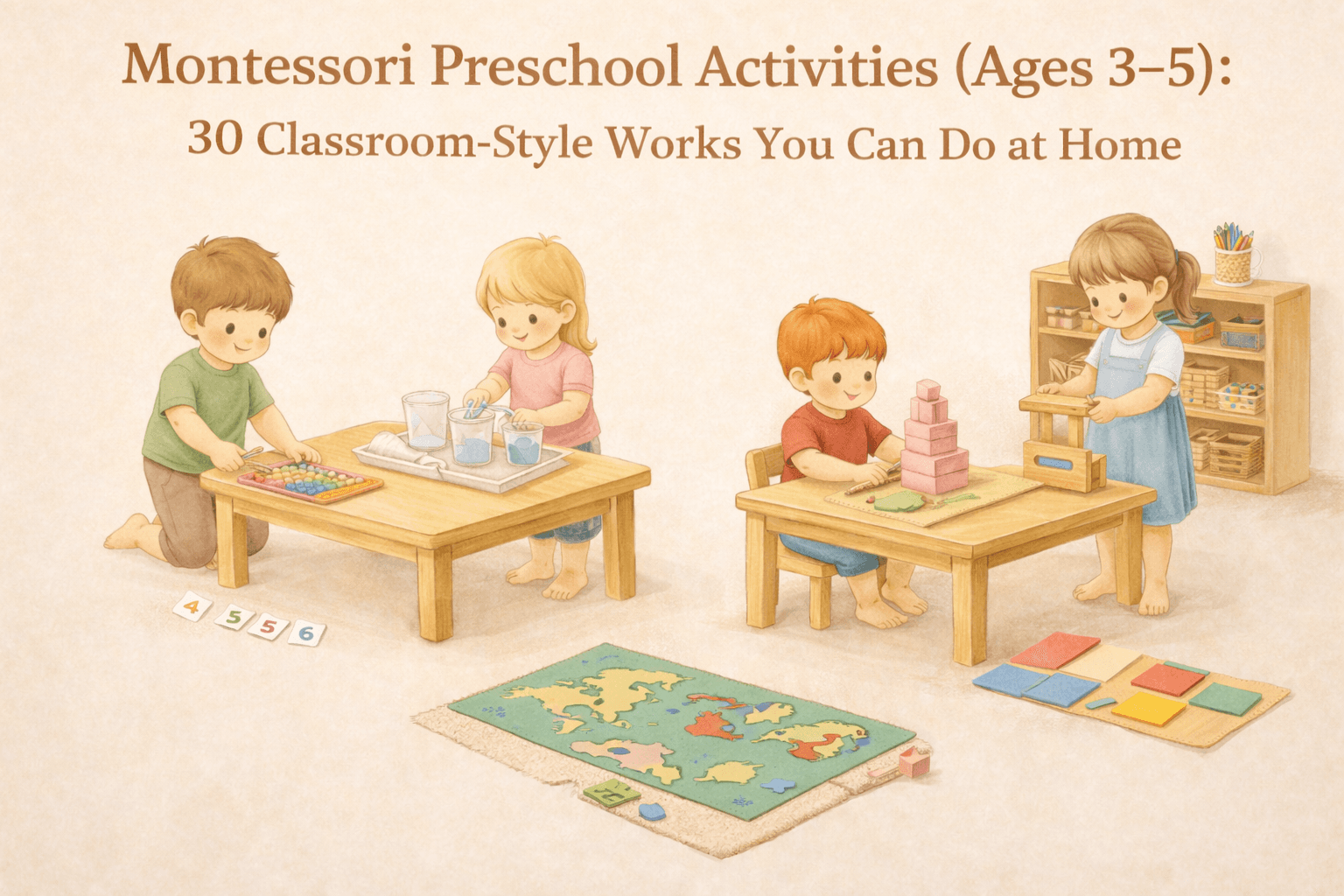
If you are searching for Montessori preschool activities, you are likely looking for true Montessori-style works - hands-on, repeatable, and structured - without needing a full classroom of materials. This page gives you 30 classroom-style Montessori preschool activities you can do at home, including several that feel fun and play-like (science missions, art processes, music games), not just practical life chores.
Important: Every activity below is different from the activities in your:
- 12-24 months page (posting, pom-pom drop, sponge squeeze, tape pull, lid matching, texture basket, and more)
- 24-36 months page (zipper and snap boards, clothespin monster, hole punch confetti, paint-in-bag, ice rescue, rhythm sticks, and more)
What makes an activity Montessori preschool (not just a craft)
A Montessori preschool work usually has:
- A clear work cycle: start, do, finish, reset
- Control of error: the child can see what worked (or did not)
- Real skills: language, math, coordination, independence
- Order: limited materials, arranged neatly, easy cleanup
How to present Montessori works at home (fast and effective)
Use the same routine every time:
- Invite: "I will show you."
- Demonstrate once, slow and minimal words.
- Hand it over: "Your turn."
- If it falls apart, reset and re-present (do not coach mid-action).
- Close the cycle: "All done," return to shelf.
Shelf rule (ages 3-5): Put out 8-12 works at a time, rotate 2-4 weekly.
Montessori preschool activities at home: 30 classroom-style works
Practical life (skill-building, but not just housework)
1. Tying a bow frame (shoe-tying prep)
- You need: a shoelace mounted on cardboard (two holes).
- Present: cross, pull through, bunny ears, cross ears, pull tight.
- Control of error: the bow holds or collapses.
2. Transfer with chopsticks (game-like precision)
- You need: training chopsticks, two bowls, cotton balls or pom-poms.
- Present: pick up, transfer, release gently.
- Make it fun: "Can you move 10 before the timer ends?"
3. Sewing cards (straight stitch)
- You need: thick card with holes, blunt plastic needle, yarn.
- Present: push needle through, pull yarn, repeat hole-by-hole.
- Control of error: holes guide the stitch path.
4. Weaving on a simple loom
- You need: cardboard loom and yarn strips.
- Present: over, under, over, under across the loom.
- Control of error: the pattern visibly alternates.
5. Sprout a seed jar (living science and responsibility)
- You need: clear jar, cotton pad or paper towel, dried beans, water mister.
- Present: place cotton, mist, place beans, check daily.
- Fun factor: visible growth feels magical.
6. Make-and-serve snack tray (structured host play)
- You need: small tray, tongs, cup, napkin, three snack items.
- Present: arrange neatly, carry tray, serve to a family member.
- Why it is Montessori: grace and courtesy, careful movement, order.
Sensorial (refining perception, very classroom)
7. Baric (weight) jars: light to heavy grading
- You need: six identical jars filled with different amounts of sand or rice.
- Present: lift two, decide heavier, build a line light to heavy.
- Control of error: weight differences give feedback.
8. Thermic exploration: warm and cool materials
- You need: six objects of different materials (metal spoon, wooden block, ceramic cup, fabric).
- Present: touch with fingertips, sort cool vs warm.
- Montessori twist: do it without looking first, then check visually.
9. Constructive triangles (pattern building)
- You need: pattern blocks (triangles) and simple pattern cards.
- Present: match pieces to card outline, complete the shape.
- Control of error: gaps show incorrect placement.
10. Geometric solids matching (3D to picture)
- You need: sphere, cube, cylinder, cone (or household equivalents) and picture cards.
- Present: pick solid, find matching picture, place together.
- Language extension: name attributes (flat face, curved surface).
11. Sound walk observation journal (quiet game)
- You need: small notebook and pencil.
- Present: walk quietly for 2 minutes, stop, name 3 sounds, draw a mark for each.
- Fun factor: feels like a spy mission.
12. Mystery-feel geometry bag (not your toddler mystery bag)
- You need: bag with flat wooden shapes (triangle, square, rectangle, oval).
- Present: feel edges, guess shape, pull out to check.
- Control of error: child verifies by sight after the guess.
Language (phonics and vocabulary, true Montessori preschool staples)
13. Sandpaper letters (sound-first)
- You need: sandpaper letters (or DIY textured letters).
- Present: trace with two fingers, say the sound (not the letter name), repeat.
- Tip: introduce 2-3 letters per week.
14. I Spy beginning sound game
- You need: a small basket of objects (cat, cup, sock, sun).
- Present: "I spy something that starts with /k/" and let the child guess.
- Control of error: the object confirms the sound.
15. Movable alphabet: build 3-letter words
- You need: letter tiles and picture cards (cat, sun, map, bed).
- Present: place picture, say sounds slowly, child selects letters.
- Why it works: writing often comes before reading in Montessori.
16. Classified vocabulary cards (animals by habitat)
- You need: picture sets (farm, forest, ocean).
- Present: sort by habitat, name each, add three-part card matching later.
- Fun factor: kids love categories.
17. Story sequencing (beginning, middle, end)
- You need: 3-part story cards (plant growing, baking, getting dressed).
- Present: mix cards, arrange in order, tell the story aloud.
- Control of error: sequence must make logical sense.
18. Command cards movement reading (playful, not worksheets)
- You need: simple written commands (jump, clap, tiptoe, hop).
- Present: child draws a card, reads or you read, then performs it.
- Fun factor: reading becomes a game.
Math (hands-on number sense and operations)
19. Number rods (1-10 length and quantity)
- You need: DIY rods (paper strips) with 1-10 segments colored or marked.
- Present: build staircase smallest to largest, count segments with finger.
- Control of error: rod lengths do not fit if out of order.
20. Spindle box (0-9 with bundles)
- You need: 10 compartments (egg carton) labeled 0-9 and sticks or buttons.
- Present: place correct number of counters into each compartment.
- Control of error: leftovers reveal miscounts.
21. Teen numbers (11-19) with ten plus ones
- You need: a ten bar (bundle of 10 sticks) and loose sticks.
- Present: show ten bundle, add 1-9 ones, label 11-19.
- Control of error: quantity is visible.
22. Golden bead place value game (bank exchange)
- You need: ones (beans), tens (bundles), hundreds (bundles of bundles), plus number cards.
- Present: build a number (for example, 243) with materials, read it aloud.
- Fun factor: kids love banking and exchanging.
23. Addition with dot equation cards
- You need: cards showing dot groups (3 + 2) and counters.
- Present: place counters for first group, add second group, count total.
- Control of error: total must match the dot card.
24. Fraction circles (pizza math)
- You need: fraction circle puzzle (or paper circles cut into halves, thirds, quarters).
- Present: build a whole, compare pieces (two quarters equals one half).
- Fun factor: it feels like puzzle play.
Culture, science, and art (high-interest fun works)
25. Continent map puzzle and flag matching
- You need: world map puzzle (or printed outline) and a few flags.
- Present: place continent pieces, match three flags to the correct continent.
- Control of error: map outline guides placement.
26. Land and water forms tray (mini geography)
- You need: tray with clay and water (island, lake, peninsula).
- Present: form one landform, label it, switch to next.
- Fun factor: it is sensory and world-building.
27. Botany leaf study and leaf rubbing
- You need: three real leaves, paper, crayons.
- Present: trace leaf outline, do rubbing, compare shapes.
- Vocabulary: smooth and serrated edges, vein, stem.
28. Life cycle sequencing (butterfly or plant)
- You need: four cards (egg, larva, pupa, adult).
- Present: arrange in order, name each stage, retell the cycle.
- Control of error: cycle order is fixed.
29. Sink or float investigation (prediction game)
- You need: basin of water, 10 objects, sink or float chart.
- Present: predict, test, record a check mark, compare results.
- Fun factor: it is a science experiment with a scorecard.
30. Volcano work cycle (controlled science demo)
- You need: baking soda, vinegar, small cup, tray, towel.
- Present: add baking soda, pour vinegar, observe, wipe and reset.
- Montessori tweak: emphasize careful measuring and full cleanup cycle.
Example Montessori preschool shelf (8-12 works)
A strong balanced set:
- 2 practical life: #1 bow frame, #4 weaving
- 2 language: #13 sandpaper letters, #14 I Spy sounds
- 2 math: #20 spindle box, #24 fraction circles
- 2 culture, science, art: #29 sink or float, #25 continents
Rotate 2-4 works weekly, keep 1-2 favorites constant.
FAQ: Montessori preschool activities
How long should preschool works last?
Often 10-30 minutes when the work is the right level and clearly presented.
Do I need official Montessori materials?
No. Many classics can be DIY (spindle box, number rods, classified cards) as long as you keep the work orderly and self-correcting.
How do I keep it from turning into chaotic play?
Limit materials, define a finish line (complete the card, fill all compartments), and always close the work cycle by resetting the tray.