Montessori toy rotation keeps your child’s shelf calm, purposeful, and easy to reset. Use this step-by-step guide to set up a 6–8 activity shelf and rotate based on your child’s interest—not the calendar.
Key takeaways
- Fewer, well-chosen toys on a low open shelf support concentration and independence.
- Rotate 2–3 trays weekly based on your child’s interest.
- Clear order (one tray = one activity) is the “control of error.”
- Observation drives what you keep out vs. store—follow the child.
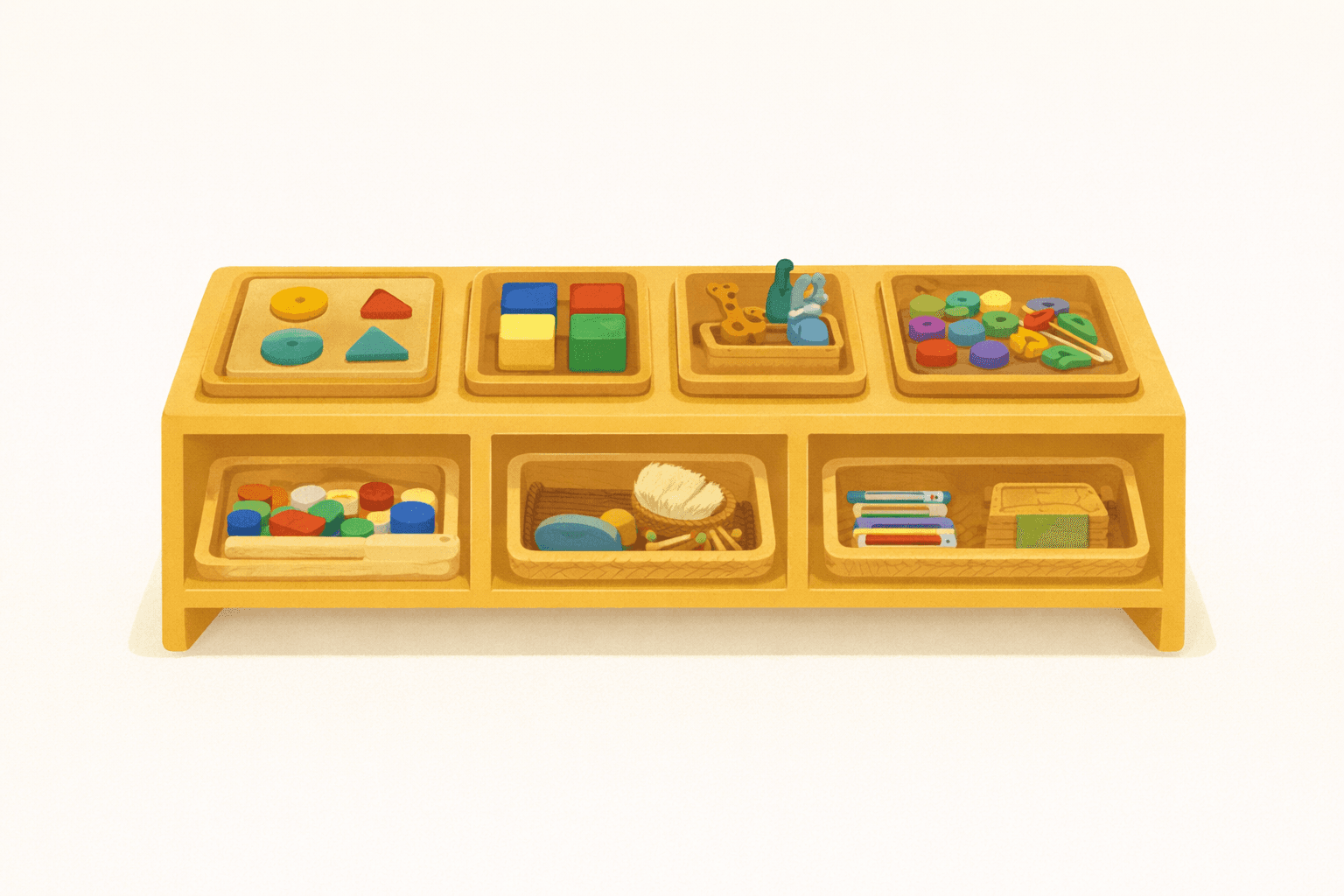
Table of contents
- Why toy rotation works (Montessori lens)
- What you’ll need
- Step-by-step setup (HowTo)
- Age adaptations (12–36 months)
- Safety & common pitfalls
- Troubleshooting & variations
- FAQs
- Related guides
Why toy rotation works (Montessori lens)
Montessori environments prioritize order, beauty, and independence. For toddlers, too many choices fragment attention. A simple shelf with 6–8 activities invites deep engagement, natural repetition, and proud clean-up. Rotation keeps challenge levels aligned to your child’s development and interests.
What you’ll need
- Low open shelf (child-height; 2–3 levels).
- 6–8 trays or baskets (one activity per tray).
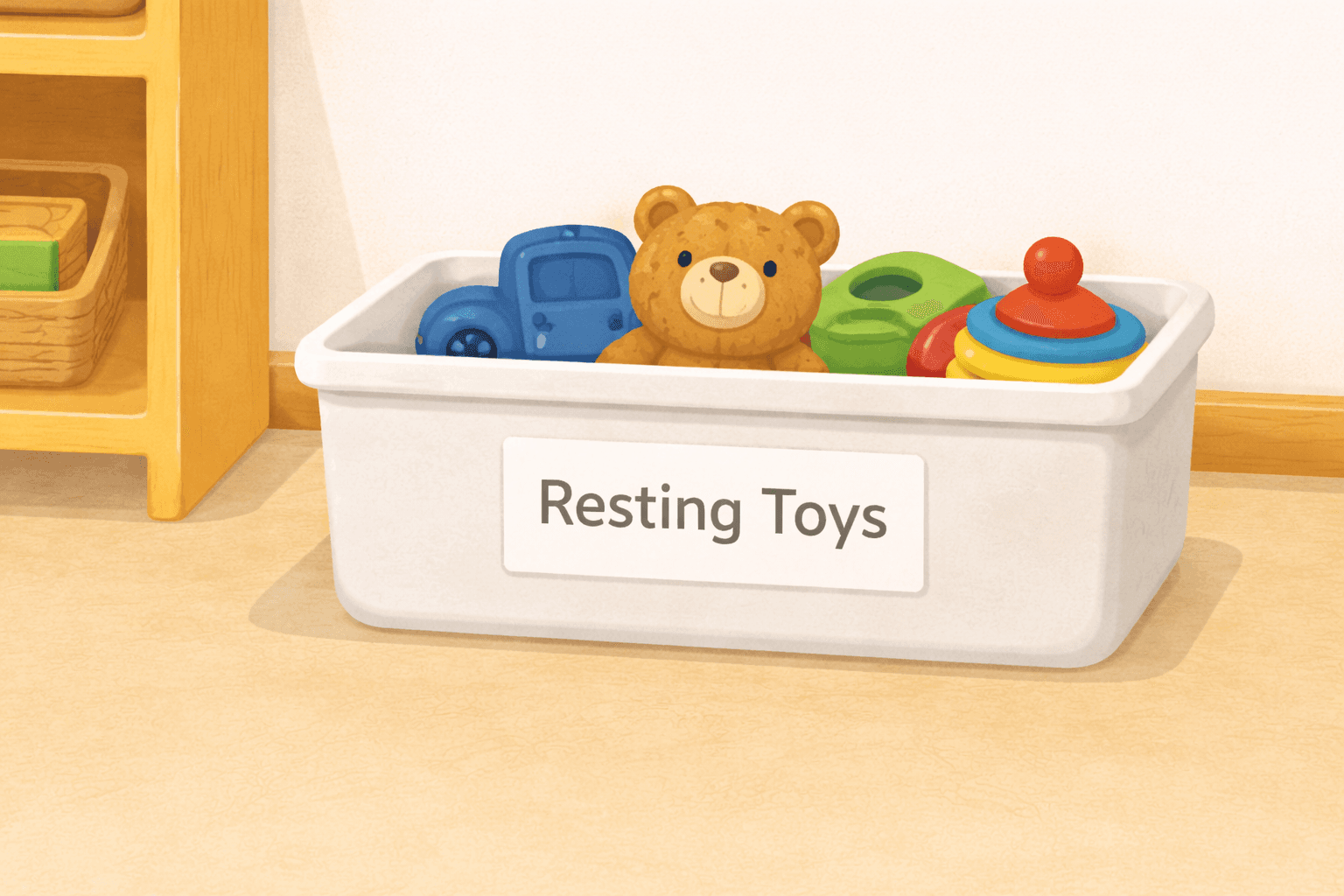
- Storage box or bin for the “resting” toys.
- Observation notebook (or Notes app).
- Optional: floor rug as a defined work space.
Time: 45–60 minutes for initial setup; 10–15 minutes for a weekly refresh.
Space: 80–120 cm wide shelf area is enough.
Budget: Use what you already have—focus on clarity over buying more.
Step-by-step setup (HowTo)
- Declutter the zone (10–15 min). Remove everything from the shelf. Keep only complete, age-appropriate activities. Store duplicates and noisy/flashy items that compete for attention.
- Curate 6–8 activities (10–15 min). Choose a balance:
- Hand-to-hand and coordination: large rings, posting, object permanence.
- Practical life: simple transfer (spooning, scooping), opening/closing.
- Language: 2–3 themed books, picture cards.
- Fine motor: pegging, knobbed puzzles, threading (large).
- Gross motor add-on (nearby): push cart, low climber (not on shelf).
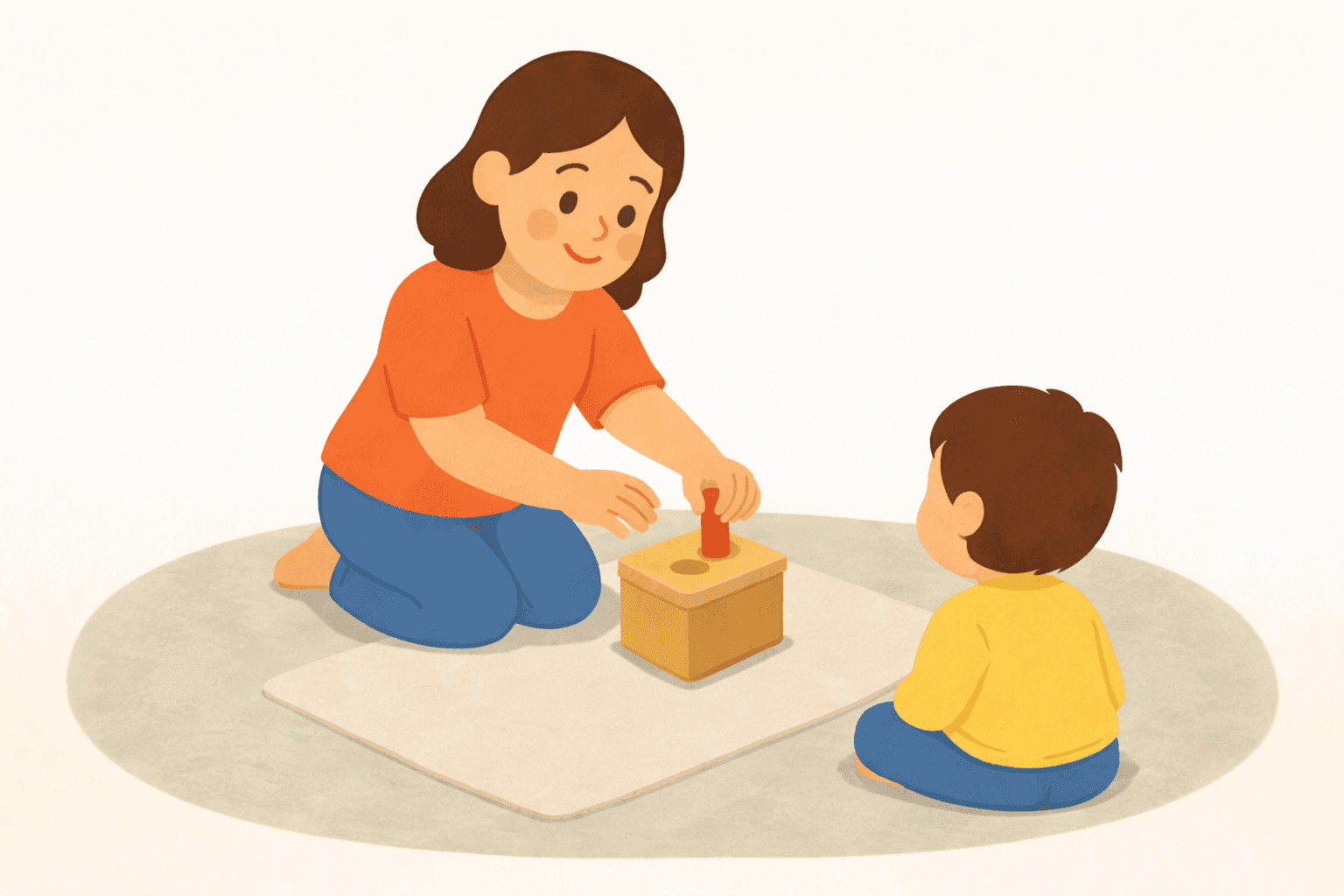
- Present the order (5–10 min). Place each activity on a tray with all parts visible. Arrange left-to-right, top-to-bottom. Model: take the tray to a rug, work slowly, return all parts, then return the tray to the same spot.
- Observe for 3–5 days. Note engagement signals: repeat use, sustained focus (>2 minutes), frustration, or avoidance.
- Rotate 2–3 items weekly (10–15 min). Swap what’s ignored or too easy. Keep favorites to respect sensitive periods. Introduce one stretch challenge and one confidence activity.
- Maintain the environment (ongoing). Repair missing pieces, retire broken toys, and keep surfaces clear. The shelf itself teaches order.
Age adaptations (12–36 months)
12–18 months
- Big posting (cups → cup), object permanence boxes, ring stackers, chunky puzzles (1–3 pieces), simple transfer (large beans), grasp and release.
- Rotate gently—toddlers may want the same activity for weeks.
18–24 months
- Two-step transfers (spoon → bowl), knobbed puzzles (3–5 pieces), pegging, simple matching cards (real-life photos), open/close containers, simple threading (thick cord + big beads).
24–36 months
- Sorting by one attribute (color/size), 6–8 piece puzzles, tong transfer, basic sequencing (2–3 cards), language baskets (kitchen tools), early practical life (wipe table, water a plant).
Safety & common pitfalls
- Choking: avoid parts < 3.2 cm diameter for under-3s; supervise always.
- Too many choices: cap at 6–8. Overflow = storage, not the shelf.
- Mixed parts: one tray = one complete activity; no cross-contamination.
- Over-rotating: don’t swap everything at once; follow the child’s cues.
- Adult “fixing”: demonstrate once, then step back.
Troubleshooting & variations
- Child dumps trays: reduce to 4 activities; choose single-step tasks; model slower.
- Ignores the shelf: check difficulty (too hard/easy) and room distractions; try morning invites.
- Short attention: remove flashy/electronic toys; ensure everything is complete and visible.
- Small space: a two-level shelf + a lidded storage cube works; rotate more frequently.
- Siblings: label shelves (names or color dots); duplicate only the hottest item temporarily.
FAQs
How often should I rotate?
Weekly is typical, but observation wins. If a child is in love with an activity, keep it.
How many toys total should I own?
Enough to support variety across domains—but the shelf shows only 6–8. Store the rest.
Can I use non-Montessori toys?
Yes—prefer simple, real-life, open-ended items. The presentation (clarity/order) matters most.
What about books?
2–3 front-facing at a time. Swap seasonally or by interest.
Do I need special trays?
No. Any low basket or tray with visible parts is fine.
How do I handle gifts and clutter?
Create a storage “resting box.” Introduce one at a time; donate duplicates.
Related guides
- Montessori Toys for 1 Year Old
- Montessori Toys for 2 Year Olds
- Montessori Toys for 3 Year Olds
- Montessori Activities for 1 Year Olds (12-24 Months): 20 Simple, Practical Ideas
- 15 Montessori Activities for 18 Month Olds
- Montessori Activities for 2 Year Olds (24-36 Months): 25 Purposeful Activities
- Montessori Activities for Toddlers (1-3 Years): The Complete At-Home Guide by Age