A Montessori toy shelf for 12–24 months can stay simple, calm, and budget-friendly. Here’s how to choose toys with purpose, set up a 6–8 item shelf, and rotate without overspending.
Key takeaways
- You do not need many toys—6–8 visible activities are enough.
- Choose simple, real-feeling materials with a clear purpose (control of error).
- Everyday household items can be excellent Montessori toys.
- Rotate 2–3 items weekly based on your child’s interest and readiness.
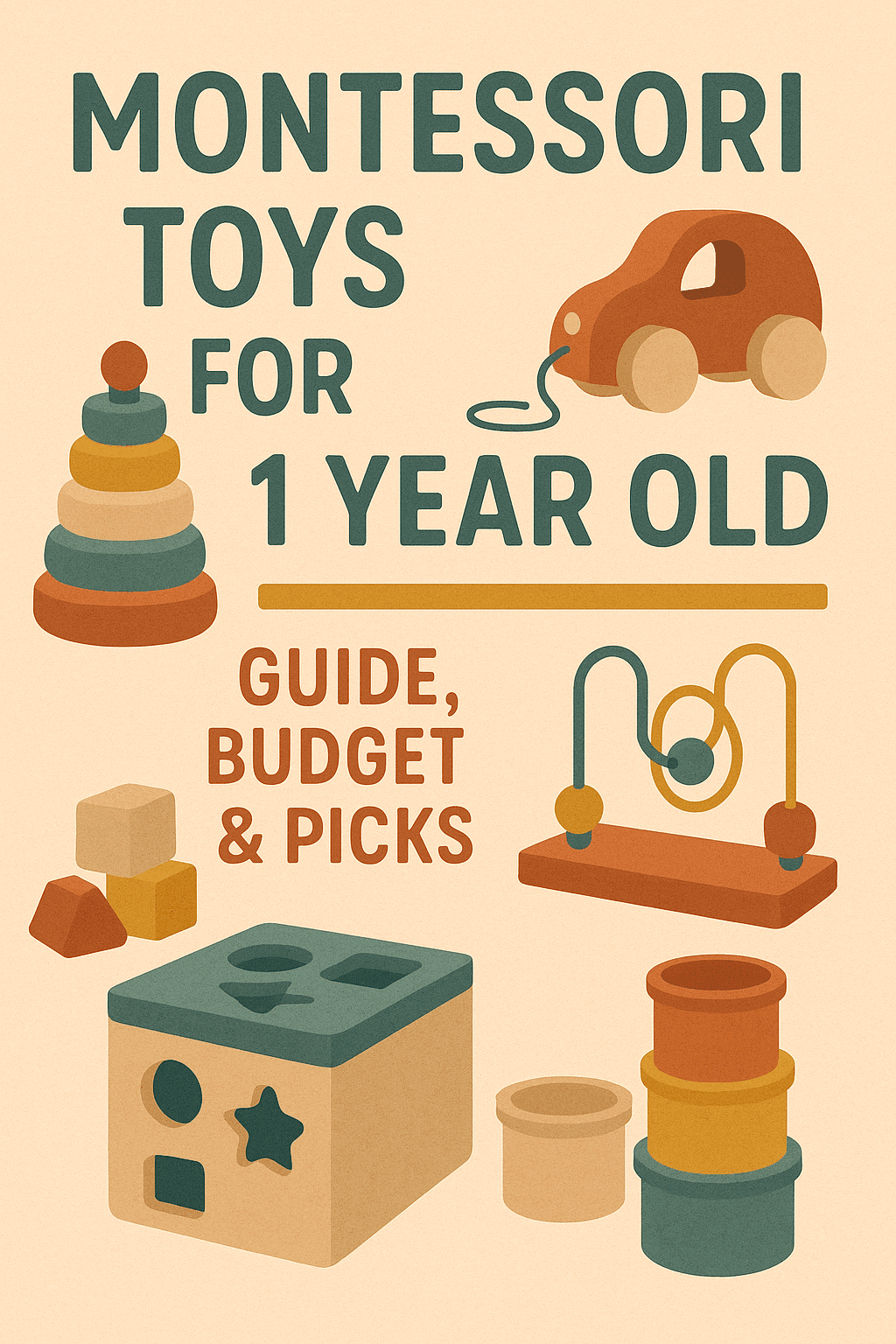
Table of contents
- Why fewer toys work better (Montessori lens)
- Development snapshot: 12–24 months
- How to choose Montessori toys for a 1 year old
- Top Montessori toy picks (12–24m)
- No-budget & everyday Montessori toys
- Sample shelf (6–8 activities)
- Rotation & storage tips
- Safety notes
- FAQs
Why fewer toys work better (Montessori lens)
Montessori emphasizes order, independence, and concentration. A toddler’s focus grows when the environment is calm and choices are limited. A neat shelf with 6–8 activities outperforms a room full of toys. The goal is not to buy more; it is to offer clear, purposeful materials your child can use independently.
Development snapshot: 12–24 months
Common sensitive periods you may see:
- Hand-to-hand transfer and posting
- Object permanence (love for hide-and-reveal)
- Gross motor (pulling up, climbing, pushing)
- Language explosion (names of everyday objects)
- Practical life (pouring, opening/closing, wiping)
How to choose Montessori toys for a 1 year old
Use this quick filter:
- Simple and self-correcting: one clear objective; child sees if it is right (control of error).
- Real materials and textures: wood, metal, fabric over flashing electronics.
- Right size: large parts for grasping; avoid small pieces.
- One task per tray: everything needed is together and visible.
- Interest-led: observe your child—swap what is ignored or too easy.
Top Montessori toy picks (12–24m)
Generic categories—pick what you have or can DIY; you do not need expensive brands:
- Object Permanence Box – post a ball, watch it return; builds cause-and-effect.
- Large Posting Set – chunky cylinders/cards dropped into a slot; strengthens wrist rotation.
- Ring Stacker (3–5 rings) – hand-eye coordination; start with uniform rings, then graded sizes.
- Single-Shape Sorter – 1–2 shapes before multi-shape boxes to prevent overwhelm.
- Chunky Knob Puzzle (1–3 pieces) – pincer grip practice.
- Opening and Closing Containers – jars with easy lids; containers within a tray.
- Practical Life Transfer – large spoon + beans between two bowls (supervised).
- Language Basket – 4–6 real objects from one theme (kitchen tools) + matching photo cards.
- Push/Pull Cart or Soft Ball Set – safe gross-motor outlet.
- Montessori Busy Board & Busy Book (9–18m) – simple board with 3–5 real actions (zip, latch, buckle); place it low or on a tray; skip flashing lights.
No-budget & everyday Montessori toys
You already own many great “toys.” Present them neatly on a tray or in a basket:
- Kitchen set: wooden spoon, small whisk, metal measuring cups → sound, weight, transfer.
- Spice jar + coffee stirrers → posting (choose jars with small holes; supervise).
- Oatmeal tin slot box → cut a mail-slot in the lid; “post” old loyalty cards.
- Treasure basket: natural brush, napkin ring, fabric square, silicone trivet, scrubber.
- Scarf pull box: tissue box filled with fabric squares for grasp and pull.
- Egg carton sorter: big pom-poms or large corks → one-to-one correspondence.
- Laundry helper: match socks, carry cloths, wipe a small spill → practical life.
- Cardboard cube + soft ball: roll in/out, push through openings → object permanence.
- Montessori kitchen tools: small pitcher + cup on a tray and a sponge for wipe-up → practical life.
Montessori rationale: everyday tools are real, purposeful, and sized for success. The “control of error” is built in (stirrer only fits the small hole, lid must align to close), so your child learns by doing—not by adult correction.
Sample shelf (6–8 activities)
- Posting box
- Ring stacker
- Single-shape sorter
- Chunky knob puzzle
- Opening/closing tray
- Spoon transfer (large beans)
- Language basket (kitchen theme)
- Soft ball basket (nearby on floor, not on shelf)
Place trays left-to-right, top-to-bottom. Model: take tray → work on a small rug → return parts → return tray.
Rotation & storage tips
- Rotate 2–3 items weekly, but keep favorites—follow the child.
- Store extras in a lidded box; repair or remove incomplete items.
- Photograph your shelf after a good setup; use it as your reset guide.
Safety notes
- Avoid parts smaller than 1.25 inches (3.2 cm) for under-3s; supervise transfers.
- Skip magnets, button batteries, and plastic bags.
- Anchor shelves; keep cords and outlets secured; use non-slip rug pads.
- Clean household items before placing them on trays; check for sharp edges.
FAQs
Do I have to buy official Montessori toys?
No. Many everyday items make excellent Montessori toys when presented clearly on a tray.
How many toys should be out at once?
Keep 6–8 complete activities visible. Store the rest and rotate based on interest.
Are electronic toys Montessori?
Prefer simple, real-feeling materials; electronics can distract from purposeful movement and concentration.
What is the best Montessori toy for a 1-year-old?
There is not a single best toy. Choose from posting, stacking, simple puzzles, practical life, or language baskets based on current interests.
How often should I rotate toys?
Weekly is a good start. Observe for 3–5 days, swap what is ignored or mastered, and keep favorites.