A Montessori bedroom is calm, simple, and mapped for independence. Use this step-by-step guide to place the floor bed, bookshelf, toy shelf, wardrobe, and movement corner with safety and budget in mind.
Key takeaways
- Keep everything low, open, and reachable to support independence.
- Show fewer, complete activities (6-8 max) and rotate; you do not need to overspend.
- Use real, child-sized tools and simple materials; everyday items can be great toys.
- Prioritize safety and clear pathways; anchor tall furniture; use a mat for any movement area.
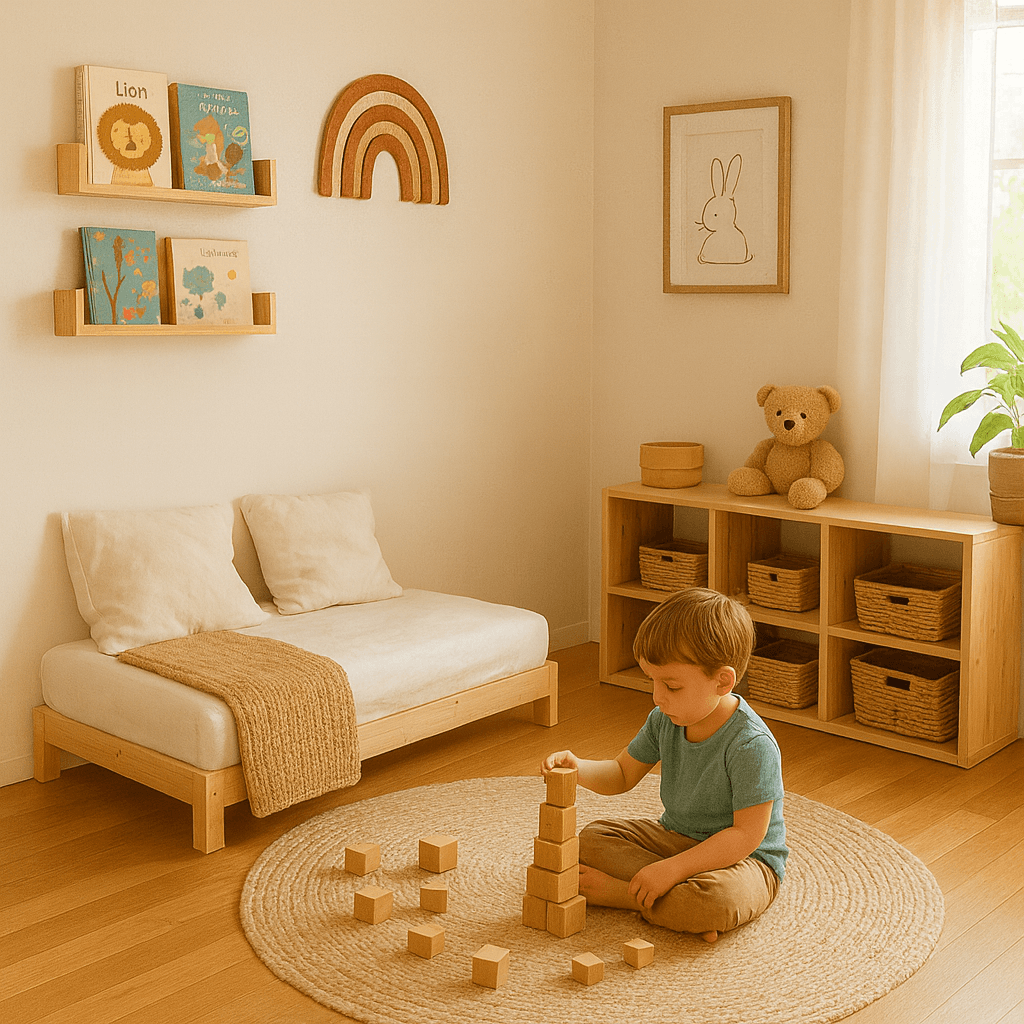
Table of contents
- Room philosophy & zones
- Step-by-step bedroom setup (HowTo)
- Montessori floor bed
- Montessori Bookshelf & reading nook
- Montessori Toy Storage (rotation)
- Montessori Wardrobe (dressing area)
- Movement corner: climbing set, busy board
- Lighting, mirror, decor at child height
- Small rooms & rental-friendly layout
- Printable bedroom setup checklist
- Age adaptations (0-3, 3-6)
- Budget / no-spend ideas
- Safety checklist
- Common challenges & solutions
- Design tips: color, lighting, decor
- Maintenance schedule
- Getting started this weekend
- Related reading
- FAQs
Room philosophy & zones
A Montessori bedroom is designed for self-care and self-direction. Map zones first:
- Sleep: Montessori floor bed in a quiet corner. See our Montessori sleep guide for bedtime routines and common challenges.
- Reading: Montessori Bookshelf (front-facing) and a floor cushion.
- Play/Work: Open Montessori Toy Storage shelf with 6-8 trays.
- Dressing: Montessori Wardrobe with a low rail, two bins, and a mirror.
- Movement (optional): a small Montessori climbing set or Montessori Busy Board on a mat, away from the bed.
Step-by-step bedroom setup (HowTo)
- Declutter and child-proof the room: clear floors, hide cords, and cap outlets.
- Place the floor bed: low frame or mattress on the floor with breathable bedding in a quiet corner.
- Add the bookshelf: front-facing, chest height to your child; display 2-3 books.
- Set the toy shelf: 6-8 complete activities; place left-to-right for order.
- Create the dressing area: low rail (3-5 outfits), two bins, and a small mirror.
- Optional movement zone: small climbing set on a thick mat or a simple busy board on the wall.
- Light and decor: warm lamp, art at child height, low mirror; keep the sleep corner visually calm.
- Observe for 3-5 days: rotate 2-3 items based on interest.
Montessori floor bed
- Choose: low frame or mattress on the floor; firm, breathable mattress; fitted sheet only.
- Place: quiet corner with clear sight lines; avoid busy mobiles above the bed.
- Why it helps: supports independence, safe movement, and healthier sleep associations.
For a deeper look at floor bed age, dimensions, crib transition, and safety details, see our complete Montessori floor bed guide.
Montessori Bookshelf & reading nook
- Use a front-facing shelf with 4-6 slots at chest height.
- Display 2-3 books; rotate seasonally or by interest.
- Add a small rug or cushion and anchor the unit for stability.
Montessori Toy Storage (rotation)
- Open shelf with one complete activity per tray or basket; nothing stacked.
- Keep 6-8 activities max (posting, stacking, puzzles, practical life, language basket). You can make many of these yourself for under $20.
- Rotate 2-3 items weekly and keep favorites to respect sensitive periods. See our toddler activity hub for age-specific shelf ideas.
Montessori Wardrobe (dressing area)
- Low rail (about 16-24 inches high) with 3-5 outfits and two bins (tops/bottoms/underwear).
- Add a child-height mirror and a small seat.
- Use a hook for tomorrow's outfit and a laundry basket to support autonomy. See our full Montessori wardrobe guide for more details.
Movement corner: climbing set, busy board
- For toddlers, a compact Montessori climbing set (triangle, ramp, or arch) on a thick mat with 5-6 feet of clearance is ideal and should not sit near the bed.
- A Montessori Busy Board (3-5 real actions like zip, buckle, latch) can live on the wall at child height.
- Keep one configuration at a time, supervise climbing, and retire noisy or light-up boards.
Lighting, mirror, decor at child height
- Warm, dimmable lamp in the sleep zone with brighter task light near the shelf.
- Low wall mirror supports body awareness and care routines.
- One or two simple pictures at child height; avoid busy visuals near the bed.
Small rooms & rental-friendly layout
- Use a two-level shelf (about 32-40 inches wide) with more frequent rotation instead of more furniture.
- Choose a freestanding or strap-anchored wardrobe; use removable hooks for art.
- Swap a climbing frame for a taped balance line and beanbags if space is tight.
Printable bedroom setup checklist
Montessori Bedroom Setup Checklist (PDF)
Want this as a one-page room setup checklist? Enter your email to unlock the printable download.
Age adaptations (0-3, 3-6)
0-3 years
- Floor bed, low mirror, and an optional pull-up bar early on.
- Shelf starts with 4-6 trays and later moves to 6-8.
- Busy board with simple actions; climbing set at a low angle; constant supervision.
3-6 years
- Shelf with 6-8 purposeful activities (sorting, sequencing, early practical life).
- Wardrobe stays small and capsule-style; include the child in the laundry routine.
- Movement adds balance line or beanbag toss; adjust climbing challenge or phase out as needed.
Budget / no-spend ideas
- Use what you have: low coffee table as shelf, mattress on the floor, baskets for trays.
- Everyday tools become toys: small pitcher and cup for pouring, jars with safe lids for open/close, sock matching, language basket with real objects.
- DIYs: oatmeal-tin posting box, cardboard shape sorter, photo sequencing cards.
- Buy fewer, better pieces: one sturdy Montessori Bookshelf or open shelf anchors the room; a compact Montessori Wardrobe can replace a bulky dresser.
Safety checklist
- Anchor all tall furniture and round any sharp edges; use non-slip rugs.
- Keep 5-6 feet clear around the climbing set and place a thick mat under it.
- Avoid small parts under 1.25 inches for under-3s; skip magnets and button batteries.
- Secure cords and outlets; use child-safe window coverings.
- Keep the sleep corner uncluttered with breathable bedding; monitor room temperature.
Common challenges & solutions
"My child won't stay in bed!"
This is normal and temporary. Stick to a consistent bedtime routine, use a baby gate at the doorway initially, and lead them back without engagement. Trust the process — it gets easier.
"The room gets messy immediately"
Usually means too many items. Reduce toys by half, implement a daily reset routine with your child, and try the one-toy-out-at-a-time rule.
"We don't have space for all this"
Start small. A floor bed and one low shelf can hold everything. See the small rooms section above for rental-friendly ideas.
"My partner thinks I'm crazy"
Start with small changes. Try the floor bed for naps first, show the research on independence and sleep, and focus on safety benefits.
Design tips: color, lighting, decor
Color palette
Choose calm, neutral tones: soft whites, natural wood, muted pastels. Stick to one accent color maximum and avoid busy patterns. The sleep corner should be the most visually calm area.
Layered lighting
- Natural light: Maximize during the day
- Overhead: Dimmable for flexibility
- Task lighting: A child-controllable lamp near the shelf
- Night light: Warm, gentle glow in the sleep zone
Meaningful decor
- Child's own artwork displayed at their eye level
- Family photos they can see and talk about
- Nature items (shells, pinecones, seasonal flowers)
- Beautiful, real objects — minimal character or licensed items
Maintenance schedule
Daily: Evening reset with your child — put items back in their places, wipe surfaces.
Weekly: Rotate 2-3 toys or books, assess what is working, remove outgrown items.
Monthly: Refresh decor elements, introduce seasonal items, donate unused materials.
Getting started this weekend
- Friday evening: Declutter — remove 80% of toys, box up excess clothes, clear surfaces.
- Saturday morning: Rearrange furniture to child height, secure everything to walls, shop for any missing essentials.
- Saturday afternoon: Arrange items on low shelves, set up floor bed, create activity areas, add beauty (plants, art).
- Sunday: Tour the room with your child, demonstrate where things go, observe what works, adjust as needed.
Related reading
- What is Montessori? A Parent's Complete Guide
- 40 Montessori Practical Life Activities You Can Start at Home Today
- Montessori Activities for Toddlers (1-3 Years): Complete At-Home Guide
- Montessori Activities for 1 Year Olds (12-24 Months)
- Montessori Activities for 2 Year Olds (24-36 Months)
- Montessori Preschool Activities (Ages 3-5)
- 10 DIY Montessori Materials You Can Make for Under $20
- Montessori Sleep: Bedtime Routines by Age (1-6)
FAQs
Is a Montessori floor bed safe?
Yes, when the room is child-proofed: low bed, anchored furniture, safe outlets, and supervision during transitions.
How many toys should be out?
Limit the Montessori Toy Storage shelf to 6-8 complete activities and rotate based on interest.
Do I need a special Montessori bed?
No. A simple low frame or a mattress on the floor works; stability and clear floor space matter most.
Where should I place a Montessori climbing set?
In a movement corner on a thick mat with 5-6 feet of clearance, away from the bed and bookshelf.
Can everyday items count as Montessori toys?
Absolutely, when presented clearly on a tray or in a basket with a single purpose (pour, open/close, match).
When should I start a Montessori floor bed?
Many families start from birth or transition between 6-12 months when the baby begins to roll and move independently. There is no strict age — readiness depends on your child and your room safety. See our floor bed guide for age-specific advice.
How do I set up a Montessori bedroom in a small room?
Focus on a floor bed and one low shelf — that is enough. Use a two-level shelf with frequent rotation instead of more furniture, freestanding or strap-anchored storage, and removable hooks for art. See the small rooms section above for more tips.