Independent play sounds simple: your toddler plays, you drink coffee, answer a message, cook dinner, or breathe for five minutes.
But in real life, many toddlers do not naturally play alone for long. They follow you around, dump toys, ask for screens, pull at your leg, or say, "Play with me," every two minutes.
That does not mean you have failed. Independent play is a skill. Like walking, talking, dressing, pouring, or waiting, it develops with practice, the right environment, and realistic expectations.
The goal is not to ignore your child. The goal is to help your toddler feel secure enough to explore, concentrate, and enjoy simple activities without needing constant adult entertainment or screens.
A Montessori-aligned approach focuses on one central idea:
Prepare the environment, offer meaningful choices, protect concentration, and build independence gradually.
Table of Contents
- What independent play means for toddlers
- Why your toddler may not play alone yet
- How long should a toddler play independently?
- How to set up independent play without screens
- Best Montessori-aligned activities for independent play
- What to do when your toddler keeps asking for you
- How to build independent play without screens
- A 7-day independent play plan
- Common mistakes that make independent play harder
- Independent play by age
- When to get extra support
- Quick parent checklist
- FAQ
What independent play means for toddlers
Independent play does not mean your toddler is alone in a room for hours.
For toddlers, independent play usually means:
- playing near you without constant adult direction
- choosing an activity from a few options
- exploring safely while you are nearby
- staying with one activity for a short time
- beginning to solve small problems without immediate help
- returning to you for connection, then trying again
A toddler may play independently for 3 minutes, 8 minutes, or 20 minutes depending on age, temperament, sleep, hunger, environment, and practice.
The key is to start small.
Independent play is not about pushing your toddler away. It is about helping them build trust in their own activity.
Why your toddler may not play alone yet
Before trying to "fix" independent play, look at why your toddler may be struggling.
1. Too many toys are available
A room full of toys can look fun to adults, but it can overwhelm toddlers. When there are too many choices, children often dump everything instead of settling into focused play.
Fewer toys usually create better play. The Montessori toy rotation guide shows how to create a simple 6-8 activity shelf and rotate based on interest.
2. The toys are too difficult or too passive
Some toys are frustrating because the child cannot use them independently. Others are too passive and do not invite real concentration.
Good independent play materials are usually simple, hands-on, and open enough for repetition.
3. Your toddler is used to adult-led play
If adults usually entertain, explain, correct, praise, or guide every step, the child may not know what to do when the adult steps back.
Independent play grows when adults give space.
4. Screens have become the default "pause button"
Screens are highly stimulating. Compared with fast-moving digital content, simple play may feel slow at first.
That does not mean your child cannot learn to play without screens. The transition may simply take practice.
5. Your toddler needs connection first
Some toddlers cannot settle into play because they are seeking connection.
A few minutes of focused connection before independent play can make a big difference.
6. The environment says "no" too often
If your toddler hears "don't touch that," "come back," "stop," and "not there" all day, they may not be able to relax into play.
Independent play works better in a prepared space where most available choices are safe and allowed. A child-friendly zone from the Montessori bedroom setup guide can offer the same low, visible, easy-to-access structure even if the main play area is elsewhere.
How long should a toddler play independently?
Expectations matter.
A 1-year-old may only play independently for a few minutes. A 2-year-old may build toward 5-15 minutes. A 3-year-old may sometimes manage 15-30 minutes, especially with familiar activities and a calm routine.
These are not strict rules. Some children need more adult presence. Some children concentrate for longer. Some days are simply harder.
Independent play is affected by:
- sleep
- hunger
- illness
- teething
- temperament
- transitions
- stress at home
- toy setup
- parent availability
- screen habits
- how often the child has practiced
Instead of asking, "Why won't my toddler play alone for 30 minutes?" start with:
Can we build one calm 5-minute independent play habit?
That is a better first goal.
How to set up independent play without screens
The environment matters more than the perfect toy.
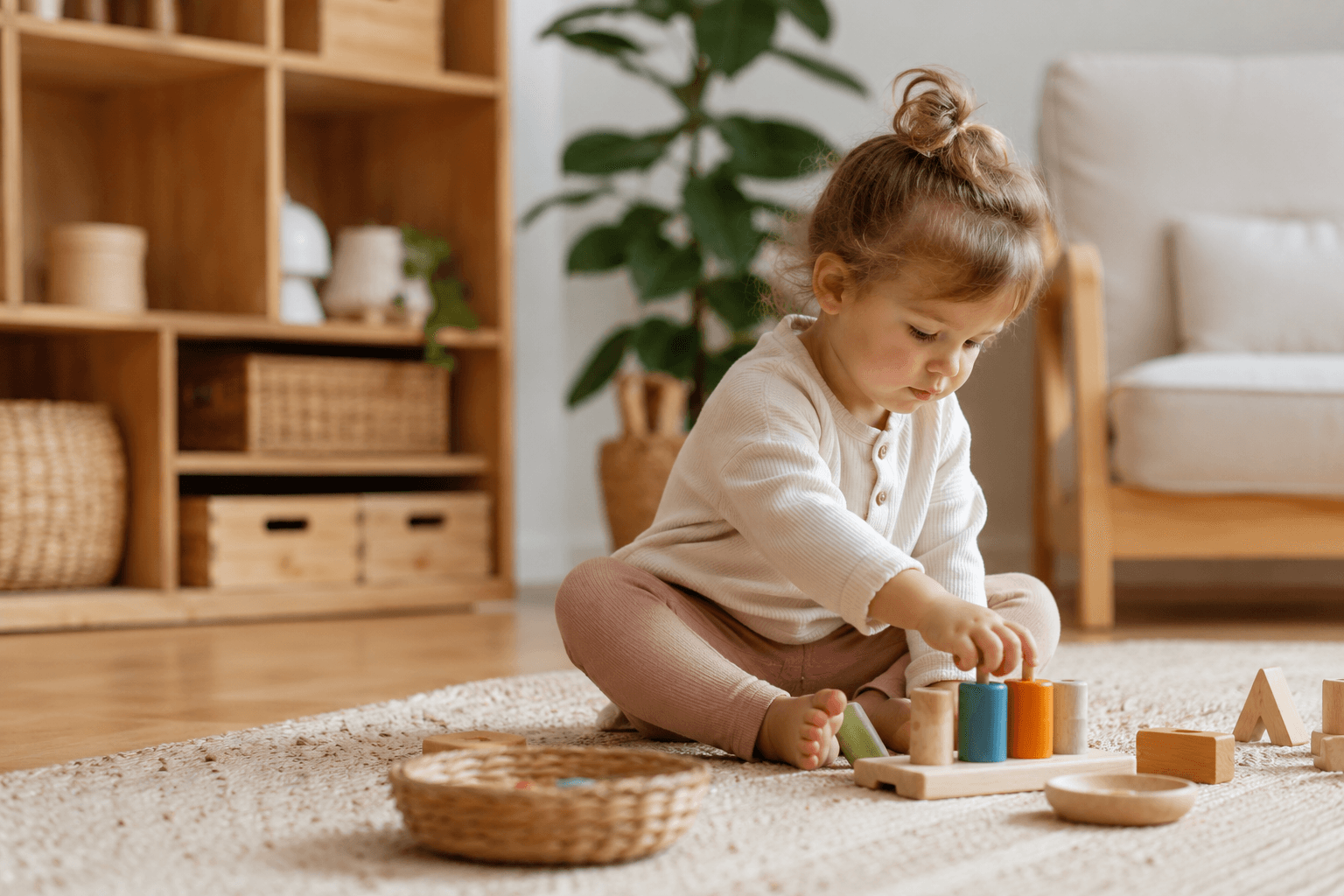
1. Create a small "yes" space
A yes-space is an area where your toddler can safely explore with fewer corrections.
It can be:
- a corner of the living room
- a low shelf
- a play mat
- a child-safe bedroom area
- a small kitchen helper area
- a reading basket near you
The space should be simple, safe, and predictable. Include:
- a few toys or activities
- books
- child-sized tools when appropriate
- soft movement space
- clear boundaries
- no fragile adult items within reach
When the space is prepared, you do not have to interrupt constantly.
2. Offer fewer choices
Instead of 30 toys, try 6-8 carefully chosen options.
A simple shelf might include:
- one puzzle
- one basket of animals
- one stacking toy
- one posting activity
- one basket of books
- one practical life activity
- one simple art option with supervision
- one movement item, such as a soft ball
Fewer choices help your toddler choose and stay longer.
3. Choose toys that invite repetition
Toddlers love repetition because repetition builds mastery.
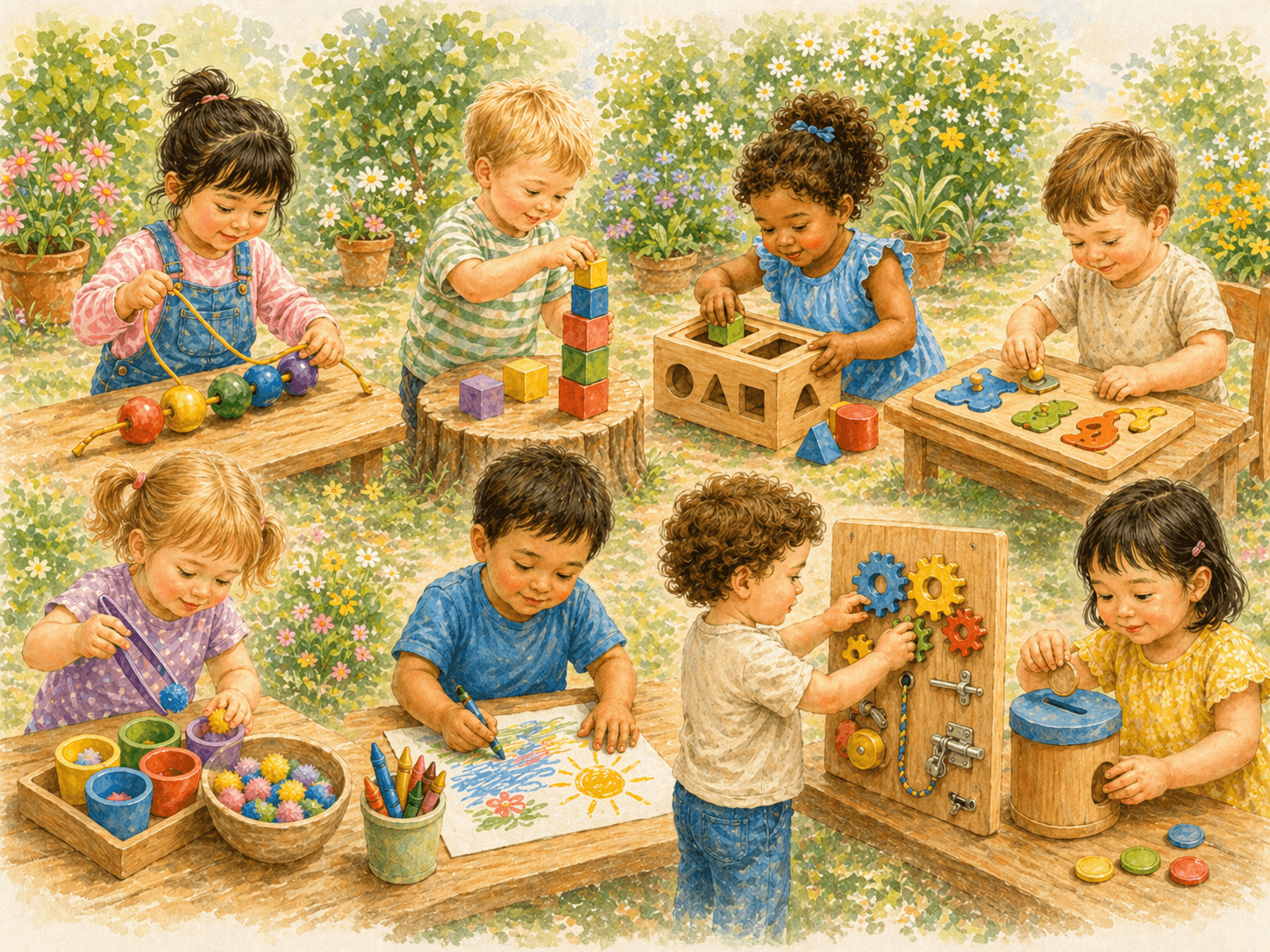
Good independent play options include:
- stacking cups
- nesting bowls
- wooden blocks
- simple puzzles
- shape sorters
- animal figures
- cars with a ramp
- scarves in a box
- an object permanence box
- large beads and pipe cleaners for older toddlers
- matching lids and containers
- pom-poms and containers with supervision
- chunky crayons and paper
- board books
The best toy is not always the most expensive one. It is the one your child can use with their own hands, again and again.
4. Start near your child
Many toddlers are not ready for "go play alone."
Start with nearby independence. You sit close but do less.
Try: "I'll sit here while you work."
Then slowly reduce your involvement:
- first, sit next to them
- then sit nearby
- then do a quiet task next to them
- then step away for one minute
- then return before they panic
This builds trust.
5. Use a predictable phrase
Use the same phrase every day.
Examples:
- "This is your play time. I'll be in the kitchen."
- "You can choose work from your shelf."
- "I'll come back when the timer rings."
- "You play; I'll fold laundry next to you."
Predictable language helps toddlers understand what is happening.
6. Do not interrupt focused play
This is one of the most important Montessori-aligned ideas.
When your toddler is concentrating, try not to interrupt with:
- "Good job!"
- "What color is that?"
- "Can you show Grandma?"
- "Do it this way."
- "What are you making?"
Even positive interruptions can break concentration. Instead, quietly observe.
You can comment later: "You worked with the blocks for a long time."
This respects the child's focus.
Best Montessori-aligned activities for independent play
Independent play does not need to be complicated. Toddlers often concentrate best with simple, real, hands-on activities.
1. Practical life activities
Practical life is one of the best ways to support toddler independence.
Try:
- wiping a small table
- transferring socks into a basket
- matching lids to containers
- washing fruit
- peeling a banana
- stirring yogurt
- putting napkins on the table
- watering a plant
- sweeping crumbs with a small brush
- sorting laundry by color
- putting shoes in a basket
These activities are meaningful because they connect your child to real life. Find more ideas in the Montessori practical life activities guide.
2. Toy rotation shelf
A small rotating shelf helps your toddler see what is available and choose independently.
Good shelf categories include:
- fine motor
- language and books
- pretend play
- building
- puzzles and problem-solving
- practical life
- movement
Keep it uncluttered. Rotate when your child loses interest, not every day. Use the toy rotation guide for ages 1-3 for a full setup.
3. Language baskets
A language basket can be simple:
- animals
- vehicles
- kitchen objects
- family photos
- nature items
- matching cards and objects
- miniature objects
Your toddler can explore, name, match, sort, and repeat. These Montessori language activities offer more ideas by stage.
4. Open-ended building
Blocks, cups, magnetic tiles, and simple construction toys can support longer play because there is no single "right" answer.
Try setting out fewer pieces at first. Too many pieces can lead to dumping.
5. Quiet book basket
Create a small basket with 5-8 books. Rotate the books weekly.
For younger toddlers, choose:
- board books
- real-life pictures
- animals
- routines
- simple words
- family photo books
Place the basket near where you need a few minutes: the kitchen, bedroom, bathroom, or living room.
6. Movement work
Some toddlers cannot sit and play because their bodies need movement first.
Try:
- pushing a laundry basket
- carrying books
- climbing cushions safely
- animal walks
- dancing
- pulling a wagon
- walking outside
- throwing soft balls into a basket
After movement, many toddlers settle better into quiet play.
Montessori Parent Guide can help you choose age-appropriate activities, simplify your play space, and build a realistic independent play routine for your child.
What to do when your toddler keeps asking for you
A toddler who wants you is not being manipulative. They may need connection, reassurance, help starting, or a clearer routine.
Here is what helps.
1. Fill the connection cup first
Before independent play, give 5-10 minutes of focused attention.
No phone. No multitasking.
Try:
- reading one book
- building together briefly
- cuddling
- singing
- sitting on the floor
- doing one practical life task together
Then say: "Now it's your play time. I'll be nearby."
Connection before separation makes independence easier.
2. Help your toddler start, then step back
Do not do the whole activity for them. Start just enough.
For example: "I'll put the first block here. You can keep building."
Or: "Let's take out the animals. You can choose where they go."
Then reduce your role.
3. Use a visual timer
For older toddlers, a timer can help.
Start very small:
- 2 minutes
- 3 minutes
- 5 minutes
Say: "I'll wash the dishes until the timer rings. You can play here."
Return when you said you would. This builds trust.
4. Expect protest at first
If your toddler is used to screens or constant adult-led play, independent play may feel hard at first.
They may complain, follow you, or say they are bored.
Stay warm and consistent: "You want me to play. I'll play after I finish this. You can choose blocks or books."
Do not turn every protest into a negotiation.
5. Stay boring during independent play time
If every interruption gets a big response, your child may interrupt more.
Keep your response calm and brief: "I'm here. It's play time."
Then return to your task.
How to build independent play without screens
Screens can be useful in some family situations, but if your goal is more screen-free play, make the transition gradual.
Step 1: Choose one screen-free window
Do not start with the hardest time of day.
Choose one easier window:
- after breakfast
- before lunch
- after nap
- while you fold laundry
- while dinner prep starts
Start with 5-10 minutes.
Step 2: Prepare the activity before your child asks for a screen
It is harder to say no once your toddler is already asking. Set up the shelf, basket, or activity first.
Step 3: Use the same language
"Screens are not available now. You can choose blocks or books."
Do not over-explain.
Step 4: Offer presence, not entertainment
You can be nearby without leading the play.
"I'll sit with you for two minutes, then I'm going to make lunch."
Step 5: Celebrate the process, not performance
Say: "You played while I made lunch."
Instead of: "Good job being independent!"
The first phrase notices effort without making independence feel like a performance.
A 7-day independent play plan
Use this plan to build the habit gently.
Day 1: Observe
Watch how your toddler plays. Ask:
- What holds their attention?
- What do they dump immediately?
- When do they ask for screens?
- Do they play better near you?
- Are they tired, hungry, or overstimulated?
Day 2: Simplify the play area
Put away excess toys. Leave a small number of visible choices. Start with 6-8 options.
Day 3: Add one practical life activity
Choose one simple job:
- wiping
- sorting
- pouring with supervision
- matching lids
- washing fruit
- putting socks in a basket
Day 4: Practice 5 minutes
Say: "This is your play time. I'll be right here."
Stay nearby. Let your child lead.
Day 5: Step away briefly
Say: "I'm going to put this cup in the sink. I'll come back."
Leave for a short, successful moment. Return calmly.
Day 6: Use a small timer
Try 3-5 minutes while you do a visible task nearby.
Day 7: Repeat the best setup
Notice what worked and repeat it.
Independent play grows through repetition, not novelty.
Common mistakes that make independent play harder
Mistake 1: Starting when your toddler is already tired
A tired toddler needs support, not independent play practice. Try earlier in the day.
Mistake 2: Offering too many toys
Too many choices can create dumping and wandering. Simplify first.
Mistake 3: Expecting too much too soon
Start with minutes, not hours.
Mistake 4: Interrupting concentration
When your toddler is focused, protect that moment.
Mistake 5: Using screens as the comparison
Screen attention and play attention are different. A toddler may watch a screen for 30 minutes but only play with blocks for 5. That does not mean blocks "don't work." It means independent play is a different skill.
Mistake 6: Only offering toy-based play
Some toddlers prefer real work over toys. Try practical life.
Mistake 7: Leaving your child without warning
Toddlers often do better when they know where you are going and that you will return.
Independent play by age
Age 1
At age 1, independent play is usually short and close to the adult.
Best options:
- posting toys
- an object permanence box
- stacking cups
- board books
- scarves in a box
- simple containers
- safe kitchen tools
- large balls
- walking and carrying
Use these Montessori activities for toddlers 12-18 months for more age-specific ideas.
Age 2
At age 2, toddlers can begin longer independent play with familiar routines.
Best options:
- puzzles
- animal figures
- simple pretend play
- washing fruit
- wiping the table
- blocks
- matching activities
- pouring with supervision
- a toy rotation shelf
See Montessori activities for toddlers 24-36 months for a fuller activity list.
Age 3
At age 3, many children can play longer when the environment is clear and the activity is meaningful.
Best options:
- building
- pretend play
- art materials with boundaries
- practical life jobs
- sorting and matching
- simple board games with an adult first
- language baskets
- early counting materials
- outdoor exploration
These Montessori preschool activities for ages 3-5 offer more ideas as play becomes more complex.
What if your toddler only wants screens?
Do not make screens the enemy. Make real play easier to access.
Try:
- predictable screen times instead of random screens
- screen-free play before screens
- fewer toys available
- more movement before quiet play
- practical life during adult tasks
- a visual routine
- the calm phrase, "Screens are not available now"
- no long debate after the limit is set
For example: "TV is after lunch. Now you can choose blocks or books."
Then stay consistent.
The first few days may be harder. That does not mean it is not working. Your child is adjusting to a new rhythm.
What if your toddler says "I'm bored"?
Boredom is not always a problem to solve immediately.
You can respond warmly: "You're looking for something to do. You can choose from your shelf."
Or: "It's okay to feel bored. Sometimes an idea comes after waiting."
Do not rush to entertain every time. A small amount of boredom can help children initiate their own play. The bored kid guide has more language and activity ideas for these moments.
When to get extra support
Most toddlers can build independent play gradually with routine, connection, and a prepared environment.
Consider asking for support if:
- your child cannot engage with any toy or activity, even briefly
- your child seems unusually distressed when you step away
- language delay or sensory needs seem to make play difficult
- your child is frequently aggressive or unsafe during play
- screen transitions cause extreme daily distress
- you feel unable to manage daily routines
- your gut says something more is going on
You can talk with your pediatrician, occupational therapist, speech-language pathologist, child development specialist, or parent coach depending on the concern.
Quick parent checklist
To help your toddler play independently without screens:
- Start with 5 minutes.
- Fill the connection cup first.
- Create a small yes-space.
- Offer fewer toys.
- Use toy rotation.
- Choose simple, hands-on activities.
- Add practical life work.
- Stay nearby at first.
- Step away briefly and return.
- Protect concentration.
- Use predictable language.
- Reduce screen-free battles with routine.
FAQ
How do I get my toddler to play independently?
Start small. Create a safe, simple play area with a few choices. Give your toddler connection first, help them begin an activity, then slowly step back while staying nearby.
Why won't my toddler play alone?
Your toddler may need connection, fewer toys, easier activities, more movement, or practice. Independent play is a learned skill, not something every toddler does automatically.
How long should a toddler play independently?
It depends on age and temperament. Some toddlers start with only 3-5 minutes. With practice, many can gradually play for longer periods, especially in a prepared environment.
How can I encourage independent play without screens?
Choose one screen-free window, prepare simple activities ahead of time, use predictable language, and offer presence without constant entertainment. Practical life activities often work well.
What are good independent play activities for toddlers?
Good options include blocks, stacking cups, puzzles, animal figures, books, posting toys, matching lids, washing fruit, wiping tables, sorting socks, and simple pretend play.
Is Montessori good for independent play?
Yes. Montessori supports independent play by preparing the environment, offering child-sized materials, protecting concentration, and giving children meaningful choices within clear limits.
Related reads on Montessori Parent Guide
- Montessori toy rotation at home
- Montessori practical life activities
- Montessori language activities
- Montessori activities for toddlers 12-18 months
- Montessori activities for toddlers 24-36 months
- Montessori preschool activities for ages 3-5
- Understanding toddler behavior
- Managing parenting stress
Independent play does not happen overnight, and you do not need to figure it out alone. Get screen-free activities for your child's age and practical support for building a calm, realistic routine.
Final thought
Independent play is not about pushing your toddler away. It is about helping them discover: "I can choose. I can try. I can focus. I can do something by myself."
Start small. Prepare the space. Offer fewer choices. Stay nearby. Protect concentration.
A few calm minutes of independent play can grow into something bigger—confidence, focus, creativity, and a little more breathing room for everyone.