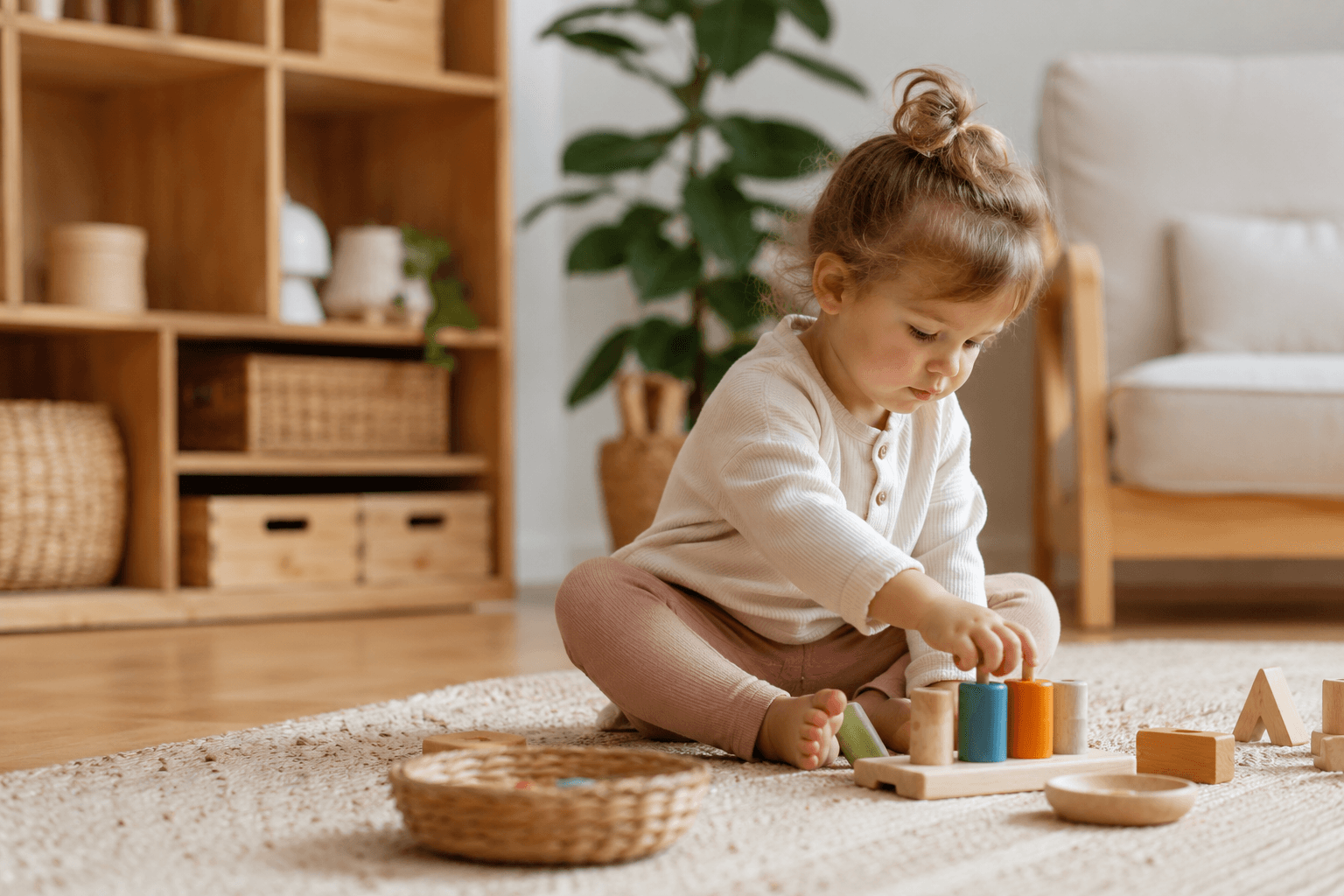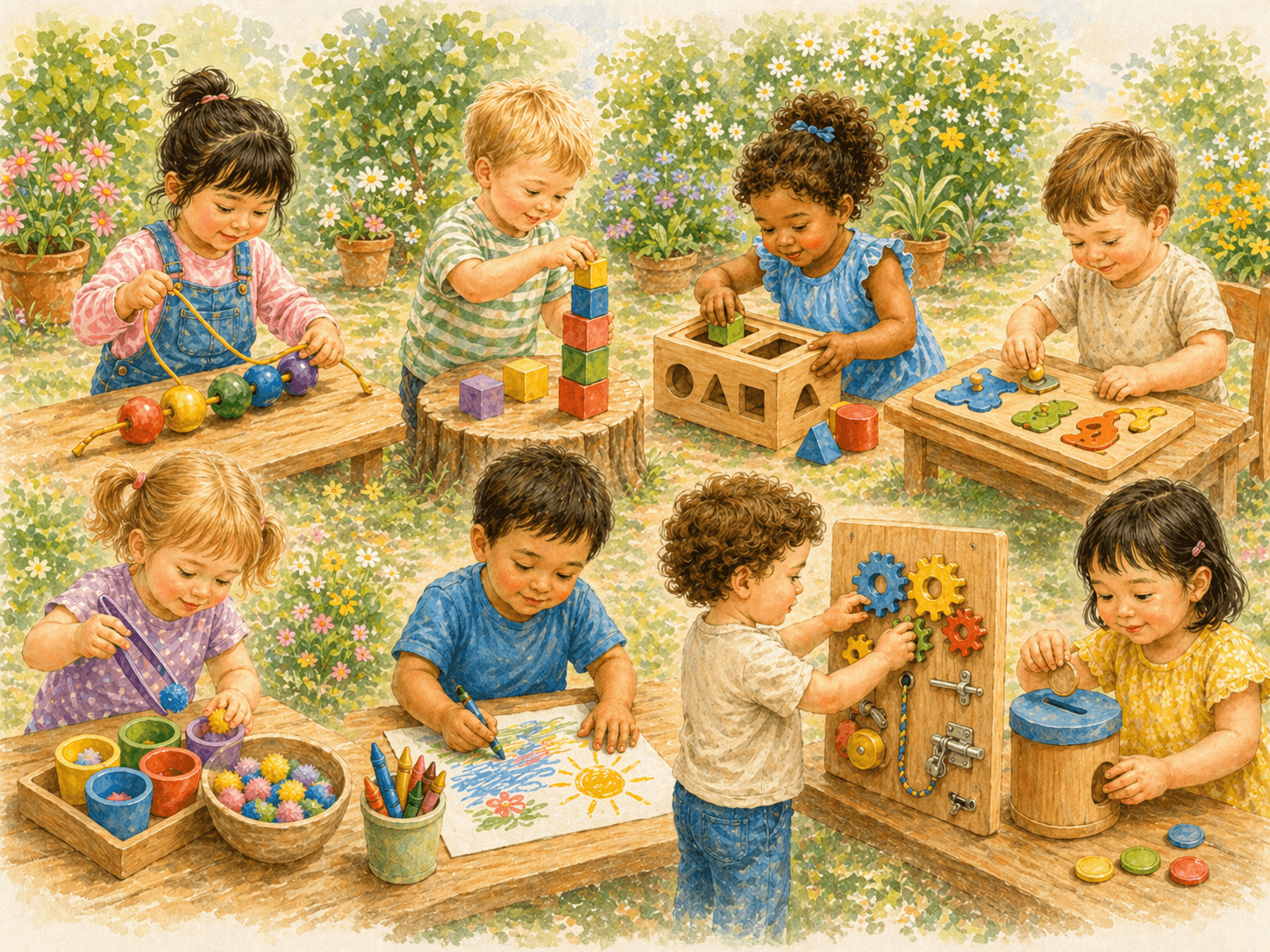
Fine motor skills are some of the most important skills young children build in the early years.
They show up when a baby grasps a cloth, when a toddler transfers beans with a spoon, and when a preschooler peels a sticker, uses tongs, or starts drawing controlled lines.
These small hand movements may not look dramatic, but they matter a lot. Fine motor development supports everyday life: eating, dressing, drawing, turning pages, opening containers, and eventually writing.
The good news is that you do not need expensive toys or complicated prep. The best fine motor activities are often simple, hands-on, and built right into daily life.
A Montessori-aligned approach works especially well here because it focuses on real materials, child-sized tools, repetition, and independence instead of busy, overstimulating activities.
This guide covers:
- what fine motor skills are
- fine motor vs gross motor
- why fine motor skills matter
- how Montessori supports fine motor development
- 35 easy fine motor activities for babies, toddlers, and preschoolers
- fine motor activities using everyday items
- a simple Montessori fine motor shelf setup
- common mistakes parents make
- when it is worth paying closer attention
Table of Contents
- What are fine motor skills?
- Fine motor vs gross motor: what is the difference?
- Why fine motor skills matter
- How Montessori supports fine motor development
- Fine motor activities for babies
- Fine motor activities for toddlers
- Fine motor activities for preschoolers
- Fine motor activities using everyday items
- A simple Montessori fine motor shelf setup
- Common fine motor mistakes parents make
- When to pay closer attention to fine motor skills
- FAQ
- Related reading
- Final thoughts on fine motor skills
What are fine motor skills?
Fine motor skills are the small movements children make with their hands, fingers, and wrists.
These skills help children:
- grasp
- hold
- squeeze
- pinch
- transfer
- stack
- turn
- open
- close
- draw
- button
- zip
- use utensils
- manipulate tools
Fine motor skills are built gradually. Babies start by reaching and grasping. Toddlers begin transferring, stacking, turning, and releasing objects more intentionally. Preschoolers refine control through practical life work, art, puzzles, tools, and early pre-writing experiences.
Fine motor vs gross motor: what is the difference?
Parents often search for fine motor vs gross motor because both matter, but they are different.
Here is the simplest way to think about it:
- Fine motor skills use small hand and finger movements. Examples: picking up a raisin, turning a page, drawing, buttoning, using a spoon.
- Gross motor skills use the large muscles of the body. Examples: crawling, walking, running, climbing, jumping, balancing.
Both develop together, but in different ways. A child who moves their whole body well often has a stronger foundation for seated work later. That is why Gross Motor Skills: 28 Easy Activities by Age is a natural companion article to this one.
Why fine motor skills matter
Fine motor skills affect many parts of daily life.
They support:
- self-feeding
- dressing
- brushing teeth
- opening containers
- turning book pages
- using crayons and pencils
- art and craft work
- practical life skills
- independence at home
- school readiness
For young children, fine motor activities are not just "learning tasks." They are life skills.
A child who can peel a banana, place a puzzle piece, pour water carefully, or zip a jacket feels more capable. That sense of capability matters just as much as the hand strength itself.
How Montessori supports fine motor development
Montessori supports fine motor development in a very natural way.
Instead of separating hand skills into artificial drills, Montessori builds them through purposeful work:
- spooning
- pouring
- opening and closing containers
- transferring objects
- using child-sized tongs
- folding cloths
- washing tables
- cutting with real scissors
- peeling fruit
- buttoning, zipping, snapping, and dressing work
That is one reason Montessori Practical Life Activities fits so well with fine motor development. Practical life work strengthens the hands while also building independence and concentration.
Montessori also tends to work better for many children because it uses:
- real objects
- simple setups
- repetition
- limited choices
- child-sized tools
- calm, uncluttered presentations
If you want a broader picture of the philosophy behind this approach, What Is Montessori? is a strong place to start.
Fine motor activities for babies
With babies, fine motor work should be simple, safe, and based on reaching, grasping, transferring, and exploring texture.
1. Grasping cloths
Offer a soft cloth, washcloth, or small fabric square for your baby to reach for and grasp.
2. Textured ring or rattle
Choose one easy-to-hold rattle or ring and let your baby practice holding and moving it.
3. Scarf pull
Place a lightweight scarf partly inside a basket or tissue box so your baby can pull it out.
4. Crinkle paper exploration
A safe crinkly material can help babies practice grasping, releasing, and listening.
5. Basket of large safe objects
Offer a few large safe objects with different shapes and textures:
- wooden spoon
- silicone spatula
- textured ball
- soft brush
6. Two-object transfer
When your baby is ready, offer two larger objects so they can practice holding one in each hand and beginning to transfer.
7. Page turning with board books
Board books are wonderful early fine motor practice.
8. Large knob puzzle introduction
For older babies who are sitting steadily and supervised closely, a simple large-knob puzzle can be a lovely start.
9. Finger food pickup
Picking up soft finger foods is one of the most natural fine motor activities for babies.
If your child is moving toward toddlerhood, Montessori Activities for 1 Year Olds (12-24 Months) is a strong next read. For toy ideas that support this stage without overcrowding your shelf, Montessori Toys for 1 Year Olds can help.
The Montessori Parent Guide app helps you find simple, practical activities based on your child's age, your time, and your energy level. It is useful on the days when you want one realistic idea without planning a full setup.
Fine motor activities for toddlers
Toddlers are in a great stage for fine motor growth because they love repetition, real tools, and visible progress.
10. Pom-pom transfer
Use fingers, a spoon, or child-safe tongs to transfer pom-poms from one bowl to another. Supervise closely and skip small items if your toddler still mouths objects.
11. Dry spooning work
Spoon rice, oats, or beans from one bowl into another.
12. Sticker peeling
Peeling and placing stickers is excellent for finger strength and control.
13. Posting activity
Cut a slit in a lid and let your toddler post craft sticks, large coins, or cards.
14. Pipe cleaner and colander
Push pipe cleaners into the holes of a colander.
15. Opening and closing containers
Offer a few small jars, tins, or containers with different lids.
16. Clothespin clipping
Clipping clothespins onto a basket or the side of a box is great hand work.
17. Simple bead threading
Use large beads or pasta with a stiff string or shoelace.
18. Water dropper play
A dropper with colored water or plain water gives toddlers wonderful hand practice.
19. Peeling banana or orange
Practical life is fine motor work too.
20. Tape pull activity
Put small pieces of painter's tape on a tray, wall, or table for your toddler to peel.
21. Tearing paper
Tearing strips of paper helps hand strength and coordination.
22. Simple puzzle work
Chunky puzzles, peg puzzles, and matching boards are great toddler fine motor activities.
For this stage, Montessori Activities for 2 Year Olds (24-36 Months), Montessori Toy Rotation for Ages 1-3, and Montessori Toys for 2 Year Olds fit naturally.
Fine motor activities for preschoolers
Preschoolers are ready for more precision, more tool use, and more independence.
23. Tong transfer with small objects
Use tongs to move felt balls, cotton balls, or wooden pieces between bowls.
24. Cutting strips with scissors
Offer paper strips and child-safe scissors.
25. Hole punch activity
A single-hole punch is excellent for hand strength.
26. Salt tray lines and shapes
Tracing lines, zigzags, or shapes in salt builds early control without pressure.
27. Buttoning and zipping practice
Real dressing work is some of the best fine motor work.
28. Lacing cards
Preschoolers often enjoy lacing when the design is simple and not too crowded.
29. Tweezers sorting
Sort small objects by color or shape using tweezers.
30. Clay or dough with tools
Rolling, pinching, poking, cutting, and pressing dough develops strong hands.
31. Nut and bolt matching
Large nuts and bolts are excellent for turning and wrist control.
32. Paper weaving
Very simple paper weaving can work well for older preschoolers.
33. Transferring with chopsticks or tongs
For older preschoolers ready for more challenge, this is great controlled hand work.
34. Food prep with child-safe tools
Slicing banana, peeling eggs, spreading butter, shelling peas, or using a crinkle cutter all build fine motor strength.
35. Drawing on vertical surfaces
Drawing on an easel or paper taped to a wall strengthens hands and shoulders too.
For preschool-age children, Montessori Preschool Activities (Ages 3-5), Montessori Toys for 3 Year Olds, and What Is Montessori? are natural next clicks.
Fine motor activities using everyday items
You do not need a craft store haul to support fine motor skills.
Use what you already have:
- spoons
- bowls
- clothespins
- jars
- lids
- tape
- paper
- tongs
- droppers
- sponges
- buttons
- pasta
- muffin tins
- socks
- tweezers
- playdough
- old greeting cards
- measuring spoons
This is one reason Montessori works so well at home. Many strong activities come from ordinary life, not fancy equipment.
A simple Montessori fine motor shelf setup
If you want this article to be more actionable, here is an easy formula:
Choose 3 to 5 fine motor activities only and place them on a low shelf.
For example:
Toddler shelf
- spooning tray
- sticker basket
- posting work
- chunky puzzle
Preschool shelf
- tong transfer
- cutting tray
- lacing work
- practical life food prep
Keeping fewer options out at once helps children go deeper. This same principle is part of why Montessori Toy Rotation for Ages 1-3 works so well.
Common fine motor mistakes parents make
Offering activities that are too hard
If the task is frustrating, children often avoid it. Start easier than you think.
Focusing only on worksheets
Young children need real hand work more than paper tasks.
Overhelping
If you complete half the work for the child, they lose the chance to build the skill.
Offering too many materials
More materials often means less focus.
Ignoring practical life
Pouring, peeling, wiping, buttoning, and opening containers are some of the best fine motor activities you can offer.
Expecting long attention spans
A few focused minutes still count.
When to pay closer attention to fine motor skills
Children develop at different speeds, so one hard task does not automatically mean there is a problem.
But you may want to pay closer attention if your child consistently seems to struggle with everyday hand tasks compared with peers, avoids using their hands, or becomes unusually frustrated by age-expected activities.
You may notice challenges with:
- grasping utensils
- turning pages
- stacking
- using crayons
- opening containers
- dressing fasteners
- cutting
- hand strength or control
If you are concerned, it is worth bringing it up with your pediatrician or another qualified professional.
Many parents look for fine motor activities because they are thinking ahead to preschool or kindergarten. That makes sense, but the best preparation is not rushing into worksheets.
A stronger path is:
- real hand work
- practical life
- sensory play
- drawing
- cutting
- transferring
- building hand strength naturally
Children usually do better when they build the foundation first.
If you want a broader developmental view, What Is Montessori? is a helpful companion guide.
FAQ
What are fine motor skills?
Fine motor skills are the small movements children make with their hands, fingers, and wrists. These skills help with grasping, pinching, drawing, using utensils, dressing fasteners, and handling tools.
What are examples of fine motor activities?
Examples include spooning, sticker peeling, posting activities, bead threading, tong transfer, cutting strips with scissors, puzzles, playdough, and food prep with child-sized tools.
How does Montessori support fine motor development?
Montessori supports fine motor development through real, purposeful work such as pouring, transferring, folding, buttoning, peeling, washing, and using child-sized tools in calm, repeatable setups.
When should I pay closer attention to fine motor skills?
Pay closer attention if your child consistently struggles with everyday hand tasks, avoids using their hands, seems unusually frustrated by age-expected activities, or is not making steady progress over time. If you are concerned, bring it up with your pediatrician or another qualified professional.
Related reading
- Gross Motor Skills: 28 Easy Activities by Age
- Montessori Practical Life Activities
- Sensory Play Ideas for Babies, Toddlers, and Preschoolers
- Montessori Activities for 1 Year Olds (12-24 Months)
- Montessori Activities for 2 Year Olds (24-36 Months)
- Montessori Preschool Activities (Ages 3-5)
- What Is Montessori?
- Montessori Toy Rotation for Ages 1-3
Final thoughts on fine motor skills
The best fine motor activities are often the simplest ones.
A spoon and two bowls. A sticker sheet. A pair of tongs. A child-sized knife. A zipper. A puzzle. A little time to repeat.
That is enough.
For babies, fine motor development starts with reaching, grasping, and holding. For toddlers, it grows through transferring, posting, peeling, and opening. For preschoolers, it deepens through cutting, tong work, dressing, drawing, and practical life.
That is what makes Montessori-aligned fine motor work so powerful: it builds real skills through real activity.