Montessori can feel confusing online: half philosophy, half aesthetic, and a lot of "perfect shelf" pressure. Real Montessori is simpler. It is an approach to development that helps children build independence, concentration, and confidence through a carefully prepared environment and respectful adult guidance.
If you only remember one sentence, make it this:
Montessori = "Help me do it myself."
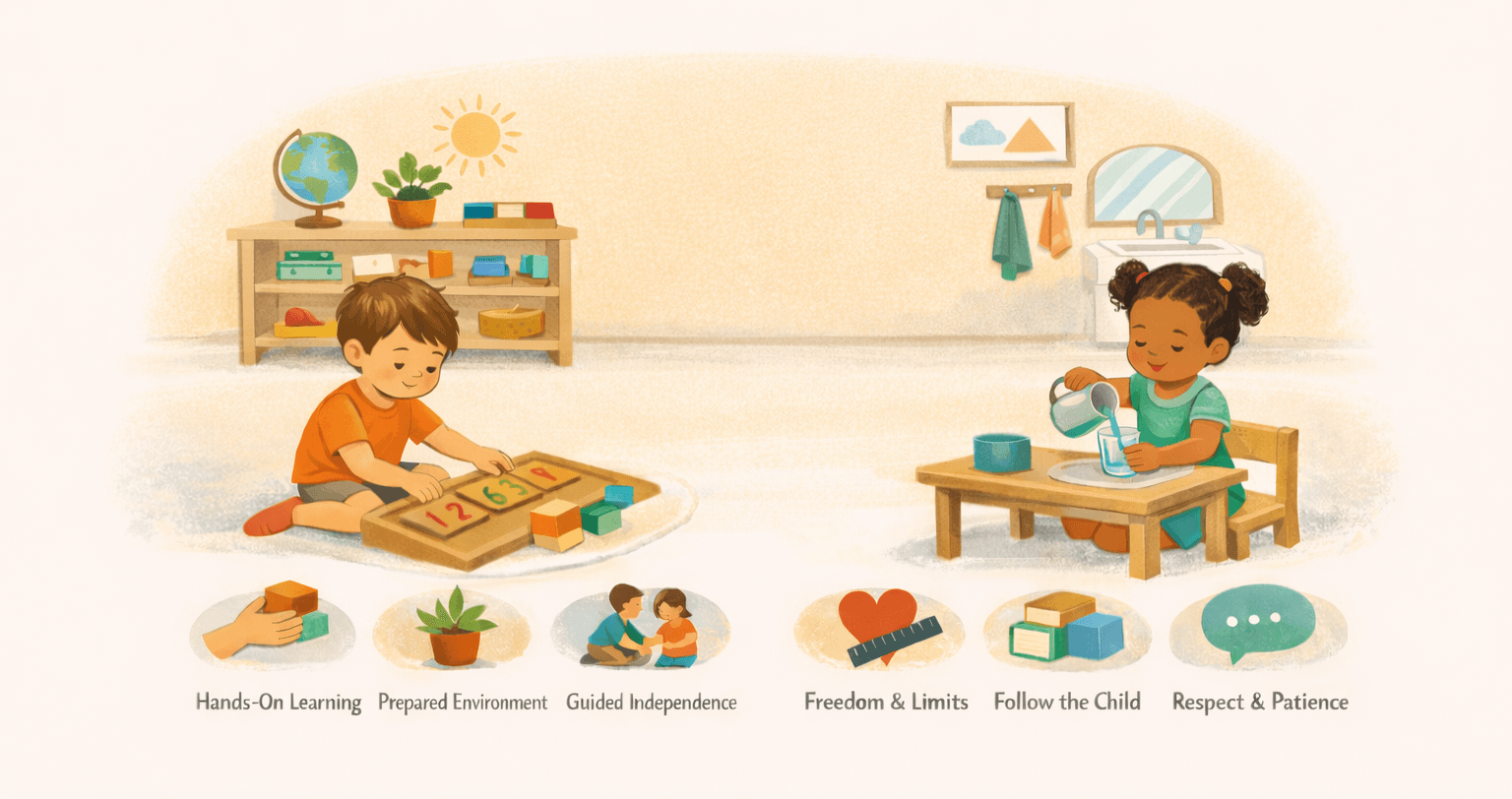
Table of contents
- Montessori in one minute
- The 5 core Montessori ideas
- Montessori for ages 0-3
- Montessori for ages 3-6
- Why parents choose Montessori
- What Montessori is not
- How to start Montessori at home this weekend
- Best next reads on Montessori Parent Guide
- FAQ
Montessori in one minute
Montessori is a child-centered approach developed by Dr. Maria Montessori, built on the idea that children learn best through hands-on exploration, freedom within limits, and an environment designed for independence. Adults observe, prepare, and guide rather than entertain, control, or constantly correct.
The 5 core Montessori ideas
-
Ages 0-6 matter because children absorb everything. Montessori described ages 0-6 as a unique developmental period (the "absorbent mind") when children take in language, culture, habits, and skills rapidly, often just by living in the environment.
-
The prepared environment does a lot of the "teaching." A Montessori environment is organized, accessible, and sized for the child so they can act independently (choose work, complete it, put it away). The environment is not decoration; it is a tool for learning.
At home, that often looks like:
- A low shelf with a few choices (not 30)
- Child-accessible self-care (stool, hooks, small towel)
- Simple, real tools (when safe)
- A clear place for everything
-
Freedom within limits (not "anything goes"). Montessori is not permissive. Children get freedom within boundaries: respect people, respect materials, respect the space. Limits are calm and consistent, not punitive.
-
Practical life is not chores, it is development. Practical life activities (self-care, care of environment, grace and courtesy, food prep) build coordination, independence, concentration, and self-control. Children repeat these tasks because repetition is how the brain wires skill.
-
The adult's role is observer + guide (not performer). A Montessori adult:
- Observes what the child is ready for
- Demonstrates slowly (then steps back)
- Reduces clutter and choices
- Protects concentration
The 5 Montessori curriculum areas
Montessori education organizes learning into five areas. At home, you will mostly use the first two:
- Practical Life: Everyday tasks like pouring, sweeping, dressing, and food preparation — see our practical life activities guide
- Sensorial: Activities that refine the five senses (sorting, grading, matching)
- Language: Vocabulary building, sound games, pre-reading, and storytelling
- Mathematics: Concrete materials leading to abstract number concepts
- Cultural Studies: Geography, science, art, and music
Montessori for ages 0-3
In Montessori terms, this stage is about movement, language, order, and independence foundations.
What to focus on at home (0-3)
- Movement: safe climbing, carrying, pushing and pulling (not constant "sit still" expectations)
- Language: real naming, slow speech, songs, books, simple conversations
- Independence: dressing participation, washing hands, putting items away
- Order: predictable routines, fewer choices, consistent places for things
A realistic Montessori home for 0-3
You do not need a perfect shelf. You need:
- A few simple works available
- Child-safe access to basics (water, towel, stool)
- A rhythm that repeats daily
If you want age-specific activity ideas, start here:
- Montessori Activities for 1 Year Olds (12-24 Months): 20 Simple, Practical Ideas
- Montessori Activities for 2 Year Olds (24-36 Months): 25 Purposeful Activities
Montessori for ages 3-6
This is the classic "Montessori preschool" stage. Children refine movement, expand language, develop early math thinking, and build social skills through structured, hands-on work cycles and longer concentration.
What Montessori looks like at 3-6 (at home)
- Work cycles: choose, do, reset (start and finish matter)
- Language: sound games, vocabulary classification, storytelling
- Early math: quantity, number symbols, patterns, sequencing
- Sensorial: sorting, grading, comparing, refining perception
- Grace and courtesy: turn-taking, polite phrases, calm problem solving
A great next step:
Why parents choose Montessori
"Montessori gave my daughter confidence. At 3, she's able to do so much independently — from preparing her own snacks to cleaning up spills. It's amazing to watch!"
What parents notice over time:
- More peaceful home environment and fewer power struggles
- Children who can entertain themselves and stay focused
- Real independence in daily routines (dressing, eating, cleaning up)
- Stronger problem-solving and a willingness to try before asking for help
- A genuine sense of pride and confidence in your child
What Montessori is not
These misconceptions block parents from using Montessori in real life. Montessori is not:
- A shopping list. You do not need every material to do Montessori at home.
- Aesthetic perfection. Beige shelves are optional; accessibility and order are not.
- "No rules." Montessori includes limits and boundaries delivered calmly.
- Force independence. We offer independence; we do not demand it on our timeline.
- Only for "calm kids." Montessori supports concentration by design (less clutter, fewer choices, repeatable work).
How to start Montessori at home this weekend
If you want traction fast, do this in 60-90 minutes:
- Choose one area: bathroom, bedroom, or play space
- Remove half the clutter (store it; do not throw it away)
- Create one low shelf or one reachable basket
- Put out 6-8 choices max (toddlers) or 8-12 (preschool)
- Make self-care accessible: stool + towel hook + simple supplies
- Pick one daily routine to "Montessori-ify" (morning, meals, bedtime)
- Teach one cleanup habit: "Everything has a home"
- Demonstrate one activity slowly, then step back
- Rotate weekly: remove what is ignored, keep what is repeated
- Do not grade yourself by outcomes; watch engagement and independence
Toy rotation helps massively:
Best next reads on Montessori Parent Guide
Room setup and environment
- Montessori Bedroom Setup: Floor Bed, Bookshelf, Storage & Room Guide
- Montessori Floor Bed: Age, Safety, and Setup
- Montessori Wardrobe Setup
Activities by age
- Montessori Activities for 1 Year Olds (12-24 Months): 20 Simple, Practical Ideas
- Montessori Activities for 2 Year Olds (24-36 Months): 25 Purposeful Activities
- Montessori Preschool Activities (Ages 3-5): 30 Classroom-Style Works You Can Do at Home
Toys by age
- Montessori Toys for 1 Year Old: Guide, Budget & Picks
- Montessori Toys for 2 Year Olds: Guide, Budget & Picks
- Montessori Toys for 3 Year Olds: Guide, Budget & Picks
Practical life and DIY
- 40 Montessori Practical Life Activities You Can Start at Home Today
- 10 DIY Montessori Materials You Can Make for Under $20
Books worth reading
- The Absorbent Mind by Maria Montessori — the foundational text on how young children learn
- The Montessori Toddler by Simone Davies — the most practical modern guide for parents of 1-3 year olds
FAQ
What age is Montessori for?
Montessori is designed across childhood, but ages 0-6 are a foundational period often emphasized because of rapid learning in the absorbent mind stage.
Can I do Montessori at home without Montessori materials?
Yes. Start with prepared-environment basics (access, order, child-sized tools) and simple practical life routines. The environment matters more than buying Montessori products.
Is Montessori just letting kids do whatever they want?
No. Montessori is freedom within limits: clear boundaries delivered calmly and consistently, with respect for people, materials, and the environment.
What is the simplest Montessori change I can make today?
Reduce choices and set up one independent routine: a reachable towel hook, a stool at the sink, or a small snack station (if appropriate). Small access changes create big independence.