Montessori language work for ages 1-5 helps children build vocabulary, sound awareness, and pre-reading readiness through real objects, calm repetition, and short purposeful activities.
If you are searching for Montessori language activities or Montessori language materials, you are probably trying to answer one question: what should I do at home to support speech, vocabulary, and early reading without pressure?
In Montessori, language usually follows this progression:
- Real words with real objects (vocabulary)
- Sound awareness (phonological skills)
- Pre-reading foundations (without forcing early reading)
- A natural path into writing and reading when the child is ready
This guide gives you age-based ideas and a practical language shelf setup you can maintain.
Table of Contents
- Quick Montessori Language Principles
- Montessori Language Materials at Home
- Montessori Language Activities by Age
- 15 Montessori Language Activities for Ages 1 to 5
- How to Set Up a Montessori Language Shelf
- Common Mistakes and Easy Fixes
- FAQ
- Related Reading
- Simple Next Step
Quick Montessori Language Principles
Montessori language development is strongest when:
- The child handles real objects and hears accurate language
- Activities have a full work cycle: start -> do -> finish -> reset
- Adults use rich, calm speech instead of constant quizzing
- The child gets repeated exposure (the same basket for a week can be ideal)
Montessori Language Materials at Home
You do not need a classroom setup. Start with:
- 6-12 small, safe, recognizable objects
- A few baskets or trays
- Simple picture cards (printed photos work well)
- A small mat or defined work area
- Optional for preschoolers: letter tiles, tactile letters, and a few sound objects
Language shelf guideline: offer 4-8 language works at a time depending on age, then rotate weekly.
Montessori Language Activities by Age
Ages 1-2: vocabulary and matching
Goal: naming, comprehension, and simple categories.
Ages 2-3: vocabulary and sound noticing
Goal: sorting, describing, and early sound awareness.
Ages 3-5: sound games to pre-reading
Goal: phonemic awareness, letter-sound connection, and early word building when ready.
Not sure which language activity to start with for your child's age? The Montessori Parent Guide app gives you age-based activity ideas and simple next steps you can actually use at home.
15 Montessori Language Activities for Ages 1 to 5
Object baskets (ages 1-3)
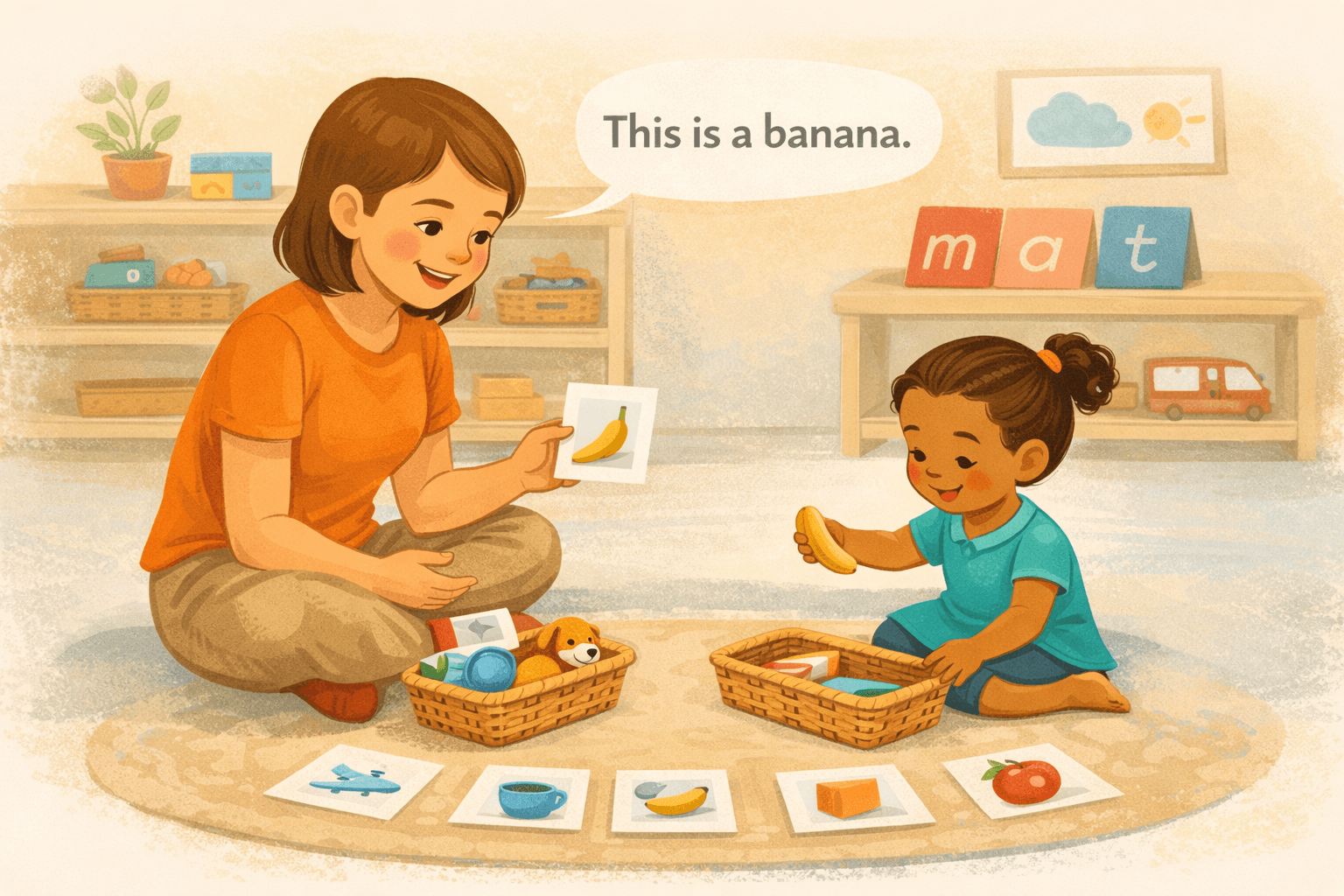
Object baskets are one of the highest-value Montessori language activities for toddlers. They feel like play, but they build strong vocabulary.
1. Breakfast object basket
- Age: 12 months+
- Materials: spoon, cup, napkin, small bowl, banana (real or toy)
- How to present:
- Take out one object at a time.
- Name it slowly: "Spoon."
- Place it in front of the child.
- Repeat for 4-6 objects.
- Extension: "Can you give me the spoon?"
2. Bath time object basket
- Age: 12-24 months
- Materials: washcloth, small soap bottle, towel, unused toothbrush
- How to present: name -> explore -> "Show me the towel."
3. Things-that-go basket
- Age: 18 months+
- Materials: small car, bus, train, airplane
- How to present: name each object and emphasize verbs such as "go," "stop," "fast," and "slow."
4. Nature basket (indoor version)
- Age: 18 months+
- Materials: pinecone, leaf, smooth stone, flower
- How to present: add descriptive words like "smooth," "rough," "soft," and "spiky."
5. Clothing basket
- Age: 18 months+
- Materials: sock, hat, mitten, scarf
- How to present: combine naming with action: "hat on," "sock on."
Tip: keep each basket to 6-8 objects. Too many items can overwhelm attention.
Picture-to-object matching (18 months-3 years)
This work helps children understand that pictures represent real things.
6. Real object to photo match
- Age: 18-36 months
- Materials: 3-6 real objects and matching printed photos
- How to present:
- Place one object on the mat.
- Offer two photos.
- Match the photo to the object.
- Increase pairs gradually.
7. Find-and-match scavenger photo cards
- Age: 2-4 years
- Materials: photo cards of household items (spoon, towel, chair)
- How to present: child finds the real item and places it beside the matching card.
Classified vocabulary (ages 2.5-5)
Categories accelerate vocabulary growth.
8. Sort by category
- Age: 2.5-5 years
- Materials: real objects or photos
- Category ideas: fruit and vegetable, animals and vehicles, kitchen and bathroom
- How to present:
- Show simple category headers.
- Name each item.
- Place each item under the correct category.
- Control of error: category logic is clear and self-correcting.
9. What does not belong? (odd one out)
- Age: 3-5 years
- Materials: 4 cards (3 from one category, 1 odd)
- How to present: ask, "Which one is different?" then invite the child to explain why.
- Why it matters: explaining choices builds expressive language.
Montessori sound games (bridge to pre-reading)
Sound games help children notice sounds within words without pressure.
10. I Spy beginning sound game
- Age: about 2.5+
- Materials: 6-8 small objects (ball, brush, banana, sock, spoon)
- How to present:
- Place objects in a basket.
- Say: "I spy something that starts with /b/."
- Child finds the object.
- Important: use the sound ("/b/") instead of the letter name ("bee").
11. Two-sound sorting baskets
- Age: 3-5 years
- Materials: two baskets labeled with pictures (or letters later)
- Example: /m/ basket and /s/ basket
- How to present:
- Name an object slowly.
- Emphasize the first sound.
- Sort into the correct basket.
12. Rhyming match (optional)
- Age: 3-5 years
- Materials: picture pairs like cat/hat, sun/fun, boat/goat
- How to present: match rhymes and say the pairs.
- Note: rhyming is helpful, but broader sound awareness matters most.
13. Syllable clapping
- Age: 2.5-5 years
- Materials: none
- How to present: clap syllables in words and names, for example: "Mon-tes-so-ri" and "ba-na-na."
Montessori pre-reading activities (ages 3-5)
Pre-reading in Montessori means building the parts that make reading easier later.
14. Sound-to-letter introduction
- Age: 3-5 years
- Materials: letter cards or tactile letters
- How to present:
- Choose 2-3 letters maximum.
- Trace each letter and say its sound.
- Find objects that start with each sound.
- Stop while interest is still high.
15. Build simple words with letter tiles
- Age: often 4-5 years (readiness varies)
- Materials: letter tiles and picture cards (cat, sun, map)
- How to present:
- Place one picture card.
- Say sounds slowly: /c/ /a/ /t/.
- Child selects tiles to build the word.
- Control of error: the picture acts as a built-in check.
How to Set Up a Montessori Language Shelf
A practical shelf can look like this:
For ages 1-2 (4-6 works)
- 2 object baskets
- 1 picture-to-object matching set (3 pairs)
- 1 category sort (2 categories)
- 1 song or story basket (book plus 2 props)
Pair language activities with age-appropriate Montessori toys for 1 year olds on the same shelf.
For ages 2-3 (5-7 works)
- 1 object basket
- 1 scavenger photo card set
- 1 classified vocabulary sort
- 1 I Spy beginning sound basket
- 1 syllable clapping game (no materials)
For shelf setup and rotation tips, see the toy rotation guide for ages 1-3. Language works rotate well alongside Montessori toys for 2 year olds.
For ages 3-5 (6-8 works)
- 1 classified vocabulary set
- 1 odd-one-out set
- 1 I Spy sound basket
- 1 two-sound sorting set
- 1 sound-to-letter tray (2-3 sounds)
- 1 optional word-building tray
At this age, language works can share shelf space with Montessori toys for 3 year olds.
Common Mistakes and Easy Fixes
Mistake: turning everything into a quiz
Instead of repeated "What is this?", model richer language:
"This is a whisk. You can whisk eggs."
Mistake: offering too many items
Keep baskets small (6-8 objects) and rotate weekly.
Mistake: skipping real objects
Real objects usually create stronger memory than pictures alone, especially for toddlers.
Mistake: pushing letters too early
If your child is not interested yet, continue building vocabulary and sound awareness first.
FAQ
What are Montessori language materials?
At home, Montessori language materials are usually object baskets, matching cards, classified vocabulary sets, and sound game objects. In classrooms, tactile letters and movable alphabets are often introduced later for preschoolers.
When should I start Montessori language activities?
From infancy. Start with rich spoken language and simple object naming. Sound games are often enjoyable closer to age 2.5-3+, depending on readiness.
How long should language activities last?
- Toddlers: 2-10 minutes
- Preschoolers: 10-20 minutes
Stop while the activity is still enjoyable.
Related Reading
If you want age-based activity plans, start here:
- Montessori Activities for 1 Year Olds (12-24 Months): 20 Simple, Practical Ideas
- Montessori Activities for 2 Year Olds (24-36 Months): 25 Purposeful Activities
- Montessori Preschool Activities (Ages 3-5): 30 Classroom-Style Works You Can Do at Home
- Montessori Toy Rotation at Home: Ages 1-3 (Step-by-Step)
Simple Next Step
If you want to start today:
- Choose one object basket with 6 items
- Present it for 3 minutes a day for one week
- Add one matching activity the following week
Consistency beats complexity, especially for language development.