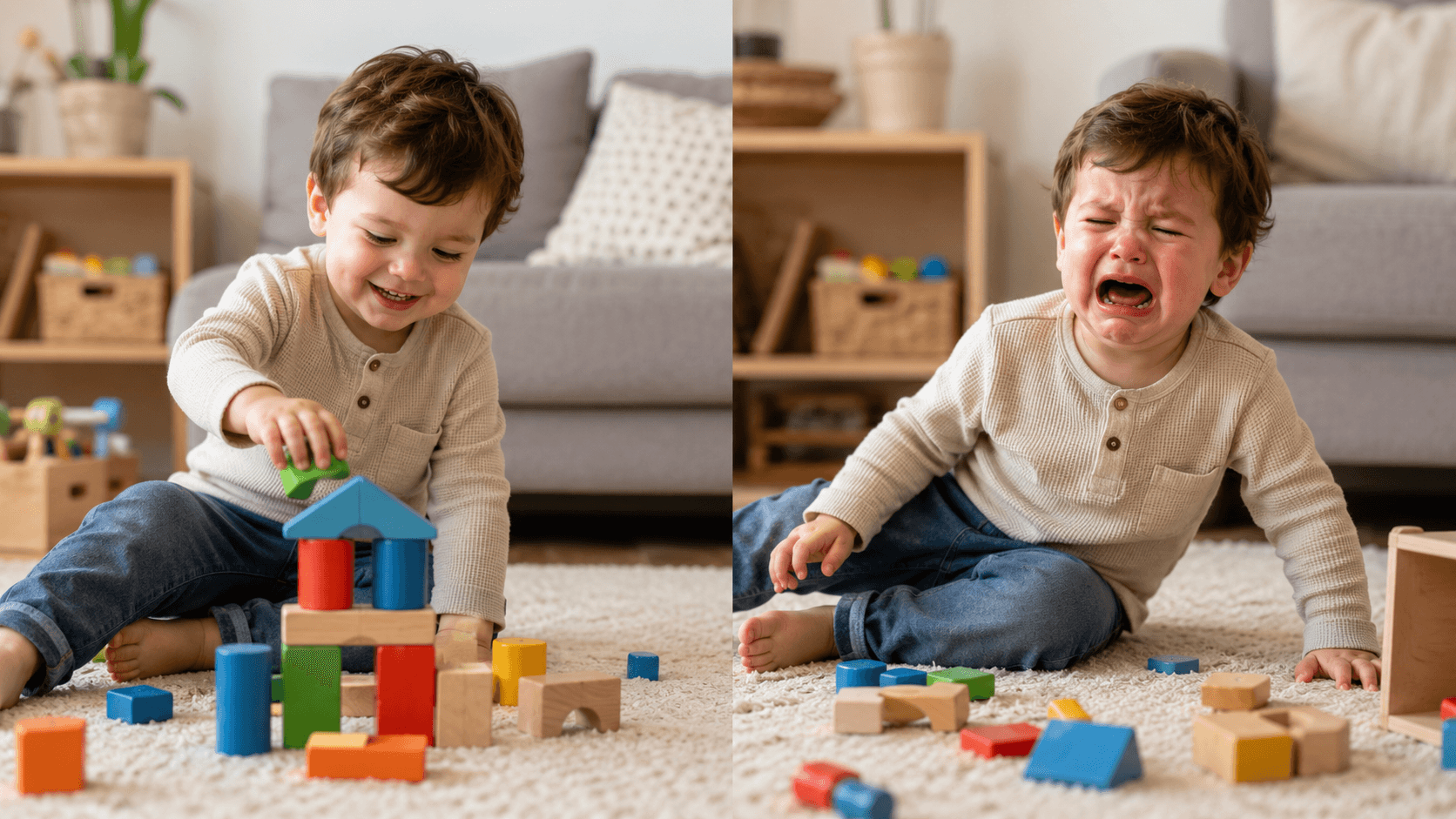
A toddler tantrum can start fast and feel enormous.
One minute your child is asking for a snack. The next, they are on the floor screaming because you peeled the banana the wrong way.
It is exhausting. It is embarrassing in public. And it can make even calm parents feel completely overwhelmed.
The part many parents need to hear is this: a toddler tantrum is usually not bad behavior in the way adults imagine it. More often, it is a child reaching the edge of what they can handle.
Toddlers have strong feelings, very little impulse control, and limited language for explaining what is wrong. Add hunger, tiredness, transitions, frustration, noise, or too many limits, and the whole thing can spill over fast.
The goal is not to stop every tantrum forever. The goal is to understand what is underneath it, respond calmly, and make daily life easier over time.
This guide covers:
- what a toddler tantrum really is
- the most common triggers
- what to do in the moment
- how Montessori can reduce daily friction
- when to get extra help
What Is A Toddler Tantrum, Really?
A toddler tantrum is often a stress response.
Your child may be feeling:
- overwhelmed
- frustrated
- rushed
- tired
- hungry
- overstimulated
- powerless
- unable to do something they want to do alone
From a Montessori perspective, tantrums often grow when a child's need for order, movement, choice, or independence is blocked again and again.
That does not mean every tantrum is preventable. It means some tantrums are a message: this is too much for me right now.
The Most Common Toddler Tantrum Triggers
Many tantrums look random, but patterns usually show up.
Common triggers include:
- being told "no" repeatedly
- having to stop an activity suddenly
- not being able to do something independently
- too much noise, clutter, or stimulation
- being hungry or tired
- being rushed through routines
- having too many choices
- not knowing what comes next
When you start spotting the trigger, you can often reduce the tantrum before it begins.
What To Do In The Moment
When a toddler tantrum is happening, think: calm body, few words, clear boundary.
1. Get calm before you get clever
You do not need the perfect script. You need a steady presence.
Take one breath. Lower your voice. Slow your movements.
That alone changes the moment.
2. Say less
A child in full meltdown cannot process a lecture.
Try short phrases like:
- "You're upset."
- "I'm here."
- "I won't let you hit."
- "You wanted more time."
- "It's hard to stop."
Simple words help more than big explanations.
3. Keep the boundary
Calm does not mean permissive.
If the answer is still no, it can stay no.
You might say:
- "You're mad. We are still leaving."
- "I hear you. I won't let you throw that."
- "You wanted the other cup. This is the cup we're using."
A calm limit feels safer than an angry one.
4. Focus on safety first
If your child is hitting, biting, kicking, throwing, or near danger, move them gently to a safer space.
Stay close. Some toddlers want a hug. Some want space with you nearby.
Follow their nervous system, not your pride.
5. Teach later
In the middle of a tantrum, your child is not ready for a lesson on gratitude, respect, or listening.
First: regulate. Later: teach.
That order matters.
The Montessori Parent Guide app gives you practical support for tantrums, routines, and daily parenting struggles with age-based guidance, calm scripts, and realistic Montessori ideas you can actually use at home.
What Not To Do
Some responses make a toddler tantrum bigger.
Try not to:
- yell over your child
- shame them
- threaten abandonment
- lecture during the meltdown
- bargain with treats every time
- change your limit just because the tantrum got louder
You do not need to be cold.
You do not need to be harsh.
You do need to be steady.
What About A Public Toddler Tantrum?
A public toddler tantrum feels harder because you are being watched, but the approach stays the same: calm body, few words, clear boundary.
You do not owe anyone an explanation while your child is melting down in the store or the parking lot.
What helps:
- Get low. Crouch near your child rather than standing over them.
- Use the same short phrases you would at home: "You're upset. I'm here."
- If it is not safe, carry your child calmly to the car or a quieter spot.
- Skip the apology tour. Other parents have been there.
The biggest shift is letting go of what strangers might think. Your child needs the same steady presence whether you are at home or in the grocery aisle. If you stay calm, the tantrum usually passes faster, and your child learns that your boundaries hold everywhere.
How Montessori Can Help Reduce Tantrums
Montessori does not eliminate hard feelings. Toddlers still get upset.
But it does remove a lot of unnecessary friction.
More independence
When children can do more for themselves, they feel less constant frustration.
Think:
- low hooks
- easy-to-reach cups and plates
- simple clothing choices
- a step stool for handwashing
- snack access with support
- enough time to try before adults jump in
If your home still creates lots of "wait, stop, not that" moments, start with a more prepared environment.
More order
Toddlers feel calmer when the day has rhythm and the environment makes sense.
A simple routine helps them know what to expect.
Fewer unnecessary no's
If the home is prepared for the child, you spend less of the day blocking, grabbing, and correcting.
That often leads to fewer power struggles.
More real choices
Children who get safe, limited choices often resist less.
Try:
- "Blue shirt or green shirt?"
- "Walk or be carried?"
- "Apple or yogurt?"
Choice supports dignity without giving up leadership.
How To Prevent More Toddler Tantrum Moments
You cannot prevent every tantrum. But you can make them less frequent.
Watch the basics
Before assuming it is "behavior," check:
- sleep
- hunger
- movement
- overstimulation
- transition timing
A tired toddler and a rushed toddler often look the same.
Slow transitions down
Many tantrums happen when adults move too fast.
Try:
- "Two more minutes."
- "One last turn."
- "After this book, we leave."
Predictability helps.
Make independence easier
Ask yourself: what is my child always trying to do alone?
That is often where your next home change should be.
This is also where simple practical life activities, activities for 2 year olds, and a small toy rotation can help. When children have clear work, clear routines, and fewer overloaded shelves, the day usually gets smoother.
Reduce overload
Sometimes less is better:
- less clutter
- fewer toys out
- fewer rushed errands
- fewer words in hard moments
- fewer choices at once
A calmer environment often supports a calmer child.
After The Tantrum
When the storm passes, reconnect first.
You might say:
- "That was hard."
- "You were really upset."
- "Next time I'll help you sooner."
- "Next time we can stomp instead of hit."
Keep it short. Warm. Clear.
No long speech needed.
When Tantrums Happen All The Time
If a toddler tantrum is happening daily, look for the pattern before blaming the child.
Ask:
- What time does it happen most?
- What happened right before it?
- Is my child hungry, tired, or overstimulated?
- Am I rushing too much?
- Is my child asking for more independence than I am allowing?
- Does my child understand what comes next?
Very often, the answer is not stricter discipline.
It is better support.
When To Get Extra Help
Most tantrums are a normal part of toddlerhood.
But it is worth talking with your pediatrician or another trusted professional if:
- tantrums feel extreme or nonstop
- your child regularly hurts themselves or others
- you are concerned about communication or development
- nothing seems to improve over time
- you feel overwhelmed and unsupported
Parents deserve support too.
Montessori Parent Guide helps you with routines, independence, activities, and tough parenting moments based on your child's age and your real daily life, not an idealized version of parenting.
Final Thought
A toddler tantrum is not proof that your child is spoiled, manipulative, or headed in the wrong direction.
It is usually a sign that your child needs help with something they cannot yet manage alone.
Your calm matters.
Your boundaries matter.
Your routines matter.
Your home setup matters.
And the small things you change today really can make tomorrow easier.