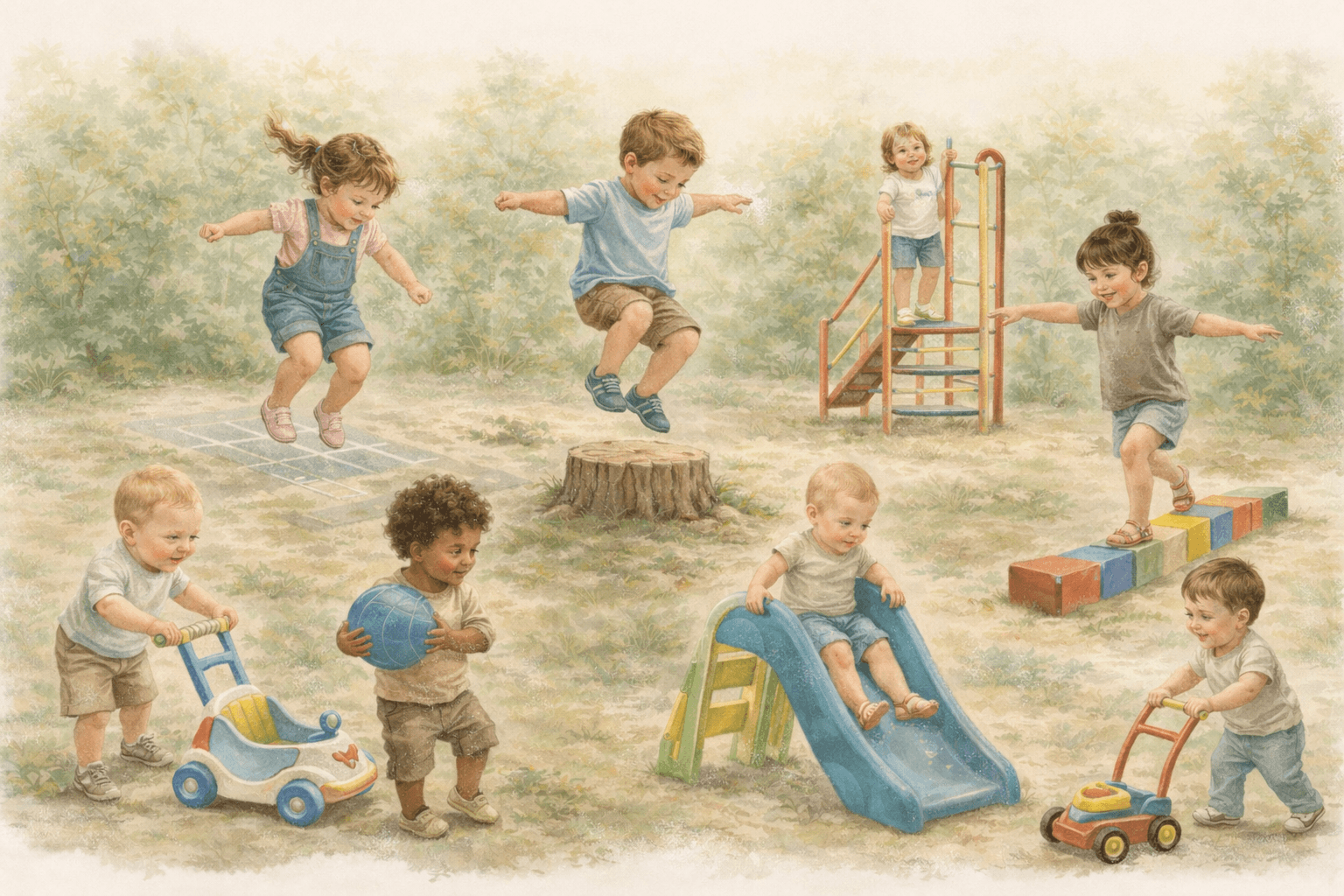
Gross motor skills are the big-body movements children use every day: rolling, crawling, walking, running, climbing, jumping, balancing, throwing, pushing, pulling, and carrying.
They may look simple, but these movements are doing important work.
When a baby reaches across a mat, a toddler climbs onto a cushion, or a preschooler balances on a curb, they are building strength, coordination, body awareness, confidence, and independence.
The good news is that supporting gross motor development does not require expensive equipment or a perfect playroom. Some of the best gross motor activities happen with a mat, a ball, a basket, a few cushions, or a little outdoor space.
A Montessori-aligned approach is especially useful here because it respects the child's natural need for movement while preparing the environment so movement is safe, purposeful, and increasingly independent.
This guide covers:
- what gross motor skills are
- how gross motor development supports everyday learning
- 28 simple gross motor activities for babies, toddlers, and preschoolers
- what milestones are useful for, and when concerns deserve follow-up
- which gross motor toys and materials are actually worth keeping around
Table of Contents
- What are gross motor skills?
- Fine motor vs gross motor: what is the difference?
- Why gross motor development matters
- How Montessori supports gross motor skills
- Gross motor milestones: what parents should know
- Gross motor activities for babies
- Gross motor activities for toddlers
- Gross motor activities for preschoolers
- Indoor gross motor activities
- Outdoor gross motor play ideas
- Gross motor toys and materials that are actually useful
- When to ask about a gross motor delay
- Common mistakes parents make with gross motor activities
- FAQ
- Related reading
What are gross motor skills?
Gross motor skills are movements that use the large muscles of the body, especially the arms, legs, shoulders, and core.
Examples of gross motor skills include:
- rolling
- sitting
- crawling
- standing
- walking
- running
- climbing
- jumping
- balancing
- kicking
- throwing
- pushing
- pulling
- carrying
For young children, gross motor movement is not just about "getting energy out." It is part of how they learn. Babies learn through reaching, rolling, and crawling. Toddlers learn through climbing, carrying, and pushing. Preschoolers learn through running, balancing, jumping, and purposeful physical work.
Fine motor vs gross motor: what is the difference?
Parents often search for fine motor vs gross motor because the terms sound similar.
Here is the simplest way to think about it:
- Gross motor skills use the big muscles of the body. Examples: crawling, walking, jumping, climbing, kicking, throwing.
- Fine motor skills use smaller muscles, especially in the hands and fingers. Examples: picking up small objects, drawing, buttoning, using utensils, cutting with scissors.
Both matter. But gross motor skills often support fine motor skills later because children need posture, core strength, shoulder stability, and balance before many hand skills become easier and more controlled.
That is one reason movement belongs in daily life, not only at the playground.
Why gross motor development matters
Gross motor development supports much more than physical strength.
It helps children build:
- balance
- coordination
- core strength
- posture
- confidence
- independence
- body awareness
- risk assessment
- concentration
- emotional regulation
A child who has not had enough movement may seem restless, impulsive, or unable to focus. That does not mean movement fixes every hard day. But for many babies, toddlers, and preschoolers, more purposeful movement supports calmer, more regulated days.
If you also want calming hands-on ideas that pair well with movement, Sensory Play Ideas for Babies, Toddlers, and Preschoolers is a strong next read.
How Montessori supports gross motor skills
Montessori does not treat movement as a distraction from learning. Movement is part of learning.
A Montessori-aligned home supports gross motor skills by offering:
- open floor space for babies
- safe opportunities to crawl, pull up, cruise, and climb
- child-sized furniture and tools
- real work like carrying, wiping, pushing, and watering
- outdoor movement whenever possible
- fewer unnecessary restrictions
The goal is not to force children into stillness. The goal is to prepare an environment where movement is safe, purposeful, and connected to real life.
That is why Montessori Practical Life Activities are so valuable. Sweeping, carrying laundry, watering plants, wiping a table, and pushing a basket all support gross motor skills while also building independence.
If you are thinking about movement spaces at home, Montessori Bedroom Setup and the Montessori Floor Bed Guide both connect naturally to this topic because floor-level spaces often support safer movement and easier independence.
Gross motor milestones: what parents should know
Many parents search for gross motor milestones because they want to know whether their child is "on track."
Milestones can be helpful, but they should not become a source of panic. Children develop at different speeds, and one skill can appear earlier or later depending on the child.
A parent-friendly way to think about milestones is this:
- Babies gradually build control from head and trunk to rolling, sitting, crawling, standing, and walking.
- Toddlers build walking, climbing, squatting, pushing, pulling, throwing, and beginning jumping.
- Preschoolers refine balance, running, jumping, hopping, climbing, catching, kicking, and more coordinated movement.
What matters most is steady progress over time.
The CDC describes developmental milestones as skills children show in how they play, learn, speak, act, and move. Those milestone checklists are useful conversation tools, not diagnoses. If you are concerned, use them to organize what you are seeing and bring those concerns to your child's pediatrician.
Gross motor activities for babies
Baby gross motor play should be simple, safe, and based on natural movement.
Babies do not need complicated setups. They need space, time, and a few interesting objects that invite movement.
1. Tummy time with one interesting object
Place your baby on a firm mat with one object nearby.
Good options:
- soft ball
- baby-safe mirror
- wooden rattle
- textured cloth
- high-contrast card
One object is enough. Too much visual clutter can distract more than help.
2. Reaching just out of reach
Place a toy slightly to the side or just beyond your baby's reach.
This encourages:
- stretching
- shifting weight
- reaching
- early rolling
- core strength
Keep it gentle. The goal is invitation, not frustration.
3. Rolling practice
Place an object to one side and let your baby turn, reach, and roll toward it.
You can lie nearby and talk softly to encourage movement without taking over.
4. Open floor movement
A safe floor space is one of the best gross motor materials for babies.
It allows babies to:
- kick
- stretch
- roll
- pivot
- crawl
- pull up when ready
Try not to rely on seats, jumpers, or other containers for long periods when floor movement is possible.
5. Crawling tunnel
For crawling babies, create a simple tunnel using:
- a cardboard box
- a play tunnel
- a space between cushions
- a blanket over two stable chairs, with close supervision
Let your baby move through at their own pace.
6. Pull-up practice with stable furniture
When your baby starts pulling to stand, offer very stable furniture.
Good options may include:
- low couch
- heavy ottoman
- sturdy low shelf
- safe pull-up bar
Avoid anything that can tip.
7. Cruising along furniture
Place an interesting object along a couch or low shelf to encourage your baby to move sideways while holding on.
This supports balance, leg strength, and coordination.
8. Carrying a soft object
Older babies may enjoy carrying a lightweight cloth, soft ball, or small plush item.
It looks simple, but carrying builds coordination and body control.
For babies moving toward toddlerhood, Montessori Activities for 1 Year Olds (12-24 Months) is a natural next read.
The Montessori Parent Guide app helps you find simple, purposeful activities based on your child's age, your time, and your energy level. It is useful on the days when you want one realistic idea without planning a full setup.
Gross motor activities for toddlers
Toddlers need movement every day. They are building balance, strength, coordination, confidence, and independence all at once.
The best gross motor activities for toddlers are simple, repeatable, and safe enough for practice.
1. Cushion climbing
Place firm cushions or pillows on the floor.
Invite your toddler to:
- climb over
- crawl across
- step down
- walk around
- repeat again and again
Keep the setup low and stable.
2. Laundry basket push
Give your toddler an empty laundry basket to push across the floor.
Add a few soft items for gentle resistance.
This is Montessori-aligned because it feels like real work and supports whole-body coordination.
3. Carrying work
Invite your toddler to carry safe household items:
- napkins to the table
- socks to a drawer
- a towel to the bathroom
- a small basket of toys
- a light grocery item
Carrying builds strength, balance, and independence.
4. Animal walks
Try simple animal movements:
- bear crawl
- frog jumps
- bunny hops
- penguin walk
- crab walk
Keep it playful. Do not worry about perfect form.
5. Step over a line
Put painter's tape on the floor.
Invite your toddler to:
- walk along the line
- step over it
- jump over it
- place toys on it
- follow it from room to room
A simple line can become a full gross motor activity.
6. Ball rolling
Sit across from your toddler and roll a ball back and forth.
This supports coordination, visual tracking, turn-taking, and connection.
7. Throwing into a basket
Use rolled socks or soft balls.
Start close to a laundry basket, then move farther away if your child is ready.
8. Simple obstacle course
Create a low obstacle course:
- crawl under a chair
- step over a pillow
- walk around a basket
- carry a beanbag to a bowl
Too many steps can overwhelm toddlers, so keep it short.
9. Dance and freeze
Play music, dance, then pause and freeze.
This builds listening, coordination, impulse control, and body awareness.
10. Water carrying outside
Outside, give your toddler a small watering can, cup, or bucket.
Let them:
- carry water
- pour water
- water plants
- refill and repeat
This is sensory play, gross motor play, and practical life work in one.
If your child is in the older toddler stage, Montessori Activities for 2 Year Olds (24-36 Months) gives you more age-matched ideas.
Gross motor activities for preschoolers
Preschoolers are ready for more challenge, more coordination, and more purposeful movement.
They often enjoy activities with rules, imagination, and real responsibility.
1. Balance line
Use painter's tape, chalk, or a rope.
Invite your child to:
- walk forward
- walk backward
- walk heel-to-toe
- carry something while walking
- balance with arms out
This is simple, but it builds concentration and body control.
2. Jumping spots
Place paper circles, cushions, or tape marks on the floor.
Invite your preschooler to jump:
- from spot to spot
- with two feet
- forward and backward
- side to side
- on one foot if ready
3. Beanbag balance
Place a beanbag or small soft toy on your child's head, shoulder, or hand.
Ask them to walk carefully without dropping it.
4. Ball kicking target
Use a cardboard box, basket, or cone as a target.
Let your child kick a soft ball toward it.
This supports aim, leg coordination, and balance.
5. Follow-the-leader movement
Take turns leading movements:
- jump three times
- crawl under the table
- spin once
- stretch tall
- stomp slowly
- tiptoe to the door
This supports listening, sequencing, and coordination.
6. Practical life heavy work
Preschoolers often love real work that uses the whole body.
Try:
- sweeping
- raking leaves
- carrying towels
- washing a low window
- moving cushions
- pushing a child-sized cart
- watering plants
This is one of the most Montessori-aligned ways to support gross motor skills because the movement has a real purpose.
7. Outdoor climbing
Use safe playgrounds, logs, low hills, or climbing structures.
Climbing supports:
- grip strength
- planning
- confidence
- balance
- risk awareness
Stay close enough for safety, but try not to over-coach every move.
8. Scavenger hunt movement
Give movement-based prompts:
- run to something green
- step over a stick
- carry three leaves
- balance on a curb
- walk slowly to the bench
This blends observation, movement, and independence.
9. Yoga-style shapes
Try simple shapes:
- tree
- star
- mountain
- butterfly
- cat
- cow
Keep it playful, not perfect.
10. Hopscotch-style path
Use chalk outside or tape inside to make a short path of squares or spots.
Invite your child to:
- hop with two feet
- hop on one foot if ready
- jump to a color you call out
- move slowly, then quickly
This works well because it adds pattern, rhythm, and self-control to movement.
For more ideas at this stage, Montessori Preschool Activities (Ages 3-5) is a strong follow-up.
Indoor gross motor activities
Parents often need gross motor activities for rainy days, small apartments, or long afternoons.
Try:
- pillow path
- painter's tape balance line
- laundry basket push
- sock ball toss
- animal walks
- dance and freeze
- crawl under chairs
- step over cushions
- carry books from one basket to another
- wipe a low table or window
The key is to prepare the space.
Move breakable items, set one clear boundary, and keep the activity simple.
A small home can still support gross motor development.
Outdoor gross motor play ideas
Outdoor play gives children more room to use their whole bodies.
Try:
- walking on logs
- climbing small hills
- running between trees
- jumping over sticks
- digging
- carrying a bucket
- watering plants
- kicking a ball
- collecting leaves
- pulling a wagon
- balancing on a curb
- sweeping the patio
Outdoor gross motor play works beautifully because it combines movement, nature, sensory exploration, and practical life.
Gross motor toys and materials that are actually useful
You do not need many gross motor toys. In fact, fewer open-ended materials usually work better.
Useful options include:
- soft balls
- a tape line or simple balance beam
- stepping stones
- a play tunnel
- child-sized broom
- small watering can
- wagon or push cart
- firm floor cushions
- a Pikler-style climbing frame, if you have the safe space for it
- low stool or child-sized chair
Montessori-aligned materials are usually simple, durable, and useful for repeated practice.
If you are deciding what to keep available at home, Montessori Toy Rotation at Home: Ages 1-3 can help you keep movement options accessible without turning the room into chaos.
When to ask about a gross motor delay
Parents also search for gross motor delay, so it is helpful to address this carefully.
Children develop at different speeds, and one late skill does not always mean there is a problem. But if you are worried about your child's movement, balance, strength, coordination, or a loss of skills, it is worth talking with your pediatrician.
You may want to ask for guidance if your child:
- seems unusually floppy or stiff
- strongly favors one side of the body
- is not making steady progress over time
- loses a skill they previously had
- struggles with balance much more than peers
- avoids movement because it seems difficult or uncomfortable
- has delays in several areas, not just movement
This section is not a diagnosis checklist. It is a reminder not to ignore a concern that keeps coming up.
Common mistakes parents make with gross motor activities
Offering activities that are too advanced
If the activity is too hard, children may become frustrated or unsafe.
Start simple. Add challenge slowly.
Interrupting repetition too soon
If your child climbs the same cushion ten times, that is not wasted time. That is practice.
Repetition is how young children build control.
Overhelping
Stay close for safety, but allow your child to try.
Confidence grows when children feel their own body solving the problem.
Thinking movement has to be wild
Gross motor activities do not need to become chaos.
Movement can be calm, purposeful, and contained.
Forgetting daily life
You do not always need a planned activity.
Carrying groceries, watering plants, climbing stairs safely, sweeping, washing, and pushing a basket all support gross motor development.
FAQ
Common questions about gross motor skills
What are gross motor skills?
Gross motor skills are movements that use the large muscles of the body, especially the arms, legs, shoulders, and core. Examples include rolling, crawling, walking, climbing, jumping, balancing, throwing, and carrying.
What is the difference between fine motor and gross motor skills?
Gross motor skills use large muscle groups for movements like walking, climbing, and jumping. Fine motor skills use smaller muscles, especially in the hands and fingers, for tasks like buttoning, drawing, and using utensils.
How can I support gross motor development at home?
Keep it simple: provide safe floor space, offer time outdoors when possible, choose a few repeatable movement activities, and include real-life work like carrying, pushing, sweeping, and watering plants.
When should I ask about a gross motor delay?
Talk with your pediatrician if your child is losing skills, not making steady progress over time, strongly favors one side, seems unusually floppy or stiff, or movement consistently looks difficult or painful.
Related reading
- What Is Montessori?
- Montessori Floor Bed Guide
- Montessori Bedroom Setup
- Montessori Practical Life Activities
- Sensory Play Ideas for Babies, Toddlers, and Preschoolers
- Montessori Activities for 1 Year Olds (12-24 Months)
- Montessori Activities for 2 Year Olds (24-36 Months)
- Montessori Preschool Activities (Ages 3-5)
Final thoughts on gross motor skills
The best support for gross motor skills is not complicated.
Children need space, time, repetition, and safe chances to move.
For babies, that may look like tummy time, rolling, reaching, crawling, and pulling up. For toddlers, it may look like climbing cushions, carrying baskets, pushing laundry, throwing soft balls, and pouring water. For preschoolers, it may look like balancing, jumping, climbing, kicking, sweeping, and doing real household work.
Gross motor movement is not separate from learning. It is part of learning.
When children move, they build strength, coordination, confidence, independence, and trust in their own bodies.
That is why simple gross motor activities belong in everyday family life.