A Montessori toy shelf for 24–36 months thrives on clarity and purpose. Use these picks and setup tips to keep engagement high without overspending.
Key takeaways
- A limited shelf (6–8 activities) beats a room full of toys.
- Pick simple, self-correcting materials (clear purpose = control of error).
- Everyday household items make excellent Montessori toys for 2-year-olds.
- Rotate 2–3 items weekly based on your child’s interest—not the calendar.
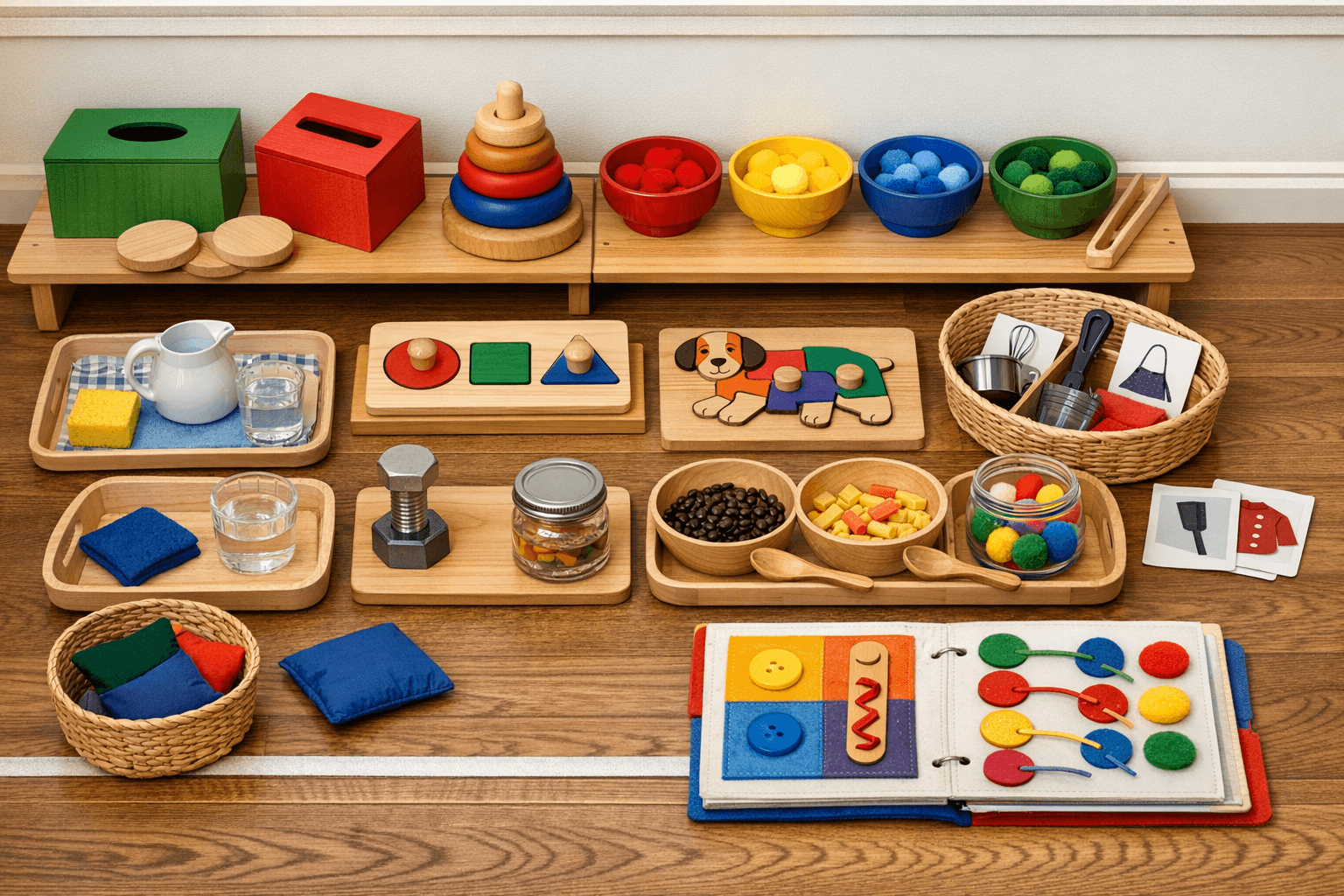
Table of contents
- Why fewer toys help focus
- Development snapshot: 24–36 months
- How to choose Montessori toys for a 2 year old
- Top Montessori toy picks (24–36m)
- No-budget & everyday Montessori toys
- Sample shelf (6–8 activities)
- Rotation & storage
- Safety notes
- FAQs
Why fewer toys help focus
Montessori environments prioritize order, independence, and concentration. For two-year-olds, clear shelves with a handful of complete activities invite longer engagement and confident clean-up. You don’t need expensive sets—clarity beats quantity.
Development snapshot: 24–36 months
Common sensitive periods/capacities:
- Two-step actions & sequencing (pour → wipe, open → close).
- Sorting & early categorizing (by color/size/shape—one variable at a time).
- Refined hand control (tongs, screwing/unscrewing, pegging).
- Language bloom (names, actions, two-word phrases → short sentences).
- Practical life (wipe spills, water a plant, carry a tray).
How to choose Montessori toys for a 2 year old
- Single clear objective (self-correction built in).
- Real materials, real work (small pitcher, brush, cloth).
- Right challenge (slight stretch, not frustration).
- One task per tray with all parts visible.
- Observation first—swap what’s ignored or mastered.
Top Montessori toy picks (24–36m)
Categories, not brands—choose what you have or can DIY:
- Posting & slot boxes (variable) – slot size changes or angled slot; use large wooden discs/chips (>3.2 cm).
- Ring stacker → graded sizes – progress from uniform rings to a size series.
- 2–6 piece puzzles (chunky knobs → interlocking) – start simple, add one piece at a time.
- Color sorting with bowls – one attribute only; later add toddler tongs.
- Open/close & screw/unscrew – safe jar lids, oversized bolts/boards (no small metal nuts).
- Transferring – spoon → scoop → tongs; beans to pasta to pompoms (supervise).
- Language baskets – themed real objects (kitchen tools, clothing) + matching photo cards.
- Practical life trays – water pouring with small pitcher & sponge; window spray (water) + cloth.
- Gross motor add-on – beanbags to toss into a basket; simple balance line on the floor.
- Montessori Busy Book (24–36m): Buttons & Matching – single-skill pages (large buttons, simple lacing, color matching). Present 1–2 pages at a time.
No-budget & everyday Montessori toys
You already own many great materials—present them neatly on trays/baskets:
- Kitchen work: small pitcher + cup for water pouring on a tray with sponge (pour → wipe).
- Sock sorter: match pairs by color/size; place in two baskets (sorting).
- Pantry jars & lids: open/close set with 3–4 different closures.
- Clothespins on a box edge: thumb-index strength; later transfer pins cup→cup.
- Rice + funnel + measuring cups: controlled scoop/pour practice.
- Oversized screw caps: shampoo/condiment bottles (cleaned) on an “open/close” tray.
- DIY posting: oatmeal can with wide slot + large wooden discs; outline on lid helps self-check.
- Laundry helper: carry a small basket, load washer (adult places detergent), wipe low table.
Montessori rationale: everyday tools are real and purposeful. The “control of error” is built in (e.g., water outside the cup signals “wipe and try again”), so your child learns through natural feedback—not adult correction.
Sample shelf (6–8 activities)
- Posting box (large discs)
- Color sorting bowls (later with tongs)
- 3–4 piece knob puzzle
- Screw/unscrew tray (safe & oversized pieces)
- Water pouring with sponge
- Opening/closing jars (3 lid types)
- Language basket (kitchen)
- Beanbag basket (near shelf for movement)
Arrange left-to-right, top-to-bottom. Model: take tray → work on a small rug → return parts → return tray.
Rotation & storage
- Rotate 2–3 items weekly after observing for 3–5 days.
- Keep beloved favorites—they signal a sensitive period.
- Store extras in a lidded box; repair or retire incomplete items.
- Snap a quick photo of a good setup to guide your weekly reset.
Safety notes
- Avoid parts < 3.2 cm for under-3s; supervise transfers and posting.
- Skip magnets, button batteries, and real coins; use large wooden discs instead.
- Anchor shelves; secure cords/outlets; use non-slip rug pads.
- Clean/inspect household items before use; round sharp edges.
FAQs
Do I need official “Montessori” branded toys?
No. Everyday items and simple DIYs work wonderfully when presented clearly on a tray.
How many toys should be out for a 2-year-old?
Limit the shelf to 6–8 complete activities. Store the rest and rotate based on interest.
Are puzzles appropriate at two?
Yes—start with 2–4 pieces and gradually increase. Offer just one new challenge at a time.
Should I use tongs now?
Yes, toddler-safe tongs build pre-writing grip. Begin with large items like pompoms or corks.
What if my child just dumps trays?
Reduce to 4 activities, simplify to single-step tasks, and slow your demonstration.