A Montessori toy shelf for 36–48 months thrives on clarity, purpose, and a few well-chosen activities. Here is how to pick toys, set up a 6–8 item shelf, and rotate without overspending.
Key takeaways
- Keep a limited shelf (6–8 activities); rotate 2–3 weekly based on interest.
- Choose simple, self-correcting materials (clear goal = control of error).
- Everyday household items make excellent Montessori toys.
- Prioritize practical life, early pre-writing skills, simple sorting/sequence, and movement.
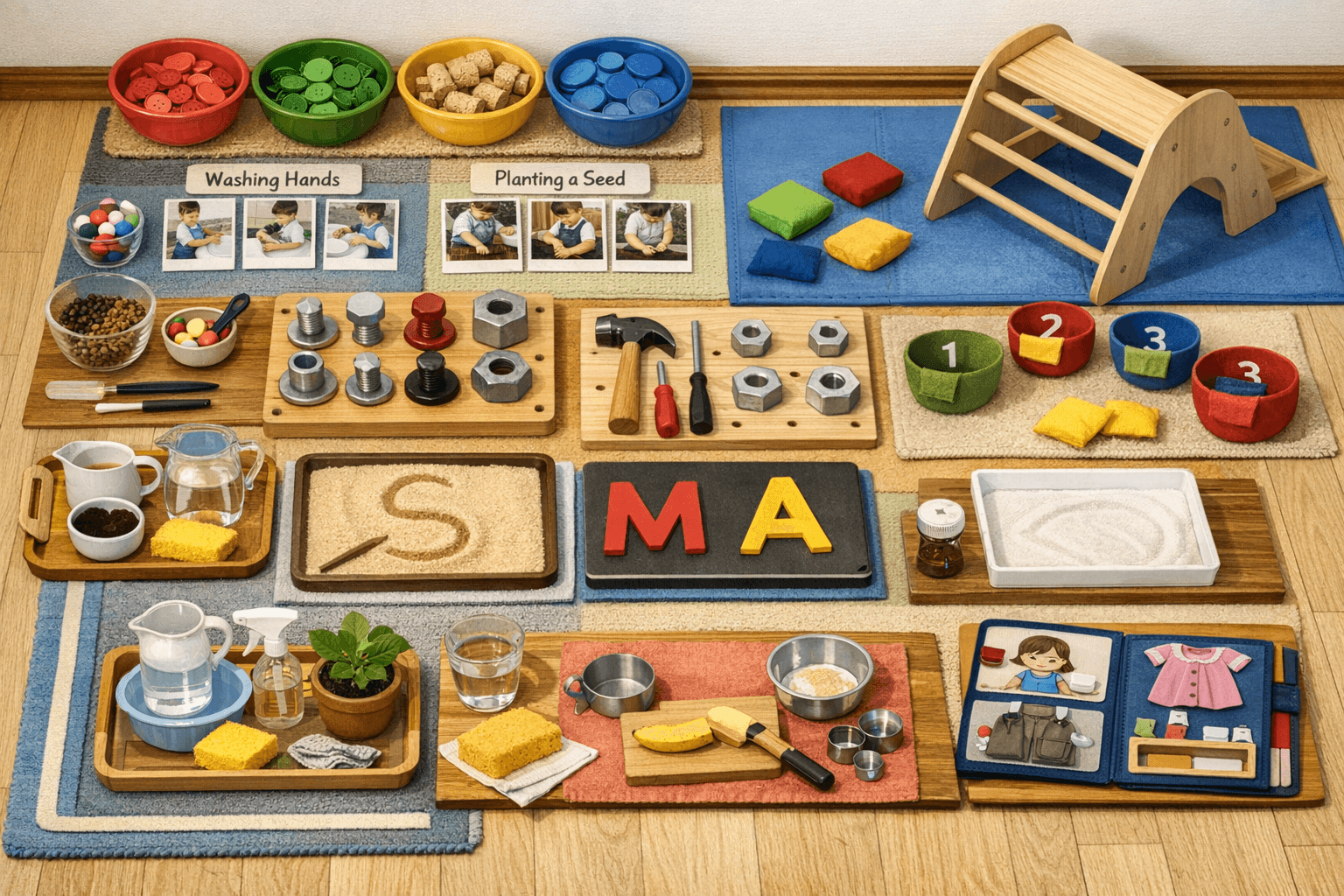
Table of contents
- Why fewer toys help learning
- Development snapshot: 36–48 months
- How to choose Montessori toys for a 3 year old
- Top Montessori toy picks (36–48m)
- No-budget & everyday Montessori toys
- Sample shelf (6–8 activities)
- Rotation & storage
- Safety notes
- FAQs
Why fewer toys help learning
At three, children refine concentration, coordination, and independence. A clear shelf with a handful of complete activities invites deeper focus and successful clean-up. You do not need expensive sets—clarity and purpose beat quantity.
Development snapshot: 36–48 months
You will notice:
- Sequencing and early logic (first/then; simple steps).
- Sorting and classification (by color, size, shape—one variable at a time).
- Refined hand control (tongs, droppers, scissors readiness).
- Language growth (longer sentences, new categories, story recall).
- Practical life (pouring, wiping, table washing, plant care).
- Gross motor (jumping, balancing, climbing with control).
How to choose Montessori toys for a 3 year old
- One clear objective (built-in self-check = control of error).
- Real materials and real work (small pitcher, brush, cloth, wood/metal).
- Right challenge (slightly beyond current skill; avoid frustration).
- One task per tray, all parts visible.
- Observe and rotate based on your child, not a calendar.
Top Montessori toy picks (36–48m)
Categories—use what you have or DIY; no need for costly brands:
- Sorting and classification: bowls plus large buttons/discs/corks (one attribute at a time; later add two-step sorts).
- Sequencing cards (2–4 steps): real-life photo sequences (wash hands, plant a seed).
- Early puzzles (6–10 pieces): clear images, sturdy pieces; build up gradually.
- Transferring and tools: toddler tongs, droppers, small sponge; move beans/water/pompoms (supervise).
- Open/close and screw/unscrew: safe jar lids, oversize nuts/bolts board (large pieces only).
- Pre-writing trays: sand or salt tray with stylus; metal cookie sheet plus magnets for large letter shapes (sensory, not worksheets).
- Practical life: water pouring with tray and sponge, table washing, window spray (water only), plant care set.
- Gross motor: balance line on floor, beanbag toss, low climbing set (one configuration, mat beneath).
- Busy Book (sequencing): 2–4 step sequencing (dress, brush teeth) instead of babyish flaps.
- Kitchen tools: child knife for soft foods, whisking, measuring; towel under trays so spill -> wipe is the control of error.
No-budget & everyday Montessori toys
Present neatly on a tray or in a basket—everyday tools are often best:
- Kitchen work: small pitcher + cup (pour -> wipe); measuring cups for graded volume.
- Laundry station: match socks, fold small cloths, carry a light basket.
- Tool tray: large screwdriver board with oversized screws (or screw-top jars).
- Tongs and sorting: salad tongs + large pompoms/corks into color bowls.
- Dropper transfer: water + food coloring in two cups; move drops from A to B (place towel under).
- Sequencing DIY: print 3–4 photos of a home task; child arranges in order.
- Nature basket: leaves, seed pods, stones (large); classify by texture/size/color.
- Cleaning kit: small spray bottle (water), cloth, mini brush/dustpan.
Why this is Montessori: real tools and simple tasks provide purposeful movement and self-correction (spilled water -> wipe, mis-sorted item is visible), so the child learns by doing—not by adult correction.
Sample shelf (6–8 activities)
- Sorting bowls (one attribute)
- Sequencing cards (3 steps)
- 6–8 piece puzzle
- Tongs transfer (large pompoms)
- Dropper transfer (water; towel on tray)
- Open/close jars (3 lid types)
- Practical life: table washing set
- Sand/salt pre-writing tray
Arrange left to right, top to bottom. Model: take tray -> work on small rug/table -> return parts -> return tray.
Rotation & storage
- Rotate 2–3 items weekly after observing for 3–5 days.
- Keep beloved favorites (sign of a sensitive period).
- Store extras in a lidded bin; repair or retire incomplete items.
- Take a quick photo of a good setup to guide resets.
Safety notes
- Three-year-olds vary: if your child still mouths objects, avoid small parts; otherwise choose large pieces and supervise tool work.
- Skip magnets, button batteries, and real coins.
- Anchor shelves; cover outlets; use non-slip rug pads.
- For water work, place a towel under the tray; teach wipe-up.
FAQs
Do I need official "Montessori" toys for age 3?
No. Everyday items and simple DIYs are excellent when presented clearly on a tray.
How many toys should be out?
Keep 6–8 complete activities on the shelf and rotate based on interest.
Are letters and numbers appropriate now?
Yes—via indirect preparation (sand/salt tracing, sorting, sequencing, language baskets), not drills or worksheets.
Which is better: tongs or droppers?
Both. Tongs build grip and control; droppers build finger isolation and pressure control.
What if my child dumps trays?
Reduce to 4 activities, re-model slowly, and offer one stretch plus one confidence task.