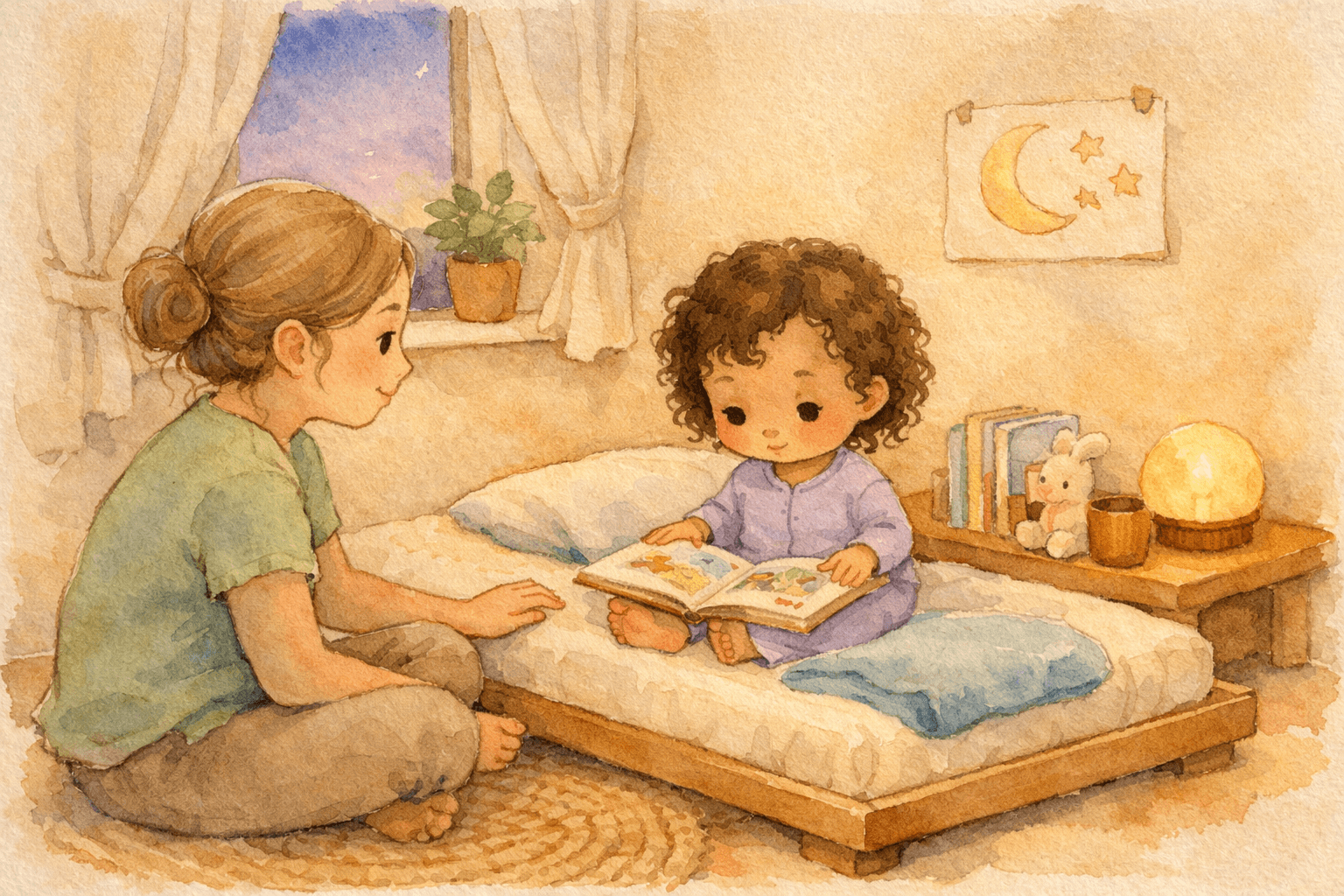
Your toddler has a beautiful floor bed, a calm bedroom, and a shelf of carefully rotated books. Everything looks perfect.
Then bedtime arrives and your child climbs out, asks for water, walks to your room, and does the whole thing again three more times.
Sound familiar? You are not alone. Montessori sleep is one of the topics parents ask about most, and much of the advice online stops at "follow the child" without explaining what that actually looks like at 18 months, 2 years, or 5 years old.
This guide is the practical part. It covers a montessori sleep schedule by age, how to build a Montessori bedtime routine that grows with your child, what to do about sleep regressions, and how to handle the most common floor bed challenges. If you have already set up the room (or plan to), this is the piece that brings it all together.
Looking for baby sleep guidance (under 12 months)? Infant sleep is a different world — safe sleep rules, night nursing, co-sleeping safety, and building first routines. We cover all of that in our Baby Sleep in the First Year guide.
This guide shares general Montessori-aligned sleep practices for ages 1-6. For persistent sleep difficulties, consult your pediatrician.
Table of contents
- What is the Montessori approach to sleep?
- How much sleep does your child need?
- Setting up a Montessori sleep environment
- Nursing, night weaning, and sleep after age 1
- Co-sleeping and the transition to independent sleep
- Building a Montessori bedtime routine (step by step)
- Montessori sleep regressions: ages, causes, and what to do
- Common Montessori sleep challenges (and what to do)
- Night terrors, nightmares, and other sleep disturbances
- Naptime the Montessori way
- Putting it all together
- FAQ
What Is the Montessori Approach to Sleep?
Montessori sleep is not a sleep training method. If you have searched for "montessori sleep training," you may have expected a step-by-step program. There is no specific program to buy, no set of rigid rules to follow, and no single "right" way to do it.
Instead, Montessori offers a set of principles you can adapt to your family:
- Follow the child. Observe when your child shows tiredness, not just what the clock says. Cues like eye-rubbing, yawning, clumsiness, and irritability tell you more than any schedule.
- Prepare the environment. A calm, simple, child-accessible sleep space helps your child feel safe enough to settle. This is where the floor bed and bedroom setup come in.
- Freedom within limits. Your child can choose a book or a comfort object but the boundary is clear: it is time for sleep.
- Consistency. Children between ages 1 and 6 are in what Montessori called a "sensitive period for order." They crave predictability, and a consistent bedtime routine uses that developmental need in your favor.
What Montessori does not require
There are common misconceptions worth clearing up.
Montessori does not require a floor bed. A crib is fine for as long as it works. The floor bed is one tool, and many families transition when the child shows readiness, often between 18 months and 3 years.
Montessori does not forbid co-sleeping or bed-sharing. Maria Montessori herself observed families around the world, including cultures where co-sleeping is the norm. What matters is that the arrangement supports the child's growing independence over time. If your family co-sleeps, the co-sleeping section covers how to transition gradually.
Montessori does not forbid nursing to sleep. Responding to your child's needs is not a bad habit. The WHO recommends breastfeeding until age 2 or beyond, and nursing to sleep is biologically normal. As children develop, they naturally need less support, especially when the environment and routine are working well.
Montessori does not prescribe one parenting style. Families who practice attachment parenting, gentle parenting, RIE, or any other philosophy can all apply Montessori sleep principles. The core ideas — a prepared environment, a consistent routine, respect for the child, and gradual independence — work within any approach. What varies is the timeline.
How Much Sleep Does Your Child Need?
These are general ranges based on AAP-endorsed recommendations and the Cleveland Clinic's toddler and preschooler sleep guidelines. Every child is different.
| Age | Total sleep (24h) | Nighttime | Daytime naps |
|---|---|---|---|
| 12-18 months | 11-14 hours | 10-12 hours | 1-2 naps (transitioning to 1) |
| 18-24 months | 11-14 hours | 10-12 hours | 1 nap |
| 2-3 years | 11-14 hours | 10-12 hours | 1 nap (dropping toward end) |
| 3-4 years | 10-13 hours | 10-12 hours | 0-1 nap |
| 4-5 years | 10-13 hours | 10-12 hours | Usually none |
| 5-6 years | 9-12 hours | 9-12 hours | None |
For sleep needs under 12 months, see our baby sleep guide.
Signs your child is getting enough sleep
- Falls asleep within 15 to 30 minutes of lying down.
- Wakes relatively easily in the morning without extended crankiness.
- Stays mostly alert and regulated during daytime activities.
- Naps without extreme resistance (for children still napping).
Signs they may need more
- Consistent meltdowns in the late afternoon.
- Falling asleep in the car or stroller at unexpected times.
- Difficulty concentrating during activities they usually enjoy.
- Frequent night waking or very early morning rising (before 5:30am).
The Montessori perspective here is practical: observe your child, not just the chart. If your 2-year-old seems well-rested on 12 hours total, that is fine. If another child the same age clearly needs 14, honor that.
Setting Up a Montessori Sleep Environment
The physical space matters more than most parents expect. A well-prepared sleep environment does a lot of the work for you.
We have detailed guides for the floor bed and full bedroom setup. Here is the quick version focused on sleep.
Room basics
- Temperature: 16 to 21 degrees Celsius (60 to 70 Fahrenheit). Slightly cool is better for sleep. If your home runs warmer (up to 22-23°C / 72-73°F), dress your child in a single layer of breathable pajamas and skip the blanket. What matters is that your child is not overheating — check the back of their neck or chest, which should feel warm but not sweaty.
- Light: Dim or warm-toned light for the bedtime routine. Darkness for sleep. Blackout curtains help with early rising and summer evenings.
- Sound: Quiet. Some families use a white noise machine at a low, steady volume (below 50 decibels, placed at least 200 centimeters / 7 feet from the child). Avoid music with lyrics or changing patterns.
What to keep near the bed
- Two to three books on a low shelf (rotate weekly).
- A water cup within reach.
- One comfort object if your child uses one (stuffed animal, small blanket). For children under 12 months still in a crib, keep the crib bare — see our baby sleep guide for safe sleep rules.
What to remove at bedtime
- Screens of any kind.
- Stimulating or noisy toys.
- Bright lights or flashing objects.
- Too many choices. If 20 books are visible, bedtime becomes browsing time.
The core idea is "room as sleep space." When your child is on a floor bed, the entire room is accessible. That means the room itself needs to be safe and boring enough for sleep. Save the activity shelf for daytime.
Nursing, Night Weaning, and Sleep After Age 1
If you are breastfeeding a toddler, this section is for you. If you are not breastfeeding, skip ahead — the montessori sleep routine principles apply equally to all families.
Nursing to sleep is not a problem
This is worth stating clearly because so much conventional sleep advice frames nursing to sleep as a "bad habit" or a "sleep crutch." From a Montessori perspective, nursing to sleep meets a real biological and emotional need. Breast milk contains tryptophan and melatonin — hormones that actually help your child fall asleep. Nursing to sleep is biologically designed to work.
The question is not whether to nurse to sleep, but when and how to gently evolve the routine as your child grows.
Night nursing after 12 months
Every child is different, and the WHO supports continued breastfeeding until age 2 or beyond. Here is a general pattern for toddlers:
- 12-18 months: One night feed is common. Some toddlers continue feeding twice. Night nursing at this age often serves an emotional comfort function as much as a nutritional one.
- 18-24 months: Some toddlers drop night feeds on their own. Others continue to nurse once at night. Both are normal.
- 2+ years: Children still breastfeeding at this age have usually dropped night feeds, though some continue. Extended breastfeeding is practiced in many cultures worldwide.
When is night weaning appropriate?
There is no single right age. Here are the considerations:
From a nutritional standpoint, most healthy toddlers who eat solid foods well during the day do not need nighttime calories after 12 months. However, "don't need" does not mean "should stop." Night feeds may continue to serve important purposes including comfort, hydration, and connection.
From a Montessori standpoint, observe your child. If they are nursing briefly and falling back asleep quickly, the feed is serving its purpose. If night feeds are disrupting everyone's sleep significantly and the child is eating well during the day, gentle reduction may help.
Gentle approaches to evolving the nursing-to-sleep association
If and when you are ready to separate nursing from the moment of falling asleep, try these gradual steps:
- Nurse earlier in the routine. Move nursing to before the last book instead of as the final step. This way, nursing still happens but is not the last thing before sleep.
- Shorten the session gradually. Reduce nursing time by a minute or two every few nights.
- Introduce other comfort. As nursing shortens, add a song, a back rub, or a phrase that becomes the new sleep cue.
- Let your partner take over bedtime occasionally. A different caregiver with the same routine shows the child they can fall asleep without nursing.
- Be patient with setbacks. Illness, teething, travel, and growth spurts may temporarily increase the need for nursing at bedtime. This is not regression — it is your child seeking comfort during a difficult time. Return to the gradual process when things settle.
There is no deadline. Some children naturally lose interest in nursing to sleep between 18 and 24 months. Others continue well past 2. Follow your child and your own needs.
Co-Sleeping and the Transition to Independent Sleep
Many families co-sleep or bed-share through the first year and into toddlerhood. If that is your family, Montessori principles can help you transition to independent sleep gradually and respectfully.
For infant co-sleeping safety (under 12 months), including AAP room-sharing recommendations and the Safe Sleep Seven, see our baby sleep guide.
Montessori and the path to independent sleep
Whatever your starting point — co-sleeping, room-sharing, or independent sleep from early on — a montessori sleep approach supports a gradual journey toward independence based on the child's readiness:
- 12-24 months: Many families begin the transition. Start with naps in the child's own room on a floor bed or crib. Then move bedtime. Your presence nearby during the transition helps. Separation anxiety often peaks between 14 and 18 months, so expect to stay close until your child settles.
- 2-3 years: Most children can sleep independently in their own room with a consistent routine and a prepared environment. For families who bed-shared, the child may now sleep on a floor bed in the parents' room initially, then move to their own room.
- 3-6 years: Independent sleep is well-established for most children. Occasional visits to the parents' room during illness, nightmares, or transitions are normal and expected.
There is no single correct timeline. A family that bed-shares until age 2 and then transitions to a floor bed can raise an independent sleeper just as well as a family that uses a crib from day one. What matters is consistency, a prepared environment, and a gradual approach that respects the child.
Practical tips for the transition
- Make the child's room inviting. A well-prepared Montessori bedroom with a comfortable floor bed, a few books, and a familiar comfort object makes the new space feel safe.
- Start with naps. Daytime sleep in the new room is lower-stakes and builds positive associations.
- Stay present at first. Sit by the bed, then near the door, then outside. Reduce your presence gradually over days or weeks.
- Keep the bedtime routine identical. Only the location changes. Everything else stays the same.
- Expect some back-and-forth. Your child may come to your room at night during the transition. Calmly walk them back each time. Consistency matters more than perfection.
Building a Montessori Bedtime Routine (Step by Step)
A predictable bedtime routine is the single most effective montessori sleep tool you have. It works because young children thrive on order. When they know what comes next, the nervous system calms down.
Here is a simple framework that works across ages:
- Wind down — Quiet activity to signal the shift from daytime energy.
- Care of self — Bath, teeth, pajamas, toilet (child does as much as they can).
- Connection — Read together, talk about the day, sing a song.
- Transition — Final goodnight ritual (kiss, tuck-in phrase, lights off).
- Separation — Parent leaves or gradually reduces presence.
Keep the entire routine to 20 to 30 minutes. Longer routines tend to create more resistance, not less.
Sample routine for young toddlers (12-24 months)
This is where a montessori sleep routine starts to look different from conventional approaches. Your child cannot say much yet, but they can participate in small, meaningful ways. The routine still relies on physical cues and repetition more than words.
At this age, your child may still be in a crib or just transitioning to a floor bed. Either is fine. Separation anxiety often peaks between 14 and 18 months, so expect to stay nearby until your child settles.
- Quiet play or a short walk 20 minutes before bed.
- Bath (child splashes and explores; parent washes).
- Choose pajamas (hold up two options; child points or grabs).
- Parent helps dress; narrate each step ("Now we put on your pajamas").
- Brush teeth (child holds the brush; parent finishes).
- Diaper change.
- Child picks one book from the bedtime shelf.
- Read together in the sleep space. At this age "reading together" may mean looking at two pages, pointing at a dog, and closing the book. That counts. Keep it short, use board books with textures or flaps, and let your child set the pace. The goal is a calm, positive association with books before sleep, not finishing the story.
- Goodnight phrase, kiss, lights off.
- Parent stays nearby until child settles.
What the child does independently: Points to a pajama choice, holds the toothbrush, picks a book, climbs into bed (if on a floor bed). These are small steps, but they matter. This is where the habit of participation starts.
If your child is also dropping from two naps to one during this period (common between 12 and 18 months), bedtime may need to shift earlier temporarily. Watch for overtiredness in the late afternoon.
Sample routine for older toddlers (2-3 years)
Now your toddler bedtime routine gets more interactive. Your child participates actively and verbally. They have opinions, and those opinions are loud. This is also when potty training often intersects with bedtime, and when fears of the dark or monsters may start to appear. Acknowledge fears calmly rather than dismissing them ("I hear you. Your room is safe. I am right here.").
- Quiet play or a calm walk 20 minutes before bed.
- Bath or wash hands and face (child does some washing).
- Choose pajamas from the wardrobe (two options). Child dresses with help as needed.
- Brush teeth together (child holds brush, parent finishes).
- Toilet or diaper change.
- Child picks one or two books from the bedtime shelf.
- Read together in the sleep space.
- Goodnight phrase, kiss, lights off.
- Parent stays briefly or steps out, depending on the child.
What the child does independently: Chooses clothes, participates in washing and teeth, selects books, climbs into bed. Each small choice builds confidence and reduces the "I don't want to" pushback.
One family we hear from often described the shift this way: their 2-year-old used to scream at every pajama change. Once they moved to a low wardrobe with two choices, the child started walking to the wardrobe on their own after bath. The power struggle disappeared because the child had real agency in the routine.
Sample routine for preschoolers (3-5 years)
By this age, your child can run most of the preschooler sleep routine with light supervision. The big transition during this period is the nap: roughly 60 percent of 4-year-olds still nap, but by age 5 most have dropped it entirely. When the nap goes, bedtime often needs to shift 30 to 60 minutes earlier to prevent overtiredness. If your child is approaching kindergarten, building a habit of 10 or more hours of nighttime sleep before school starts makes the transition much smoother.
Imaginative fears (monsters, shadows, "something under the bed") are common between 3 and 4. By 4 to 5, fears may become more specific — worries about being alone, about something they saw, or about a change at preschool. A brief, calm acknowledgment works better than logic at any age. A quick room check together, a "monster spray" bottle of water by the bed, or a small nightlight can all help.
- Bath or shower (increasingly independent).
- Brush teeth (child does it; parent checks).
- Dress in pajamas independently.
- Choose one or two books.
- Read together or child "reads" to parent.
- Talk about one good thing from today and one thing to look forward to tomorrow.
- Goodnight phrase, lights off.
What the child does independently: Almost everything. Your role shifts from doing to being present.
Some 4- and 5-year-olds begin to enjoy a few minutes of quiet time alone in bed before falling asleep, looking at a book or talking to a stuffed animal. This is healthy self-regulation, not a problem.
Sample routine for kindergarteners (5-6 years)
Your child now runs the entire routine independently. Your role shifts from supervision to connection and boundary-holding.
The biggest change at this age is school. A fixed wake time means bedtime is no longer flexible. Work backwards: if your child needs to wake at 7:00am and needs 10 to 11 hours of sleep, bedtime is 8:00pm at the latest. The AAP recommends 9 to 12 hours for children age 6 and older, so bedtime still matters even though your child may feel "too big" for one.
Naps are gone for nearly all children by now. Fears and worries become more complex at this age — instead of monsters, you may hear about a problem with a friend or anxiety about a test. The bedtime chat is where these come out.
- Set out clothes for tomorrow (child chooses, parent approves).
- Shower or bath (independent).
- Brush teeth (independent; parent spot-checks occasionally).
- Pajamas (independent).
- Quiet reading, drawing, or journaling in bed (10 to 15 minutes).
- Parent comes in for a goodnight chat — talk about one good thing from today and one thing to look forward to tomorrow.
- Lights off; child falls asleep alone.
What the child does independently: Everything. Your presence at step 6 is about connection, not task management. This nightly check-in often becomes the moment your child opens up about what is really on their mind.
When the routine gets disrupted
Travel, illness, a new sibling, or a big life change will shake things up. That is normal.
What to do:
- Keep as many elements of the routine as you can, even in a new place (same books, same goodnight phrase, same order).
- Accept that sleep will be rougher for a few days.
- Return to the full routine as soon as possible. Children bounce back faster than adults expect.
- Do not introduce new habits you will want to undo later (bringing the child into your bed every night, for example, unless that is your long-term plan).
The floor bed transition is one of the biggest Montessori sleep milestones. Most families transition between 18 months and 3 years, though some start as early as 12 months. The key principle for sleep is simple: change only the sleep surface, keep the bedtime routine identical. Our complete floor bed guide covers readiness signals, age-specific safety rules, a step-by-step transition plan, and what to do when your toddler will not stay in bed.
Montessori Sleep Regressions: Ages, Causes, and What to Do
A sleep regression is a stretch of days or weeks when a child who was sleeping well suddenly is not. They wake more often, resist bedtime, skip naps, or wake very early.
Regressions are not a sign that something is broken. They are almost always tied to a developmental leap. Understanding montessori sleep regression patterns helps you stay calm and respond with confidence instead of panic.
Common regression ages
| Age | What is happening developmentally | What you may see |
|---|---|---|
| 12 months | Walking, first words, growing independence | Nap resistance, bedtime protest, standing in the crib instead of sleeping |
| 18 months | Language explosion, stronger will, big emotions, separation anxiety peak | Bedtime battles, night waking, early rising, intense resistance to being left alone |
| 2 years | Imagination, fears, sense of self, possible new sibling, potty training | Stalling at bedtime, fear of the dark, nap refusal, new nighttime fears |
| 3 years | Dropping the nap, social awareness, bigger questions, preschool transition | Difficulty settling, long time to fall asleep, bedtime stalling with endless questions |
| 4-5 years | Starting school, social comparisons, bigger fears, complex emotions | Bedtime stalling with questions or worries, fear of the dark, resistance to sleeping alone, nightmares |
For regressions under 12 months (including the significant 4-month sleep regression when sleep architecture permanently changes), see our baby sleep guide.
How Montessori principles help during regressions
Stay consistent with the routine. This is the most important thing. When everything feels chaotic for your child internally, the external routine is an anchor.
Offer more connection during the day. Regressions often coincide with a child needing more presence and reassurance. Big emotions may also show up as toddler tantrums or bedtime meltdowns. Ten extra minutes of focused one-on-one time — something simple like doing a practical life activity together — can make a big difference at bedtime.
Avoid introducing new sleep associations during a regression. If you start rocking a 2-year-old to sleep during a regression, you may be creating a new expectation that will be harder to change later. However, briefly increasing your presence (sitting near the bed instead of leaving, for example) is different from introducing a completely new habit. Use your judgment.
Trust the timeline. Most regressions last two to six weeks. Some are shorter. If you hold the routine steady, sleep typically returns to baseline on its own.
Common Montessori Sleep Challenges (and What to Do)
"My toddler won't stay in floor bed"
The short answer: calmly return them every time with minimal words, check whether the room is too stimulating or bedtime timing is off, and give it three weeks of consistency. For the full troubleshooting approach, see our floor bed guide.
"My child plays instead of sleeping"
A child who lies in bed looking at a book or quietly talking to a stuffed animal is not a problem. This is self-regulation. They are learning to manage the transition from awake to asleep on their own.
If the playing is loud or active, the room may have too much available. Reduce bedtime options to two or three books and one comfort object. Remove everything else or put it behind a closed shelf.
"Early rising (before 5:30am)"
- Check light. Even a thin line of light from curtains can wake a child at dawn. Blackout curtains or shades often solve this immediately.
- Check bedtime. Counterintuitively, a later bedtime often makes early rising worse, not better. An overtired child sleeps less soundly. Try moving bedtime 15 minutes earlier.
- Use an "OK to wake" clock for children 2.5 years and older. Set it for a reasonable time. Teach them: "When the light turns green, you can come out of your room."
"Night waking and coming to the parent's room"
- Offer brief comfort. A hug, a few calm words, then walk them back.
- Do not get into bed with them or bring them to your bed unless that is your intentional long-term arrangement.
- Consider whether something is going on: illness, a new fear (common around age 2 to 3), a room that is too cold or too warm, or a regression.
"Nap refusal"
This one requires detective work. Is it a regression or is your child ready to drop the nap?
Signs it is a regression (keep offering the nap):
- It started suddenly.
- Your child is clearly tired in the afternoon.
- They are under 3 years old.
- Other sleep is also disrupted.
Signs they are ready to drop the nap:
- Nap refusal has lasted more than two to three weeks consistently.
- They are 3 years old or older.
- They seem genuinely rested without it.
- Nighttime sleep is solid.
If the nap is dropping, transition to "quiet time," which is 30 to 45 minutes in their room with books and calm activities. Many children still need this rest period even after they stop sleeping.
Night Terrors, Nightmares, and Other Sleep Disturbances
These are among the most frightening montessori sleep challenges for parents, but most are a normal part of development and are not signs of a deeper problem.
Night terrors vs. nightmares
These are very different things, and they require different responses.
Night terrors:
- Happen during deep non-REM sleep, usually 1 to 3 hours after bedtime.
- Most common between ages 3 and 6 (can start as early as 18 months), according to the NIH.
- The child may scream, thrash, sit up, appear terrified, sweat, and have a racing heart.
- The child is not awake and will not recognize you or respond to comfort.
- Episodes last 5 to 30 minutes and the child has no memory of them the next day.
- What to do: Stay nearby to prevent injury but do not try to wake the child. Waking them can cause confusion and make the episode longer. Wait for it to pass. Guide them gently back to lying down if needed.
- Prevention: Night terrors are more likely when a child is overtired. Ensuring adequate sleep and a consistent bedtime is the best prevention. If they happen at the same time nightly, some pediatricians suggest gently rousing the child 15 to 30 minutes before the typical episode time for a few nights to reset the sleep cycle.
Nightmares:
- Happen during REM (lighter) sleep, usually in the second half of the night or early morning.
- Most common starting around age 2 to 3, peaking between ages 3 and 6.
- The child wakes up and can describe what scared them (at least partially).
- They may be tearful, clingy, and afraid to go back to sleep.
- What to do: Comfort your child. Stay with them, offer a hug, validate their fear ("That does sound scary. You are safe now. I am right here."). A nightlight, an open door, or a brief check of the room together can help them settle.
- When to be concerned: Frequent nightmares that disrupt sleep most nights, or nightmares that coincide with a significant stress or change, may warrant a conversation with your pediatrician.
Sleepwalking
- Occurs during deep sleep, similar to night terrors.
- Most common between ages 4 and 8 but can start as young as 2 to 3.
- The child gets up and moves around, sometimes performing routine actions (opening doors, walking to the bathroom), but is not conscious.
- They will not remember it the next day.
- What to do: Gently guide the child back to bed without waking them. Ensure the home is safe: use stair gates, lock external doors, and keep the path between bedroom and bathroom clear. If sleepwalking is frequent, consider whether the child is overtired (the most common trigger).
- When to be concerned: Talk to your pediatrician if sleepwalking happens multiple times per week, includes dangerous behaviors, or continues past age 10.
Teeth grinding (bruxism)
- Very common in children, especially between ages 2 and 6.
- Often happens during transitions between sleep stages.
- Most children outgrow it without treatment.
- Causes can include jaw development, tooth alignment changes, stress, or nasal congestion.
- What to do: Mention it at your next dental visit. In most cases, no treatment is needed. If it is severe (wearing down teeth, causing jaw pain), your dentist may suggest a night guard after the permanent teeth come in.
When to talk to your pediatrician about sleep disturbances
Occasional night terrors, nightmares, and sleepwalking are normal parts of development. See your pediatrician if:
- Your child snores regularly or appears to stop breathing briefly during sleep (possible sleep apnea).
- Sleep disturbances happen most nights and significantly affect daytime functioning.
- Your child is excessively sleepy during the day despite getting adequate hours.
- You notice unusual movements or behaviors during sleep that concern you.
Naptime the Montessori Way
A good montessori sleep and nap routine follows the same principles as bedtime, just shorter.
- Use a mini version of the bedtime routine: one book, a quiet song or phrase, then rest.
- Keep the room dark and calm. Same environment as nighttime.
- Stay consistent with timing. A nap at the same time each day helps the body expect it.
Nap transitions
Two naps to one (typically 12 to 18 months): Signs include the second nap getting later and later, resistance to the morning nap, or consistently taking only one long nap. Move to one midday nap and adjust bedtime earlier if needed. This transition can take 2 to 4 weeks and often involves some grumpy late afternoons.
One nap to none (typically 3 to 4 years): Signs include consistently refusing the nap for two to three weeks, sleeping well at night without it, and staying alert through the afternoon. According to sleep research, less than 2.5% of children drop their nap before age 2, and 94% stop napping by age 5.
Quiet time replaces the nap. When the nap drops, keep the same rest period but fill it with quiet activities: books, puzzles, drawing, or calm activities for the 2-3 age range. This helps the child (and the parent) maintain the rhythm of the day.
Naptime at school vs. at home
If your child naps at a Montessori program, the school likely uses a quiet, consistent nap routine with a rest mat. At home, mirror the essentials: same approximate time, same calm environment, same expectation. Exact replication is not necessary, but consistency in the rhythm helps.
Putting It All Together
Montessori sleep comes down to a few repeating ideas: a prepared environment, a consistent bedtime routine, and the patience to let your child grow into independence at their own pace. You do not need a perfect montessori sleep schedule from day one. You need a routine that is good enough, applied consistently enough, for long enough.
For toddlers (1-3 years): Set up the sleep environment for independence. Transition to a floor bed when your child is ready. Build a bedtime routine with real choices your child can own. Handle regressions by holding the routine steady.
For preschoolers (3-6 years): Your child runs the routine. You provide connection and boundaries. Good preschooler sleep habits are built by managing the nap-to-quiet-time transition, addressing fears calmly, and enjoying the bedtime conversations that emerge when the routine is secure.
Whatever your parenting philosophy — whether you co-sleep or use a crib, breastfeed to age 3 or stopped at 6 months, practice attachment parenting or take a more structured approach — the Montessori sleep principles adapt to fit. Prepare the environment. Be consistent. Follow the child. And when things get hard, trust that two to three weeks of steady practice will get you further than any single technique.
Sleep is one of the hardest parts of parenting young children. It is also one of the places where Montessori principles pay off the most, because the habits you build now carry forward for years.
Have a baby under 12 months? Start with our Baby Sleep in the First Year guide, then come back here when your child is ready for floor beds and bedtime routines with choices.
Montessori Sleep FAQ
Does Montessori support cry-it-out sleep training?
Montessori does not prescribe a specific sleep training method. The philosophy focuses on observing the child, keeping routines consistent, and preparing the environment for independence. Some families combine Montessori principles with gentle sleep approaches, while others follow the child's lead entirely. What matters most is that your approach respects the child and stays consistent.
Can I use a crib and still follow Montessori sleep principles?
Yes. The floor bed is one Montessori tool, not a requirement. You can apply every principle in this guide — consistent routines, a calm environment, age-appropriate independence — with a crib. Many families transition to a floor bed when the child shows readiness, and others do not use one at all.
What if my partner and I disagree about the sleep approach?
Start with what you both agree on. That is usually a consistent bedtime routine and a calm sleep environment. You do not need to align on every detail. Children adapt well as long as the routine is predictable and both caregivers respond calmly. The important thing is that neither parent undermines the other's approach in front of the child.
Is it OK to lie with my child until they fall asleep?
Yes. Montessori respects each child's developmental needs. Many young children need a parent's presence to feel safe enough to sleep. Over time, as your child builds confidence in their sleep space, you can gradually reduce your presence: sit on the bed, then near the bed, then by the door, then outside. There is no rush.
Is co-sleeping compatible with Montessori?
Montessori does not forbid co-sleeping. Many cultures around the world practice co-sleeping safely, and Maria Montessori observed these families firsthand. What matters is that the family has a gradual plan for building sleep independence as the child grows. A family that co-sleeps until age 2 and then transitions to a floor bed can raise an independent sleeper. See the co-sleeping section for transition tips.
Can I breastfeed my toddler to sleep and still follow Montessori?
Yes. The WHO recommends breastfeeding until age 2 or beyond, and nursing to sleep meets a real developmental need. Breast milk contains tryptophan and melatonin, which naturally promote sleep. Over time, you can gently separate the nursing and sleep associations by moving nursing earlier in the routine when both parent and child are ready. See the nursing section for step-by-step guidance.
What is the difference between a night terror and a nightmare?
Night terrors happen during deep non-REM sleep, usually 1 to 3 hours after bedtime. The child may scream or thrash but is not awake and will not remember the episode. Do not try to wake them — stay nearby for safety and wait for it to pass. Nightmares happen during lighter REM sleep, usually in the second half of the night. The child wakes up frightened and can describe what scared them. Comfort them, validate the fear, and help them feel safe. Night terrors are most common between ages 3 and 6. See the sleep disturbances section for more detail.
When should I worry about my child's sleep?
Talk with your pediatrician if your child snores regularly or stops breathing briefly during sleep, has extreme difficulty falling asleep despite consistent routines for more than a few weeks, sleeps significantly more or less than the recommended range for their age, shows signs of excessive daytime sleepiness that affect daily life, or has frequent night terrors or sleepwalking episodes that disrupt the household most nights.
Related guides
- Montessori Floor Bed: When to Start + Safety Checklist
- Montessori Bedroom Setup: Step-by-Step Room Guide (0-6)
- Montessori Wardrobe: Setup + Daily Dressing Routine
- Montessori Potty Training: Readiness Signs + Step-by-Step