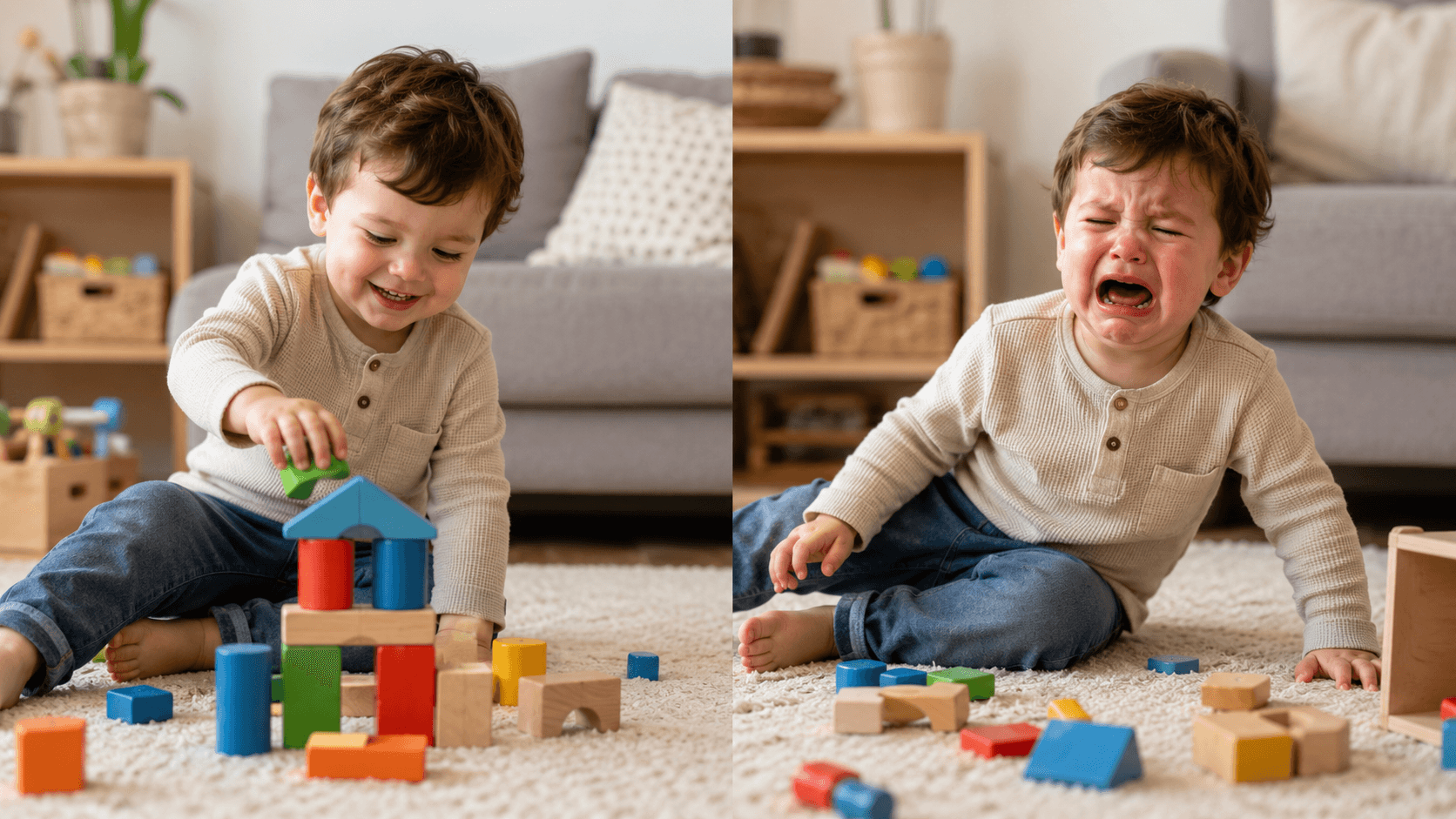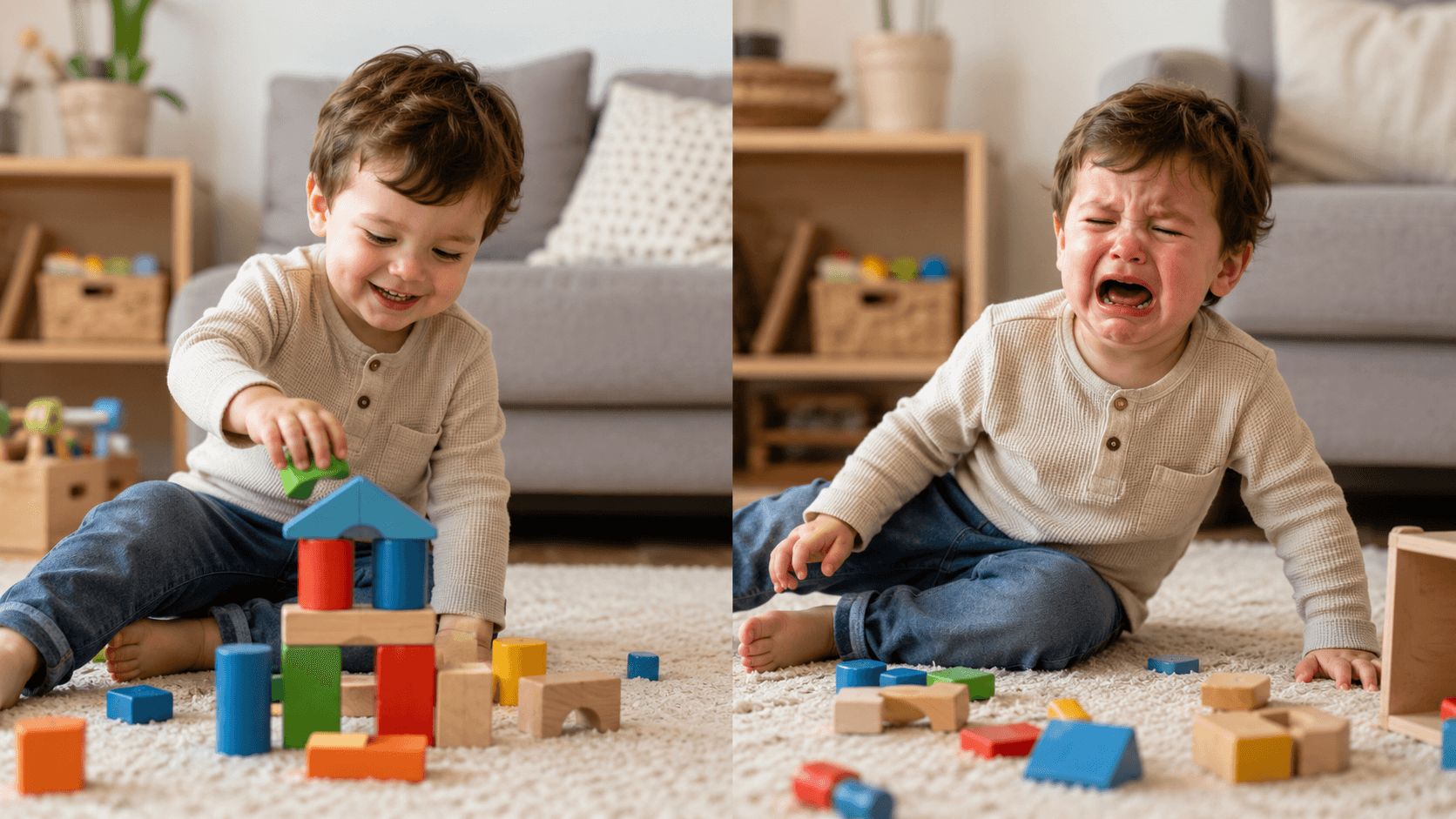
Your toddler asks for the blue cup.
You give them the blue cup.
They scream because they wanted the red one.
Then they insist on putting on their own shoes, get frustrated when the shoes will not cooperate, refuse your help—and two minutes later cry because you are not helping.
Welcome to the stage commonly called the terrible twos. Parents also search for it as the terrible 2s, terrible two, or terrible 2 stage. These terms all describe roughly the same developmental period: a time when independence grows much faster than language, patience, emotional regulation, and impulse control.
That mismatch can lead to tantrums, constant “no,” hitting, throwing, refusing routines, and intense reactions to seemingly tiny problems.
The behavior can be difficult. Your child is not terrible.
Here is what is happening—and what actually helps.
Table of Contents
- What are the terrible twos?
- When do they start?
- When do they end?
- Common signs
- Why 2-year-olds behave this way
- What actually helps
- What to do during a tantrum
- The Montessori approach
- When to ask for extra help
- FAQ
What Are the Terrible Twos?
The terrible twos is a common name for a developmental period when toddlers begin asserting much more independence while still having limited emotional regulation, communication skills, patience, and impulse control.
Are the Terrible 2s and Terrible Two the Same Thing?
Yes. Terrible twos, terrible 2s, terrible two, and terrible 2 are different ways parents refer to the same general toddler stage.
The standard expression is “terrible twos,” but parents often search using the number 2 or the singular “two.”
The phrase usually describes the increase in independence, frustration, tantrums, resistance, and strong preferences that often becomes noticeable around age 2.
Common behaviors include:
- frequent tantrums
- saying “no”
- refusing everyday requests
- wanting to do everything independently
- getting frustrated quickly
- hitting, pushing, biting, or throwing
- struggling with transitions
- changing their mind suddenly
- strong preferences about food, clothing, cups, toys, and routines
This does not mean your child is spoiled or deliberately trying to make life difficult.
They are discovering:
“I am a separate person. I can have my own ideas.”
If you want a broader age-by-age overview, see our guide to normal toddler behavior at ages 1, 2, and 3.
When Do the Terrible Twos Start?
The terrible twos do not begin on a child's second birthday.
For many toddlers, the behaviors associated with this stage start around 18 months and become more noticeable as the child approaches age 2.
At this age, toddlers can often:
- walk and climb confidently
- understand much more language
- remember routines
- form strong preferences
- know exactly what they want
But they may not yet have the words or self-control to manage disappointment.
That combination creates frustration.
Can the terrible twos start at 18 months?
Yes.
Many parents notice more tantrums, resistance, and “me do it” behavior between 18 and 24 months.
For more context on this stage, see our 18–24 month milestones guide.
When Do the Terrible Twos End?
There is no exact ending age.
For many children, the most intense behaviors gradually become easier through ages 3 and 4 as language, self-control, flexibility, and emotional regulation improve.
That does not mean tantrums disappear at age 3.
A 3-year-old may have even stronger opinions than a 2-year-old—but they are increasingly able to explain them.
Instead of screaming immediately, they may eventually say:
“I wanted to do it myself.”
That is progress.
7 Common Signs of the Terrible Twos
1. Saying “No” to Everything
“No” is an easy way for toddlers to express independence.
Instead of asking:
“Do you want to get in the car seat?”
when getting in the car is not optional, try:
“It's time to get in the car seat. Do you want to climb in yourself or would you like help?”
The boundary stays firm, but your child gets some control.
2. More Tantrums
Tantrums may happen over things that seem tiny to adults:
- the banana broke
- the wrong parent opened the door
- you cut the toast
- you helped when they wanted independence
- you did not help when they wanted help
The trigger may be small.
The feeling is not.
For a deeper guide, see Toddler Tantrums: Why They Happen and What Helps.
3. “Me Do It!”
Your toddler may suddenly insist on:
- putting on shoes
- pouring water
- feeding themselves
- opening doors
- washing hands
- choosing clothes
- carrying bags
- helping cook
This can slow adults down—but it is developmentally important.
Whenever time and safety allow:
“You can try.”
This desire for independence is one reason Montessori Practical Life activities are so valuable at this age.
4. Hitting, Pushing, or Biting
Toddlers sometimes use their bodies before they can use words effectively.
The response should be clear and calm:
“I won't let you hit.”
Block the behavior if necessary.
Later, teach a replacement:
- “Say, ‘Stop.’”
- “Say, ‘My turn.’”
- “Come get me for help.”
See our guides to toddler hitting and toddler biting for more detail.
5. Difficulty With Transitions
Leaving the park, getting dressed, stopping play, going to bed, or getting into the car can suddenly become major battles.
Give advance warning:
“Two more slides, then we're leaving.”
Then:
“One more.”
Then:
“Last slide. After this, shoes.”
The child may still be disappointed, but the transition is less abrupt.
6. Strong Preferences
The “wrong” spoon, cup, shirt, chair, or parent can become extremely important.
Toddlers are learning that they have preferences—and that those preferences do not always control reality.
You do not need to remove every disappointment.
You can acknowledge it:
“You wanted the green cup. The blue one is available today.”
7. Big Feelings Over Small Frustrations
A zipper that will not close can feel like a catastrophe.
Toddlers do not yet have an adult's perspective.
Try:
“That's frustrating.”
before immediately fixing the problem.
Sometimes a child needs help.
Sometimes they need another attempt.
Why Are 2-Year-Olds So Emotional?
Several developmental changes are happening at the same time.
Independence is growing fast
Your child is discovering:
“I can do things myself.”
Naturally, they begin resisting adults doing everything for them.
Language is still catching up
Your toddler may understand exactly what went wrong but lack the words to explain it.
Behavior fills the gap.
Impulse control is immature
A toddler may know the rule:
“We don't hit.”
But knowing the rule and following it while angry are different skills.
Emotions are intense
Hunger, fatigue, overstimulation, disappointment, and transitions can overwhelm a toddler quickly.
This is why prevention often works better than punishment.
How to Handle the Terrible Twos: 7 Things That Actually Help
1. Offer Two Acceptable Choices
Choices help toddlers experience control.
Try:
- “Red shirt or blue shirt?”
- “Walk to the bathroom or hop?”
Avoid overwhelming open-ended choices.
A useful rule:
You set the boundary. Your toddler gets some freedom inside it.
2. Stop Asking When Something Is Not Optional
Instead of:
“Can you put your pajamas on?”
say:
“It's pajama time.”
Then:
“Do you want to put on the pants or the shirt first?”
This reduces unnecessary negotiation.
3. Use Fewer Words
When a toddler is upset, long explanations usually make things worse.
Instead of a lecture:
- “I won't let you hit.”
- “Food stays on the table.”
- “It's time to go.”
Calm. Clear. Brief.
4. Let Them Do More for Themselves
Give independence a legitimate place.
Let your toddler:
- carry their plate
- wipe spills
- put clothes in the hamper
- choose between two outfits
- put shoes near the door
- help set the table
- wash fruit
- feed themselves
This does not eliminate tantrums.
But it supports the developmental need underneath many power struggles:
“I want to be capable.”
General advice is useful—but real life is specific. Maybe your child screams every morning about getting dressed, hits only when a sibling takes a toy, or melts down every time you leave the playground. With the Montessori Parent Guide app, you can describe the exact situation, your child's age, and what you have already tried. Parent Chat can help you think through a practical, Montessori-aligned response for your family.
5. Prepare for Predictable Problems
Ask:
When does my child struggle most?
Maybe it is:
- before dinner
- leaving the park
- daycare pickup
- bedtime
- grocery shopping
- getting dressed
Then change the environment first.
If hunger is the trigger, bring a snack.
If transitions are difficult, give warnings.
If getting dressed creates conflict, offer two outfits.
If too many toys create chaos, reduce what is available.
6. Connect Before You Correct
Imagine your toddler is deeply focused on playing.
Then suddenly:
“Shoes. We're leaving.”
Resistance makes sense.
Try:
“You're still playing.”
Then hold the boundary:
“It's time to go. Do you want to put the animals away or leave them here for later?”
Connection does not mean giving in.
It means acknowledging the child's experience while maintaining the limit.
7. Let Safe Frustration Exist
You do not have to rescue your toddler from every difficult moment.
If they are struggling with a shoe, try:
“That's tricky.”
Wait.
Then:
“Would you like help?”
The goal is not to prevent frustration.
The goal is to help children gradually learn that frustration is manageable.
What Should You Do During a Tantrum?
Once a full tantrum has started, stop trying to reason your child out of it.
1. Keep everyone safe
Move dangerous objects.
Block hitting or kicking if necessary.
“I won't let you hit.”
2. Reduce words
Try:
- “You're upset.”
- “I'm here.”
Avoid long explanations.
3. Stay nearby
Some toddlers want a hug.
Others want space.
You can remain available without forcing comfort.
4. Wait for the intensity to pass
Teaching works better after the child is calm.
5. Teach briefly afterward
For example:
“You wanted the truck. Next time say, ‘My turn.’”
Then move on.
The Montessori Approach to the Terrible Twos
Montessori does not mean letting children do whatever they want.
It emphasizes freedom within limits.
The adult creates safe, consistent boundaries while giving the child meaningful opportunities for independence.
A useful phrase for this age is:
“Help me do it myself.”
You might support that with:
- a low hook for a coat
- a stable stool for handwashing
- easy-to-manage clothing
- a small water pitcher
- child-sized cleaning tools
- a predictable place for shoes
- a limited number of accessible toys
Sometimes the environment can solve part of a behavior problem before discipline is needed.
For more on calm limits and cooperation, see our Child Discipline guide.
Are the Terrible Twos Really “Terrible”?
The phrase survives because age 2 can genuinely be exhausting.
But the child is not terrible.
A 2-year-old is learning:
- independence
- language
- emotional expression
- social rules
- boundaries
- self-care
- impulse control
- relationships
And they are learning all of this with a brain that is still developing rapidly.
A more useful way to interpret:
“My toddler is giving me a hard time.”
is sometimes:
“My toddler is having a hard time with a skill they haven't developed yet.”
That does not mean removing boundaries.
It changes how you teach them.
When Should You Ask for Extra Help?
There is a wide range of normal toddler behavior.
Still, talk with your child's pediatrician or another qualified professional if behavior:
- regularly causes significant injury
- is extremely difficult to manage across different settings
- occurs alongside loss of previously acquired skills
- is accompanied by concerns about communication or development
- severely interferes with eating, sleeping, childcare, or family life
- makes you concerned about safety
You do not have to decide alone whether something falls within the typical range.
Terrible Twos FAQ
What age are the terrible twos?
The phrase usually refers to the developmental period around age 2, but related behaviors can begin before age 2 and continue into age 3.
What does “terrible 2” mean?
Terrible 2 is another search term parents use for the terrible twos or terrible two stage. It refers to the period around age 2 when toddlers often show stronger independence, more frustration, tantrums, resistance, and difficulty managing emotions.
Can the terrible twos start at 18 months?
Yes. Many parents notice more independence, tantrums, and frustration around 18 months.
How long do the terrible twos last?
There is no fixed timeline. Challenging behavior usually changes gradually as language, emotional regulation, flexibility, and impulse control develop.
Do the terrible twos end at age 3?
Not necessarily. Three-year-olds can still have strong emotions and tantrums, but many become better able to communicate what they want.
Why does my 2-year-old say “no” to everything?
“No” is a simple way to express autonomy. Offer meaningful choices where possible and avoid asking optional-sounding questions when something must happen.
Should I punish terrible twos behavior?
Unsafe behavior needs limits.
But the goal is not simply to punish the behavior—it is to stop what is unsafe and teach the child what to do instead.
The Most Important Thing to Remember
Your toddler's job at this age is to become more independent.
Your job is neither to crush that independence nor to give them complete control.
It is to provide:
freedom within limits.
Let them choose when a choice is appropriate.
Let them try when trying is safe.
Keep boundaries calm and predictable.
Stop unsafe behavior.
And remember that waiting, sharing, transitioning, handling disappointment, and controlling impulses are skills that develop gradually.
The behavior is real.
The difficult days are real.
But your child is not terrible.
They are 2—and learning how to become themselves.
Every toddler has different triggers. Maybe yours refuses clothes every morning. Maybe leaving the playground ends in screaming. Maybe hitting happens only around a sibling. With the Montessori Parent Guide app, you can describe what happened, your child's age, and the situation around it. Parent Chat can help you build a practical, age-appropriate, Montessori-aligned response for the next time it happens.