You're pinning your toddler's arms down while trying to angle a toothbrush into a clamped-shut mouth. There are tears. Yours, theirs, both. This happens twice a day, every day, and you are starting to dread it more than they do.
Montessori toothbrushing takes a different approach. Instead of something done to your child, toothbrushing becomes something they learn to do for themselves, the same way they learn to wash their hands, get dressed, or use the toilet. In Montessori, brushing teeth is a care of self practical life activity built on three ideas: a prepared environment, real tools that fit small hands, and a gradual handoff from parent to child.
If you want to teach your toddler to brush teeth without the daily battle, this guide covers how to set up your bathroom, which tools to use at each stage, and a step-by-step age-by-age plan for building independent brushing habits from the first tooth through age 6.
Table of Contents
- Why Montessori Toothbrushing Works
- Montessori Bathroom Setup for Toothbrushing
- Choosing the Right Toothbrush by Age
- Montessori Toothbrushing by Age: Step-by-Step
- Common Toothbrushing Challenges and Solutions
- Montessori Toothbrushing FAQs
- Related Reading
Why Montessori Toothbrushing Works
In most households, toothbrushing follows a pattern: the parent does everything for years, then one day expects the child to handle it alone. The child hasn't practiced the individual steps. They don't know the sequence. They've been passive the entire time. The result is resistance, confusion, or both.
The Montessori approach reverses this. From the very beginning, the child participates at whatever level they can. A 10-month-old holds the silicone brush. A 15-month-old stands on a step stool and watches you brush. A 2-year-old brushes first, then you finish. By the time they're 4 or 5, the full sequence feels natural because they've been building toward it for years.
This works because of three Montessori principles:
- Prepared environment: Everything is within reach. The child doesn't need to ask for help getting started.
- Real tools: A functional, child-sized toothbrush, not a toy. Real tools invite real participation.
- Modeling and gradual release: You show, you do it together, then you step back. Independence grows at the child's pace.
When Emma, a mother in our community, moved a step stool to the bathroom sink and placed her 18-month-old son's toothbrush in a low cup, she noticed something unexpected. He started walking to the sink on his own after meals. He wasn't brushing well yet, but he was initiating the routine. The prepared environment did half the work before she said a word.
Montessori Bathroom Setup for Toothbrushing
A good Montessori toothbrushing setup removes barriers so your child can do as much as possible without asking for help. You don't need a separate bathroom or expensive materials.
What you need
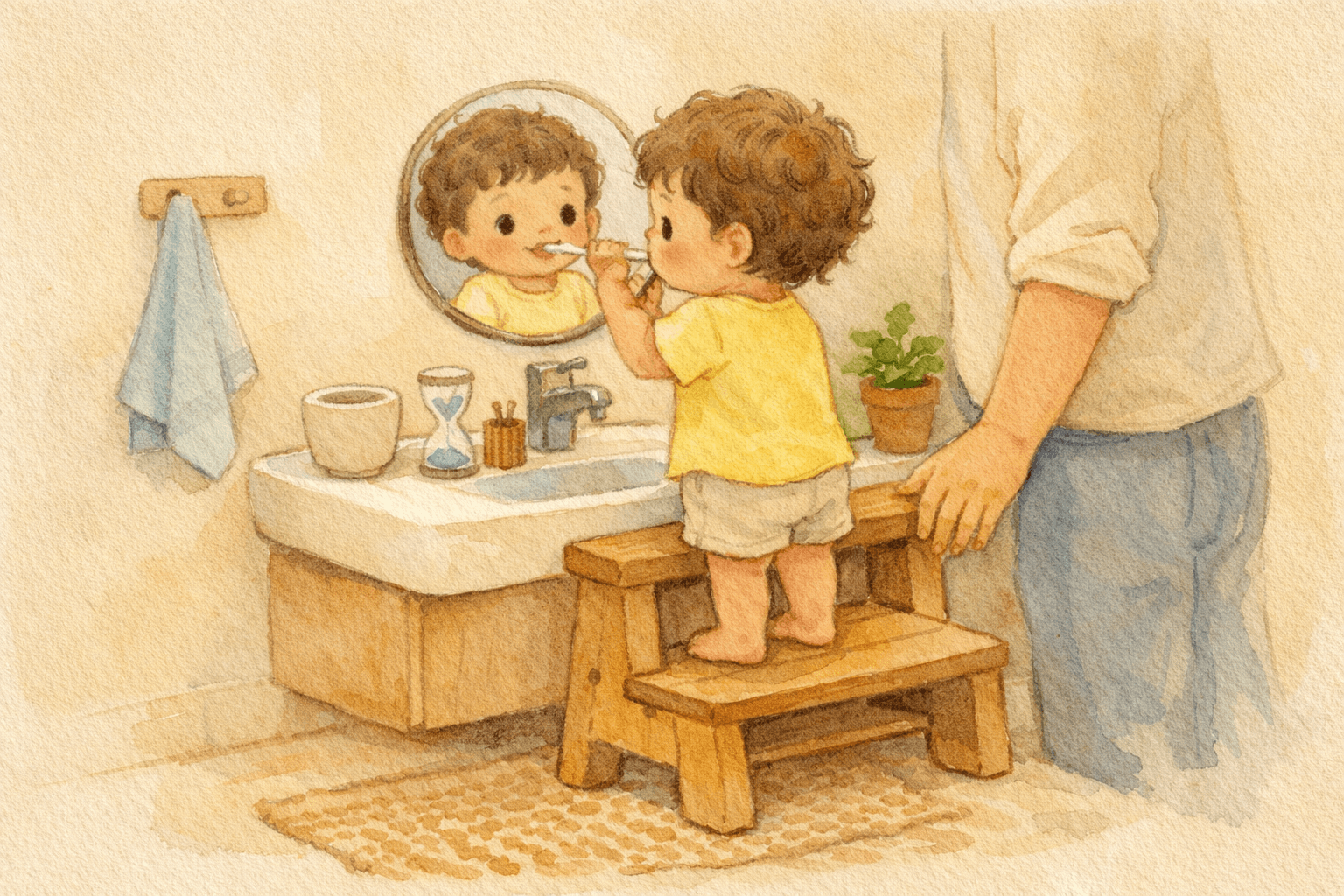
- Step stool: Wide, stable, non-slip. Your child should be able to reach the faucet handle and see the mirror comfortably. A two-step stool works well for younger toddlers.
- Mirror at child height: If your bathroom mirror is too high even with a stool, mount a small unbreakable mirror on the wall at your child's eye level. Seeing themselves brush matters. It provides visual feedback and makes the activity feel real. This is the same prepared environment principle used for dressing mirrors in the bedroom.
- Toothbrush holder at child's reach: A small cup, a wall-mounted holder low on the wall, or a hook on the side of the sink. The child should be able to get their brush and put it back without help.
- Small rinse cup: A real cup, ceramic or glass, small enough for your child's hands. Avoid sippy cups or plastic character cups. A real cup teaches careful handling.
- Towel within reach: A small hand towel on a low hook or bar.
- Sand timer (2 minutes): A visual timer gives your child a clear "done" signal. Hourglass-style sand timers are ideal because they're concrete and don't beep.
Safety notes
Place a non-slip mat or rug in front of the sink. Supervise water access for children under 3. Keep the step stool stable and positioned so it can't slide. If you use a glass rinse cup, start with a sturdy one and accept that breakage is possible. That's part of learning.
Choosing the Right Toothbrush by Age
In Montessori, the tool matters. A child-sized toothbrush that actually fits their hand and mouth makes the difference between a child who participates and one who fights you.
Infant gum care (0-12 months)
Before teeth arrive, wipe gums after feedings with a clean, damp cloth or a silicone finger brush. Once the first tooth appears (usually around 6 months), continue with the finger brush or switch to a soft infant brush. Use a rice-grain-sized smear of fluoride toothpaste from the first tooth. The American Dental Association recommends fluoride toothpaste from the appearance of the first tooth.
First toothbrush (12-24 months)
Switch to a small-headed, soft-bristled toothbrush with a short, wide handle. The handle should be easy for your child to grip. Continue with a rice-grain amount of fluoride toothpaste.
At this age, your child will mostly chew on the brush and move it around. That's fine. They're learning to tolerate the brush in their mouth and building the hand-to-mouth coordination that actual brushing requires.
Toddler and preschool (2-6 years)
Move to a standard child-sized toothbrush as your child's mouth grows. From age 3, use a pea-sized amount of fluoride toothpaste. Teach them to spit, not swallow.
A Montessori note on tool selection: avoid character brushes, light-up brushes, or brushes that play music. These turn brushing into entertainment. The goal is for your child to value the activity itself, not the novelty of the tool. A simple, well-made brush communicates that this is real self-care, not a game.
Montessori Toothbrushing by Age: Step-by-Step
This is where the gradual handoff happens. At every stage, the child does as much as they can, and the parent handles the rest without shame or pressure.
6-12 months: Introduction
The parent does all the brushing. The child's job is to observe and get comfortable.
- Wipe gums or brush emerging teeth gently after morning and evening feedings
- Let the baby hold a silicone teething brush. Mouthing it builds familiarity with having something in the mouth.
- Narrate simply: "Now we brush your teeth. Top teeth, bottom teeth. All done."
- Brush your own teeth where the baby can see you. Modeling is the strongest teacher at this age.
12-18 months: First participation
Your child can start holding the brush and standing at the sink.
- Place the step stool at the sink. Let your child stand and see themselves in the mirror.
- Hand them the brush and let them try. Most will chew or wave it around. That's participation.
- When they're done, say "My turn" and gently finish the job. Keep it brief, 30 seconds.
- Brush your own teeth at the same time. Side-by-side brushing is one of the most effective Montessori strategies for this age because it turns the activity into a shared routine rather than something imposed.
This is also a good age to explore other Montessori activities for emerging independence.
18-24 months: Emerging independence
The pattern shifts to "you brush, then I check."
- Child brushes first. They'll get more effective over time, but thoroughness isn't the point yet. Participation and routine are.
- Introduce the 2-minute sand timer. Flip it together when brushing starts.
- Add rinsing: child fills the small cup, takes a sip, swishes, spits. Spitting takes practice. Demonstrate it. Expect water on the mirror.
- Parent finishes by brushing any spots the child missed. Frame it as a partnership: "Let me check the back ones."
2-3 years: Building the full sequence
Your child is ready to learn the complete brushing routine as a sequence of steps.
Teach the order:
- Get the toothbrush
- Wet the bristles
- Squeeze a small amount of toothpaste (you may need to help with this)
- Brush top teeth
- Brush bottom teeth
- Brush tongue
- Spit
- Rinse with the cup
- Rinse the brush
- Put the brush back
This is the same sequence-learning approach used in Montessori toilet learning. When the routine becomes predictable, the child can run it without prompting.
At this age, your child will insist on doing it all themselves. Honor that. Let them brush, then take a quick finishing turn. "You did the front really well. I'm going to get the back corners." The parent's finishing step isn't a failure of independence; it's a partnership. Most children under 6 lack the fine motor control to clean molars and gum lines thoroughly.
3-6 years: Toward full independence
By 3 or 4, many children can run the full sequence from start to finish. Your role shifts from doing to observing.
- Watch without intervening unless there's a clear problem
- Spot-check a few times a week: "Open wide, let me see." Brief and positive.
- By age 5-6, most children brush effectively on their own
The American Academy of Pediatrics recommends parental supervision of toothbrushing until around age 6-7. A common milestone marker: if your child can tie their own shoes, their fine motor skills are likely developed enough for thorough, independent brushing.
Independence doesn't mean unsupervised. It means the child leads the process.
Common Toothbrushing Challenges and Solutions
Child refuses to brush
Toothbrushing resistance is common between 18 months and 3 years, right when autonomy drives peak.
- Offer a choice within the routine: "Do you want to brush before pajamas or after?" The brushing itself is not negotiable. The timing is.
- Try reciprocity: Let them brush your teeth first, then you brush theirs. This often breaks the tension because it gives them control.
- Keep it short and calm: If they clamp their mouth shut, don't force the brush in. Say "We'll try again in a few minutes" and walk away. Forcing creates a deeper power struggle.
- Check the time of day: If brushing at bedtime always triggers a meltdown, try moving it earlier, right after dinner, before the bedtime fatigue hits. The sleep guide covers this within Montessori bedtime routines.
Child won't give up the toothbrush (and won't let you finish)
This is one of the most common struggles around 18 months to 2 years. Your child grabs the brush, clamps down, and refuses to hand it over. You know they're just chewing on it or brushing the same two front teeth. But any attempt to take the brush or "help" triggers a meltdown. You try two toothbrushes, turn-taking, letting them brush your teeth first. None of it works. They scream, clamp their jaw, twist away, or go rigid the moment a second brush enters their mouth.
Here's what's actually going on and what to do about it.
Why standard advice often isn't enough at this age. At 18 months, your child is at the peak of a sensitive period for autonomy. "I do it myself" isn't a preference; it's a developmental drive as strong as hunger. Any parent intervention, no matter how gently framed, can feel like a violation of that drive. Add the fact that someone else putting an object in your mouth is a fundamentally different sensory experience from doing it yourself. Your child isn't being difficult. Their nervous system is telling them that someone else controlling a brush in their mouth feels wrong, and they can't explain why.
What to do when the basics don't work:
Separate practice from cleaning. During the day, when there's no pressure, play "dentist" or "teeth counter." Ask your child to open wide and count their teeth with your finger, no brush. "One, two, three, four, five. Five teeth!" Touch each tooth briefly. Do this as a game, not as brushing. Over days and weeks, this desensitizes the mouth to someone else being in there and builds trust that opening wide doesn't always mean a brush is coming.
Try the lap position. Many pediatric dentists recommend this for children under 3: your child lies back in your lap, head toward you, looking up. You can see into their mouth clearly and brush gently. Some children resist this at first, but others actually calm down because the position is secure and predictable. If your child accepts the lap position even for 10 seconds, that's 10 seconds of thorough cleaning on the molars you couldn't reach before.
Narrate the countdown. When you do get your turn, count teeth or seconds out loud. "Five teeth, four teeth, three teeth, two teeth, one tooth, done." Knowing exactly when it will end makes the discomfort tolerable. Unpredictability is what makes it scary.
Shift who does it. Sometimes the resistance is linked to one specific person. If the same parent always brushes, try having the other parent, a grandparent, or an older sibling take a turn. A new person sometimes resets the dynamic completely.
Accept imperfect brushing for a period. This is the hardest advice to follow, but it matters. If your child is 18 months old with 12-16 teeth and you've been locked in a daily battle for weeks, step back. Let them chew on the brush themselves. Wipe their teeth with a damp cloth after meals if they'll let you. Focus on diet: limit juice, dried fruit, and crackers that stick to teeth. At this age, what your child eats affects their teeth more than how well they brush.
A toddler who willingly walks to the sink twice a day and puts a brush in their own mouth is building a habit. The quality of brushing will improve over months as their motor skills develop and the autonomy drive softens. A toddler who has been held down and forced will avoid the bathroom entirely. Protecting the relationship with the routine matters more than getting every molar clean today.
When to talk to your dentist. If your child has visible plaque buildup, brown spots on teeth, or you haven't been able to do any parent-assisted brushing for more than a month, bring it up at your next dental visit. A pediatric dentist can check whether there's actual damage, give you specific guidance for your child's risk level, and sometimes an outside authority figure (the dentist) can demonstrate the routine in a way that clicks differently than a parent doing it.
Gagging or sensory sensitivity
Some children gag when the brush touches certain areas, especially the tongue or back molars.
- Try a toothpaste with a milder flavor, or start with water only and add paste gradually
- Use a smaller brush head
- Let the child control the brush (gagging is often worse when someone else is brushing)
- If sensitivity is persistent or severe, mention it at your next dental visit
Power struggles around the bedtime routine
When toothbrushing is the last task before bed and the child is already overtired, resistance is almost guaranteed. Move toothbrushing to right after dinner or earlier in the evening routine. A well-rested child cooperates better.
The Ramirez family tried this after weeks of nightly meltdowns with their 2-year-old. They shifted brushing to 6:15 p.m., right after dinner cleanup, instead of 7:30 p.m. during the bedtime sequence. The fights stopped within three days. The routine hadn't changed; the timing had.
Montessori Toothbrushing FAQs
When can a child start brushing their own teeth?
Most children begin participating around 12-18 months by holding the brush while a parent guides. By age 3-4, many children can brush through the full sequence, though parents should still finish or spot-check until around age 6-7, when fine motor skills are mature enough for thorough cleaning.
What toothbrush should I use for a Montessori toddler?
Use a small-headed, soft-bristled toothbrush with a short, wide handle that fits your child's hand. Avoid character brushes or electric brushes that turn brushing into entertainment. A simple, functional toothbrush supports the Montessori principle of real tools for real work.
How do I set up a Montessori bathroom for toothbrushing?
Place a stable step stool at the sink, add a child-height mirror if needed, and keep the toothbrush, a small rinse cup, and a towel within your child's reach. The goal is a setup where your child can begin and complete the routine without asking for help.
My toddler refuses to brush their teeth. What should I do?
Offer a choice within the routine (before or after pajamas), let your child brush your teeth first for reciprocity, and keep it brief and calm. Avoid forcing the brush. If refusal is persistent, try a different time of day, a milder toothpaste, or just let them watch you brush until they're ready to try again.
Should I use fluoride toothpaste for my toddler?
The American Dental Association recommends a rice-grain-sized smear of fluoride toothpaste from the first tooth, increasing to a pea-sized amount around age 3. Fluoride toothpaste is safe and effective at preventing cavities when used in these small amounts.
When should my child have their first dental visit?
The ADA and American Academy of Pediatrics recommend a first dental visit by age 1 or within 6 months of the first tooth appearing. Early visits help your child get comfortable with the dentist and catch any issues early.