At 18 months, your toddler is not a baby anymore — but not quite a 2-year-old either. This is a fast-changing stage where children shift from simple cause-and-effect exploration to purposeful, multi-step work. They want to help, they want to imitate you, and they are ready for real tasks.
The best Montessori activities for 18-month-olds are practical, repeatable, and use real materials. No flashcards, no screen time, no expensive kits. Just purposeful work that matches where your child is right now.
What 18-month-olds are working on
Understanding what is developing helps you pick the right activities:
- Multi-step sequences: Can follow 2-3 steps (pour, wipe, put away) instead of just one action
- Purposeful imitation: Watches you cook, clean, fold — then wants to do it themselves
- Refined hand control: Pincer grasp is strong, wrist rotation is improving, can use simple tools
- Language explosion: Vocabulary is growing — some children learn several new words a week, others are still building their first dozen. Both are normal
- Order and routine: Prefers same sequence, same place, predictable patterns
- Walking confidence: Stable walking means hands are free for carrying, pushing, and tool use
The key insight for 18 months: Your child is shifting from "What does this do?" to "I want to do what you do." Activities should feel like real work, not toys.
How to set up activities for an 18-month-old
Before you start:
- Low shelf with 6-8 activities, each on its own tray or in a basket
- All pieces together — everything needed for one activity sits in one place
- Real materials — a small sponge, a real pitcher, actual food, cloth (not plastic pretend versions)
- Demonstrate slowly — show the activity once with exaggerated movements, then step back
- No correcting mid-flow — if it is safe, let them work through mistakes
A prepared environment matters more than any single activity. If your child can see it, reach it, and return it, they will use it.
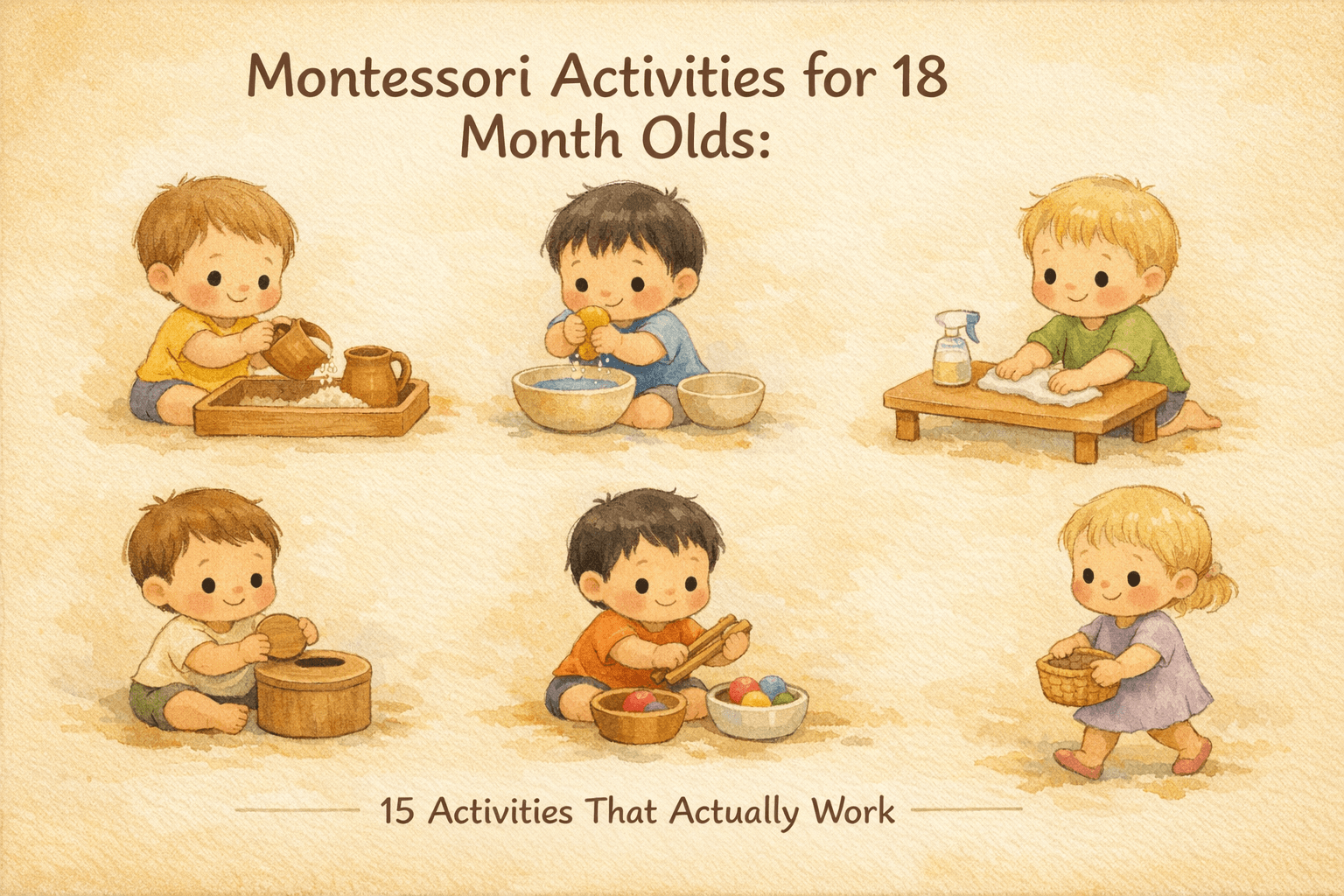
15 Montessori activities for 18-month-olds
Grouped by skill area. Pick 6-8 to start — you do not need all of them on the shelf at once.
Practical life (the heart of 18-month Montessori)
At 18 months, practical life activities are where the magic happens. These are not "pretend chores" — they are real contributions your child can make.
1. Water pouring (pitcher to pitcher)
- Skills: wrist control, concentration, sequencing
- Materials: 2 small pitchers (or creamer jugs), tray, small towel
- Setup: Fill one pitcher with a small amount of water — just enough to cover the bottom. Place both pitchers on a tray with a towel for spills.
- How to present: Pick up the full pitcher with two hands. Pour slowly into the empty one. Pause. Pour back. Place pitcher down. Wipe any spills with the towel.
- Why water: Water is safer than dry goods like rice or lentils, which are aspiration and choking hazards for children who still mouth objects. Water also gives instant visual feedback — your child can see when it spills and learn to adjust.
- Why 18 months: This is the age where pouring clicks. At 15 months most children lack the wrist control; by 18 months, they can pour without dumping.
- Tip: Do this activity on a washable surface or place the tray inside a shallow bin to contain spills. Start with very little water and increase as your child gains control.
2. Sponge squeeze transfer
- Skills: hand strength, bilateral coordination, water control
- Materials: 2 small bowls, a natural sponge (cut to child-hand size), tray, towel
- Setup: Small amount of water in the left bowl. Empty bowl on the right.
- How to present: Dip sponge, squeeze into right bowl. Move all the water. Wipe the tray with the towel at the end.
- Tip: Start with very little water — success matters more than volume.
3. Table wiping station
- Skills: care of environment, sequencing (spray, wipe, return)
- Materials: easy-squeeze or pump spray bottle (water only), cloth, basket to store them
- Setup: Place in a spot where your child can reach it whenever the table is dirty. Test the spray bottle yourself — standard trigger bottles are too hard for most 18-month-old hands. Look for a continuous-mist or pump-style bottle they can actually operate.
- How to present: Spray once. Wipe in straight lines left to right. Fold cloth. Return to basket.
- Why it works at 18 months: Three clear steps, visible result (clean table), and it is genuinely useful. This is often the first activity an 18-month-old repeats voluntarily.
4. Banana slicing
- Skills: food preparation, tool use, hand-eye coordination
- Materials: peeled banana, child-safe knife (wavy cutter or butter knife), small cutting board, plate
- Setup: Place banana on cutting board. Knife to the right. Plate below.
- How to present: Hold banana steady with one hand. Press and slide the knife through. Place slice on plate.
- Safety: Supervise closely. Banana is soft enough that even a butter knife cuts through it, making it safe for first cutting work.
- Bonus: They eat what they prepared — the ultimate Montessori motivation.
5. Putting laundry in the hamper
- Skills: carrying, completing a real task, following a sequence
- Materials: small hamper or basket at child height
- Setup: After undressing, hand one item at a time.
- How to present: Take the shirt. Walk to the hamper. Drop it in. Walk back.
- Why this matters: It is a real contribution. Your child is not practicing — they are helping. This distinction matters deeply at 18 months.
6. Washing fruit
- Skills: practical life, sensory exploration, independence
- Materials: small bowl of water, colander, 3-4 pieces of fruit (apples, oranges), towel
- Setup: Bowl of water and fruit on a tray. Colander beside it.
- How to present: Pick up fruit, dip in water, rub gently, place in colander. Dry hands with towel.
- Tip: Do this before snack time so it connects to a real purpose.
Need More Activity Ideas for Your 18-Month-Old?
The app includes 200+ Montessori activities for ages 0-6, filtered by your child's age, your energy level, and the time you have. Plus chat support for personalized ideas.
Fine motor and posting (still a favorite at 18 months)
Posting and transfer activities remain engaging at 18 months, but now with more precision and variation.
7. Coin slot posting (with rotation)
- Skills: wrist rotation, grasp precision, cause-and-effect
- Materials: DIY slot box (oatmeal tin with a cut slot) or coin box, large wooden discs or poker chips
- Setup: Discs in a small bowl. Slot box beside it.
- How to present: Pick up a disc with thumb and forefinger. Rotate wrist to align. Post through the slot.
- 18-month upgrade: Use an angled or narrow slot so the disc requires a deliberate wrist turn — this is harder than the wide slot a 12-month-old uses.
8. Clothespin drop
- Skills: thumb-index strength, release control, coordination
- Materials: 6-8 large wooden clothespins, a tall plastic container or sturdy wooden box
- Setup: Clothespins in a small basket. Container in front.
- How to present: Pick up clothespin, hold over the opening, release. Listen for the sound.
- Next step: Once they master the drop, clip pins to the rim of a container or a cardboard strip.
9. Stacking rings or nesting cups
- Skills: size discrimination, hand-eye coordination, sequencing
- Materials: wooden stacking rings (5-6 rings on a dowel) or a set of nesting cups
- Setup: Place all rings or cups on a tray, arranged largest to smallest.
- How to present: Pick up the largest ring. Place it on the dowel. Pick up the next. Continue until all are stacked. For nesting cups, place the largest down and nest each smaller one inside.
- Why 18 months: Children at this age are beginning to understand size differences and enjoy the satisfaction of completing a visible sequence. Stacking and nesting are self-correcting — your child can see when a piece does not fit, which builds problem-solving without adult correction.
- Variation: Once stacking is easy, use cups for pouring, scooping in a water basin, or building towers to knock down.
10. Tongs transfer (large pom-poms or cotton balls)
- Skills: pre-writing grip, hand strength, concentration
- Materials: toddler-sized tongs (not adult tongs), 2 bowls, large pom-poms or cotton balls
- Setup: Items in the left bowl. Empty bowl on the right.
- How to present: Squeeze tongs, grab one item, transfer, release. Work left to right.
- If tongs are too hard: Start with a large spoon. Tongs build the tripod grip needed later for writing — introduce them, but do not force it.
Sensorial and language (feeding curiosity)
At 18 months, language is exploding and sensory exploration is becoming more refined.
11. Object basket: "Things in the kitchen"
- Skills: vocabulary building, categorization, naming
- Materials: basket with 6-8 real kitchen objects (wooden spoon, whisk, small cup, napkin, sponge, measuring spoon)
- Setup: Objects arranged neatly in a basket on the shelf.
- How to present: Take out one object at a time. Name it slowly. "This is a whisk." Let your child hold it. Return it.
- Variation: After they know the names, try "Can you hand me the whisk?" This builds receptive language.
12. Texture exploration cards
- Skills: tactile discrimination, vocabulary (rough, smooth, bumpy, soft)
- Materials: 4-6 texture squares glued to cardboard (sandpaper, felt, fabric, foil, bubble wrap)
- Setup: Cards arranged on a tray.
- How to present: Feel one card together. "This is rough." Feel another. "This is smooth." Let your child explore freely.
- Extension for older toddlers: Once your child knows the textures by name (closer to 22-24 months), make pairs and introduce matching — "Can you find another rough one?" Formal pair-matching is abstract for most 18-month-olds, so start with exploration and naming.
13. Picture-to-object matching
- Skills: symbolic thinking, vocabulary, concentration
- Materials: 4-6 familiar objects (ball, cup, shoe, banana, brush, spoon) and matching photo cards
- Setup: Objects on the left side of a tray. Cards in a stack on the right.
- How to present: Pick up a card. Look at it. Find the matching object. Place them together.
- Why 18 months: Symbolic understanding is beginning to develop around this age — a picture of a ball starts to represent the actual ball. Some 18-month-olds will match easily, others are not ready yet. If your child just wants to hold the objects or look at the pictures, that is still valuable — formal matching will come in the following months.
14. Sound shakers (DIY matching)
- Skills: auditory discrimination, matching, attention
- Materials: 3 pairs of identical small containers (film canisters, spice jars), filled with different materials (rice, pasta, bells)
- Setup: Seal containers securely. Place all 6 on a tray.
- How to present: Shake one. Listen. Shake another. "Same?" or "Different?" Find the match.
- Safety: Seal containers with hot glue or strong tape so they cannot be opened. Check seals before each use — if a lid feels loose, remove the shaker until it is re-sealed.
Gross motor (burning energy with purpose)
18-month-olds need movement — but movement can be purposeful too.
15. Carry-and-deliver relay
- Skills: coordination, following instructions, real contribution
- Materials: small basket or tray with something to deliver (napkins to the table, books to the shelf, shoes to the door)
- Setup: Give a clear starting point and destination.
- How to present: "Can you carry these napkins to the table?" Hand the basket. Walk with them the first time. Let them do it alone after that.
- Why it works: This combines gross motor movement with practical life purpose. It is not exercise — it is work.
Sample shelf for an 18-month-old
Not every activity works the same way in your day. Some your child can do independently once you have shown them how. Others involve water, food, or tools that need you nearby. Grouping them this way helps you plan realistically.
Independent shelf activities
These go on the shelf and your child can choose them freely:
- Coin slot posting (angled slot)
- Clothespin drop
- Tongs transfer (large pom-poms)
- Stacking rings or nesting cups
- Object basket (kitchen theme)
- Texture exploration cards
Arrange left to right, top to bottom. Model the cycle: take tray, work on a small rug or table, return pieces, return tray.
Together activities (with you nearby)
These involve water, food, or tools — set them up when you can be present, not on the open shelf:
- Water pouring (pitcher to pitcher) — water cleanup needed
- Sponge squeeze transfer — water cleanup needed
- Banana slicing — knife and food, supervise closely
- Washing fruit — water and food prep, do before snack time
- Table wiping station — spray bottle may need help, best done alongside you at first
Anytime activities (no shelf needed)
These happen naturally throughout the day:
- Putting laundry in the hamper — after undressing
- Carry-and-deliver relay — napkins to the table, books to the shelf
A practical setup: Keep 5-6 independent activities on the shelf. Store together-activity trays in a cupboard or high shelf and bring them out when you are in the kitchen or have a few minutes to sit with your child. Weave the anytime activities into your daily routine — they do not need a tray or a shelf, just an invitation.
When to rotate activities
- Observe for 3-5 days before swapping anything
- Keep favorites — repeated use signals a sensitive period, not boredom
- Swap what gets ignored or what consistently turns into dumping/throwing
- Add one new activity at a time — too many changes at once disrupts the sense of order 18-month-olds need
- A toy rotation system helps keep the shelf fresh without overwhelming your child
Troubleshooting common 18-month-old behaviors
They dump everything off the tray
Reduce the shelf to 4-5 activities. Offer more heavy work — carrying books, pushing a laundry basket, wiping a table. Dumping usually means they need simpler activities or a sensory outlet.
They will not sit still for anything
That is normal at 18 months. Offer standing activities (table wiping, pouring at a counter-height surface, carry-and-deliver) instead of seated tray work. Gross motor practical life counts as Montessori.
They only want one activity
Celebrate this. Repetition is concentration. A child who pours water back and forth 12 times in a row is working — not stuck. Do not redirect them.
They get frustrated and cry
The activity is too hard. Remove one step, use larger materials, or switch to something they have already mastered. At 18 months, the challenge should be slight — just beyond what they can do easily, not a struggle.
What comes next after 18 months
As your child approaches 20-24 months, you will notice they can:
- Follow longer sequences (4-5 steps)
- Use more precise tools (hole punch, scissors with help, smaller tongs)
- Start matching and sorting by one attribute (color or size)
- Take on bigger practical life tasks (helping prepare a snack, setting the table)
When you see these signs, start introducing activities for 2 year olds and toys for 2 year olds.
FAQ
What Montessori activities are best for an 18-month-old? The best Montessori activities for 18-month-olds are real, purposeful tasks they can complete with 2-3 steps: water pouring, sponge squeezing, table wiping, putting laundry in a hamper, simple food prep like banana slicing, and posting activities. Focus on practical life work — it matches their drive to imitate and help.
How many activities should an 18-month-old have on the shelf? Keep 6-8 complete activities on a low shelf. Fewer choices lead to longer engagement and easier clean-up. Rotate 2-3 items weekly based on what your child ignores or has mastered.
How long should an 18-month-old focus on one activity? Expect 2-10 minutes per activity. Some children will repeat a favorite task 5-6 times in a row. The goal is voluntary repetition over days, not one long session.
What is the difference between activities for a 12-month-old and an 18-month-old? At 12 months, activities are single-step and focus on cause-and-effect (post it, drop it, see what happens). By 18 months, children can follow 2-3 step sequences and want to complete real tasks — pour the water, wipe it up, put the cloth back. The shift is from exploration to purposeful work.
Do I need to buy Montessori materials for an 18-month-old? No. Most of the best activities for 18-month-olds use household items: a small pitcher, sponge, bowls, cloths, a brush, and real food. A few good trays and a low shelf are the only "Montessori" purchases that matter.
My 18-month-old just dumps everything. Is that normal? Yes. Dumping is sensory exploration and a sign they need simpler activities or more heavy work (carrying books, pushing a basket, wiping). Reduce the shelf to 4-5 trays and offer one-step tasks until they settle into a work cycle.
Related Reading
- 20 Montessori Activities for 1 Year Olds (12-24 Months)
- Montessori Activities for Toddlers: Guide by Age (1-3)
- Montessori Activities for 2 Year Olds (24-36 Months)
- 40 Montessori Practical Life Activities by Skill Area
- Montessori Toys for 1 Year Old: Guide, Budget & Picks
- Montessori Toys for 2 Year Olds
- Montessori Toy Rotation: Step-by-Step for Ages 1-3
- Montessori Bedroom Setup: Step-by-Step Room Guide
- 10 DIY Montessori Materials You Can Make for Under $20