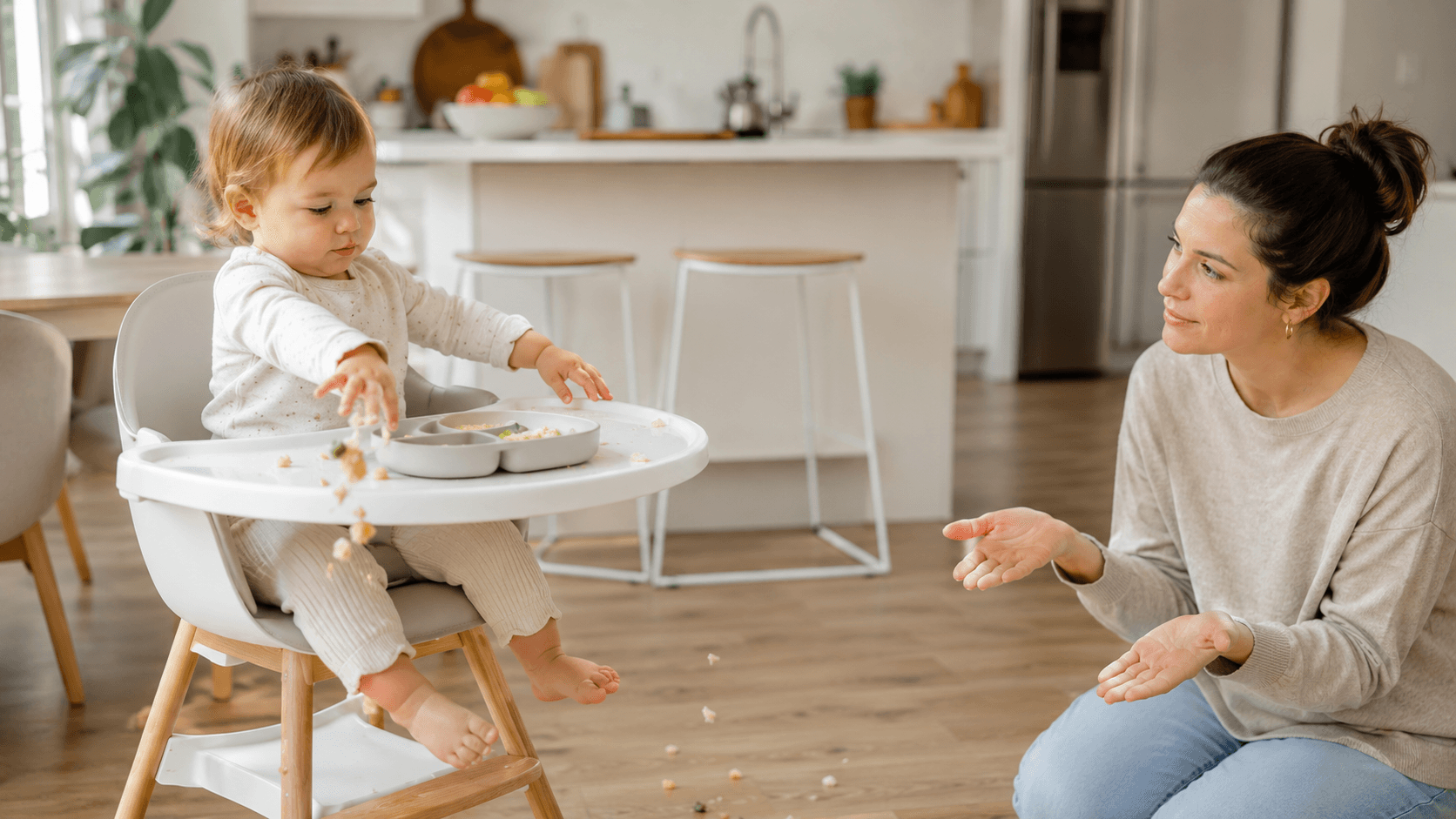
If your toddler is throwing food, you are not alone. Food throwing is one of those behaviors that can make a parent feel instantly frustrated: food on the floor, messy walls, wasted meals, and the same question every day: "Why are you doing this?"
The good news: food throwing is usually not "bad behavior." For babies and toddlers, it can be exploration, communication, boredom, sensory play, testing limits, or a sign that they are done eating.
The goal is not to shame your child or turn mealtime into a battle. The goal is to set a calm boundary, teach a replacement, and create a mealtime setup that makes throwing less likely.
This guide is Montessori-aligned in a simple way: respect the child, prepare the environment, and set clear limits without drama.
Table of contents
- Why toddlers throw food
- What to do in the moment
- What not to do
- How to stop food throwing over time
- What to say when your toddler throws food
- Montessori-aligned mealtime setup
- When food throwing means "I'm done"
- When to check in with a professional
- Related reads
Why toddlers throw food
Toddlers throw food for different reasons. The response works better when you understand the likely reason.
1. They are exploring cause and effect
A toddler drops pasta and watches it fall. They throw a banana and hear the sound. They look at your face to see what happens next.
This is learning, but it still needs a boundary.
2. They are full or done eating
Many toddlers throw food when they are finished but do not yet have the words or habit to say "all done." Turning away, pushing food away, and closing the mouth are common fullness cues.
Food throwing can mean:
- "I'm done."
- "I don't want this."
- "I want to get down."
- "I'm bored at the table."
3. They want a reaction
If throwing food creates a big response - gasps, yelling, repeated talking, or rushing around - it can become interesting.
Toddlers often repeat what gets attention.
4. They are overwhelmed by too much food
A large plate can overwhelm a toddler. Too many choices or big portions can lead to dumping, smearing, or throwing.
5. They are experimenting with control
Mealtime is one of the few places where toddlers have real control. You can offer food, but you cannot make them eat.
Throwing food may become a way to say, "I decide."
6. They are not hungry enough
If a child has been grazing on snacks or milk close to mealtime, they may not be hungry. Food becomes a toy instead of a meal.
7. They need sensory input
Some children enjoy the texture, sound, and movement of food. Squishing, dropping, and throwing can become sensory play.
That does not mean food throwing should continue, but it does tell you what replacement might help.
What to do in the moment
When food hits the floor, keep the response short and calm.
Step 1: Pause before reacting
Take one breath. Your calm response matters because big reactions can turn food throwing into a game.
Step 2: State the boundary
Use one simple sentence:
"Food stays on the table."
Or:
"Food is for eating. If you throw food, the meal is all done."
Keep your voice neutral. You are not angry; you are setting a limit.
Step 3: Offer a replacement
Give your child something they can do instead:
- "You can put it here."
- "You can say 'all done.'"
- "You can put it in the no-thank-you bowl."
- "You can hand it to me."
- "You can leave it on the plate."
Step 4: Give one chance
If your child is still engaged and hungry, give one calm chance:
"Try again. Food stays on the table."
If they throw again, calmly end the meal.
Step 5: End the meal calmly if needed
Say:
"You're showing me you're done. I'll help you down."
Then remove the food without a lecture.
This is not punishment. It is a logical boundary: throwing food means the meal is finished for now.
What not to do
These responses are understandable, but they often make food throwing worse.
Don't yell or overreact
A big reaction can make throwing more exciting.
Don't turn it into a long lecture
Toddlers cannot process a long explanation in the moment. Keep it short.
Don't force more bites
Pressure can create more resistance and stress around food.
Don't keep returning thrown food again and again
That can become a game: throw, parent picks up, throw again.
Don't shame the child
Avoid:
- "You're naughty."
- "You're so messy."
- "Why do you always do this?"
Try:
- "Food stays on the table."
- "You can say all done."
- "I'll help you."
How to stop food throwing over time
Food throwing usually improves when you change the setup, not just the reaction.
1. Serve smaller portions
A full plate can invite dumping and throwing.
Start with tiny portions:
- 2-3 pieces of fruit
- 1 spoonful of rice
- a small amount of pasta
- one piece of toast
You can always offer more.
Child-sized portions help toddlers feel successful and reduce waste.
2. Teach "all done" before they need it
Do not wait until the food is already flying.
Practice at the start and end of meals:
"When you're done, say 'all done' or put your hands up."
You can model:
- hands up
- saying "all done"
- handing the plate to you
- putting food in a no-thank-you spot
3. Use a no-thank-you bowl
For toddlers who throw unwanted food, a small bowl can help.
Say:
"You don't have to eat it. Put it here."
This respects the child's choice while keeping the boundary: food does not go on the floor.
4. Keep meals short
Many toddlers are not built for long meals.
If your child is throwing after 15-20 minutes, they may be done with the table experience.
A calm meal can be short and still successful.
5. Reduce grazing before meals
If your child is not hungry, food becomes entertainment.
Try a predictable rhythm:
- breakfast
- snack
- lunch
- snack
- dinner
Avoid constant grazing if food throwing is a frequent issue.
6. Give your child a real role
Toddlers often behave better when they are included.
Before meals, they can:
- carry a napkin
- put a spoon on the table
- help wash hands
- put a cup at their place
- wipe the table afterward
This is Montessori-aligned practical life: your child participates in the meal instead of being controlled through the meal. Find more ways to involve your child in our guide to Montessori practical life activities.
Not sure whether your child is throwing food because they are full, bored, overwhelmed, or testing a boundary? Montessori Parent Guide can help you identify the likely trigger and choose realistic next steps for your child's age and routine.
What to say when your toddler throws food
Here are simple phrases you can repeat.
If your child throws once
"Food stays on the table."
If your child throws again
"You're showing me you're done. I'll help you down."
If your child doesn't want the food
"You don't have to eat it. Put it in the no-thank-you bowl."
If your child wants attention
"I see you. Food stays on the table."
If your child is done
"All done. Thank you for telling me."
If your child is playing with food
"Food is for eating. If you want to play, we can play after the meal."
The key is consistency. Pick one or two phrases and use them every time.
Montessori-aligned mealtime setup
A prepared environment can reduce food throwing before it starts.
1. Make the seat stable
A child who feels uncomfortable or unsupported may wiggle, toss, or try to escape.
Check:
- feet supported if possible
- child sitting close enough to the table
- plate or bowl within easy reach
- a manageable cup
2. Use child-sized tools
Small utensils, small cups, and small portions help toddlers participate with more control.
3. Keep the table simple
Too many foods, toys, cups, or distractions can overwhelm.
Try:
- one plate
- one cup
- one utensil
- small portions
- no screens
4. Eat together when possible
Children learn mealtime behavior by watching. Even if you only sit for a few minutes, model:
- eating
- drinking
- wiping your mouth
- putting food down
- saying "all done"
5. Let the child help clean up
If food is thrown, cleanup should be calm and matter-of-fact.
Say:
"Food is on the floor. We clean it up."
Then offer a small cloth or let your child help in a simple way.
Do not use cleanup as punishment. Use it as a natural part of caring for the environment.
When food throwing means "I'm done"
Many toddlers throw food near the end of the meal. If that is the pattern, your job is to help them communicate "done" earlier.
Watch for signs:
- turning their head away
- pushing the plate
- playing more than eating
- trying to climb down
- dropping food repeatedly
- saying "no" or "down"
When you see these signs, prompt:
"Are you all done?"
If they say yes, or show yes, end the meal calmly.
This teaches body awareness and communication.
What if my baby is throwing food?
For babies and younger toddlers, throwing food is often exploration. They are learning gravity, texture, sound, and your reaction.
Still, you can start gentle limits:
- serve tiny portions
- offer more only when the first portion is eaten or handled safely
- use a calm phrase: "Food stays here."
- end the meal when throwing becomes the main activity
For babies, keep expectations realistic. You are building the habit slowly.
What if food throwing happens every meal?
If food throwing happens at almost every meal, look for patterns.
Ask:
- Is my child actually hungry?
- Are portions too large?
- Is the meal too long?
- Is my child tired?
- Is there too much attention when food is thrown?
- Does my child know how to say "all done"?
- Is the chair or table setup uncomfortable?
- Are snacks too close to meals?
Choose one change for a week. Do not change everything at once.
A good first change:
Tiny portions + one phrase + end the meal after the second throw.
Food throwing and picky eating
Food throwing and picky eating can overlap, but they are not the same issue.
Food throwing is usually about:
- behavior
- communication
- boundaries
- sensory exploration
- being done
Picky eating is usually about:
- food acceptance
- appetite
- texture preferences
- repeated exposure
- pressure at meals
If your child is also refusing many foods, keep this principle in mind:
You choose what, when, and where food is offered. Your child chooses whether and how much to eat.
That boundary reflects the American Academy of Pediatrics' picky eating guidance, reduces power struggles, and protects your child's relationship with food.
Quick parent checklist
Use this for one week:
- Serve smaller portions.
- Use one phrase: "Food stays on the table."
- Teach "all done."
- Offer a no-thank-you bowl.
- End the meal calmly after repeated throwing.
- Avoid big reactions.
- Let your child help with cleanup.
- Check hunger and snack timing.
- Keep meals short and predictable.
When to check in with your pediatrician
Food throwing alone is usually a normal toddler behavior.
Consider checking in if:
- your child is not gaining weight as expected
- mealtimes are extremely stressful every day
- your child eats a very limited range of foods
- there is frequent choking, gagging, vomiting, or swallowing difficulty
- you suspect sensory or feeding challenges
- you feel worried and need guidance
It is always okay to ask for support.
Related reads on Montessori Parent Guide
- Montessori Practical Life Activities
- Montessori Toy Rotation at Home: Ages 1-3
- Toddler Biting: Why It Happens and How to Stop It
- Mindfulness Activities for Kids
- Child Development Milestones: Ages 0-6
Final thought
Food throwing is often part of learning how meals work and how to communicate "no," "done," and "help."
Stay calm. Keep the boundary simple. Prepare the environment. Give your child a better way to communicate.
The goal is not a perfect meal. The goal is a calmer pattern, one small, consistent response at a time.