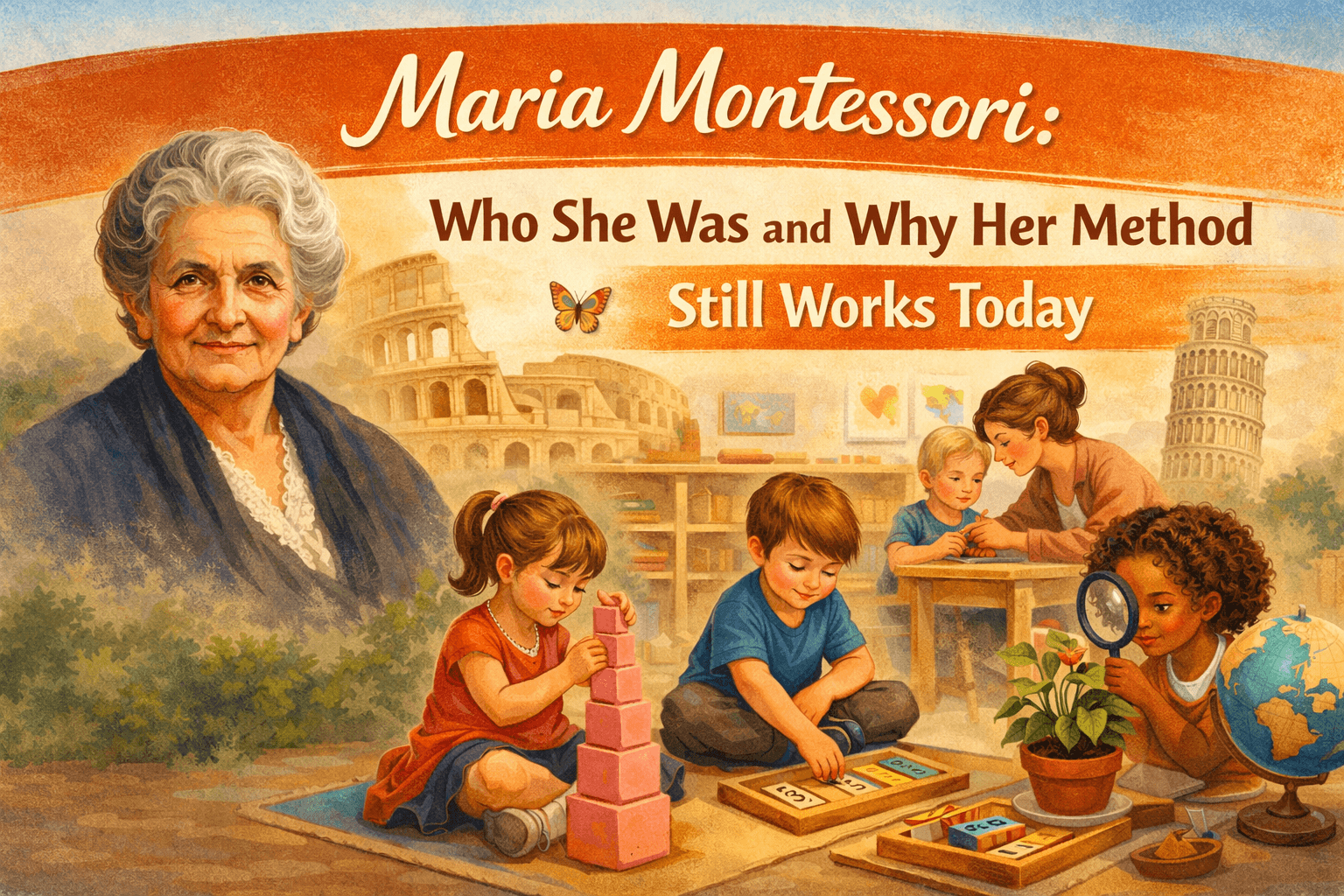
If Montessori feels like "pretty shelves and wooden toys," you are seeing the modern aesthetic—not the origin story. Maria Montessori was a physician and scientist-by-training who built an educational approach through observation, experimentation, and deep respect for children. Her method has lasted more than a century because it is anchored in how children actually develop: movement, language, order, independence, and meaningful work.
This guide gives you the real background—then turns it into useful, doable Montessori at home.
Table of contents
- Who was Maria Montessori?
- How the Montessori method was born
- What Montessori actually believed (in plain language)
- Why the Montessori method still works today
- Montessori at home (ages 0–6): what parents can do this week
- How to spot real Montessori (and avoid the label trap)
- FAQ
Who was Maria Montessori?
Maria Montessori (1870–1952) was an Italian physician and educator who became one of Italy’s first female doctors and later created what we now call the Montessori method.
Quick timeline (the big moments)
- 1896: Graduates in medicine and begins work connected to child development and psychiatry.
- Late 1890s–early 1900s: Works with children in institutions and becomes convinced they need hands-on activity and sensory stimulation, not passive confinement.
- 1907: Opens the first Casa dei Bambini (Children’s House) in Rome (San Lorenzo), applying her approach to typically developing children.
- 1934: Leaves Italy during Fascist rule and continues her work internationally.
- 1939: Travels to India; during WWII, her work continues there under restrictions; her son Mario is briefly interned.
- 1949–1951: Nominated for the Nobel Peace Prize multiple times for her educational work and its role in international understanding.
How the Montessori method was born (spoiler: it started with overlooked children)
Montessori’s breakthrough began when she noticed something adults were missing: children in barren environments were not “misbehaving”—they were starving for purposeful activity.
While working with children in institutional settings, she saw how deprivation of movement and sensory input worsened outcomes. She studied the work of Jean-Marc Itard and Édouard Séguin, pioneers who used sensory-based, hands-on techniques with children who had disabilities, then adapted and expanded those ideas.
When she opened the first Casa dei Bambini in 1907, she did something radical:
- She observed which activities drew deep concentration.
- She removed what did not work.
- She refined the environment until children could “teach themselves” through action.
That idea—children learning through independent activity in a prepared environment—is the engine of Montessori.
What Montessori actually believed (in plain language)
1) Children learn best by doing
Montessori replaced passive instruction with hands-on materials and real tasks because young children build intelligence through movement and sensory experience.
2) Independence is the goal (not perfection)
The famous Montessori phrase is essentially: help me do it myself. The adult’s job is to remove barriers—then step back.
3) The environment is the “silent teacher”
A Montessori space is orderly, accessible, and sized for the child so the child can complete a full work cycle: choose → do → finish → reset.
4) Long, uninterrupted focus matters
Montessori classrooms are known for long blocks of child-chosen work and minimal interruptions. Research papers describing Montessori typically include this “long work period” and child choice as core features.
Why the Montessori method still works today
Montessori has lasted because it aligns with durable principles of learning and development—not trends.
1) It protects concentration (a rare commodity now)
When children can repeat meaningful tasks without constant adult direction, they practice the skills underneath learning: attention, persistence, self-correction.
2) It builds executive function through real life
Practical life is not “chores for cute photos.” It is sequence, planning, impulse control, and coordination—disguised as everyday work.
3) There is meaningful research behind it (with a big caveat)
High-fidelity Montessori programs (good implementation, trained teachers, core elements present) have shown positive outcomes in studies, including academic, social, and executive function measures. The caveat: “Montessori” is not a protected label. Results depend heavily on whether the environment actually matches Montessori principles.
Montessori at home (ages 0–6): what parents can do this week
You do not need to recreate a classroom. You need a few high-impact shifts:
- Reduce choices to increase focus
- Toddlers: 6–8 activity choices visible
- Preschool: 8–12 works visible
- Store the rest and rotate weekly
- Make independence physically possible
Think: stool, low hooks, reachable cups, child-sized tools (when safe), a small place for the child’s things.
- Use the Montessori presentation style
- Show once, slowly
- Use minimal words
- Let the child try
- Reset calmly if needed
- Turn daily life into Montessori (without forcing it)
Clear steps + child participation + no rush + no shame.
If you want ready-made age-based ideas, start here:
- Montessori Activities for 1 Year Olds (12–24 Months): 20 Simple, Practical Ideas
- Montessori Activities for 2 Year Olds (24–36 Months): 25 Purposeful Activities
- Montessori Preschool Activities (Ages 3–5): 30 Classroom-Style Works You Can Do at Home
For toy overwhelm, rotation is the cheat code:
And if independence is your current pain point:
How to spot “real Montessori” (and avoid the label trap)
Whether you are choosing a school or buying “Montessori” products, look for principles—not branding:
- Child-sized, accessible environment
- Hands-on materials with a clear purpose
- Uninterrupted work time (not constant switching)
- Adult as guide, not entertainer
- Independence + responsibility (finish and reset)
If a setting is mostly adult-led activities, flashy toys, or constant interruption, it may be Montessori-inspired but not truly Montessori.
FAQ
Was Maria Montessori a teacher? She became an educator, but her original training was in medicine, and her educational approach grew out of clinical observation and work with children.
When did Montessori start? The first Casa dei Bambini opened in January 1907 in Rome.
Why is Montessori linked to peace? Montessori believed education could shape a more peaceful society, and she was nominated for the Nobel Peace Prize in multiple years (including 1949, 1950, 1951).